
Building AI agents for multi-specialty care coordination: an enterprise architecture guide
elsai team
Table of contents
The coordination problem is an architecture problem, not a tool problem
The architecture: how agent workflows connect intake, authorization, and coordination
Patient intake in a multi-specialty environment
Prior authorization across specialties
Governance that applies the same way across every specialty
Deploying the architecture: a practical path to a first live workflow

What does an AI agent architecture for multi-specialty care coordination look like?
It runs on three connected agents, one for patient intake, one for prior authorization, and one for coordination, moving through a six-stage pipeline that carries each patient's record forward from one step to the next. Governance runs the same way at every stage, so the audit trail, the human oversight, and the policy rules do not change depending on which specialty a patient passes through. That consistency is what turns a set of separate department tools into a single coordinated system.
A patient scheduled across orthopaedics, cardiology, and pre-surgical clearance in the same week sets off three separate chains of work. Each specialty opens its own intake, raises its own prior authorization request, and manages its own referral thread. None of these chains share a common record. By the time the patient arrives, the care team is often working from incomplete information and the authorization coordinator is still waiting on a payer response for one of the three visits.
This is the daily reality of patient care coordination in a multi-specialty practice, and the cost of it is well documented. McKinsey and CMS data from 2024 put the annual cost of manual administrative overhead across US healthcare at 8.3 billion dollars, and physicians spend 34 percent of their time on administrative work rather than patient care, according to AMA 2025 figures. In a practice running several specialties at once, that burden does not simply add up. It grows at every handoff, because each point where one specialty passes a patient to another is a point where information has to be found, re-entered, and re-checked by hand.

The coordination problem is an architecture problem, not a tool problem
Most health systems already have the tools. There is a tool for intake at the front desk, a platform for prior authorization, and a system for clinical documentation. The trouble is that the coordination failure does not happen inside any one of these tools. It happens in the space between them, where a patient moving across three specialties generates three intake records, three authorization workflows, and three referral threads that were never designed to share a common model of the patient.
Adding a faster tool to any single stage does not fix this. Saving ten minutes in cardiology intake does nothing for the orthopaedics coordinator who still receives a referral with missing information, and it does nothing for the surgical team preparing for a clearance visit with no view of what the other two specialties have already recorded. The underlying issue is healthcare interoperability, the ability of these stages to share one verified record rather than each rebuilding its own.
For a practice evaluating a multi-specialty EHR strategy or a coordination platform, this is the distinction that matters most. The goal is not a better tool for each department. It is a data architecture that connects the departments, so that what one specialty captures becomes available to the next without anyone re-keying it. That architecture is the subject of this guide.
The architecture: how agent workflows connect intake, authorization, and coordination
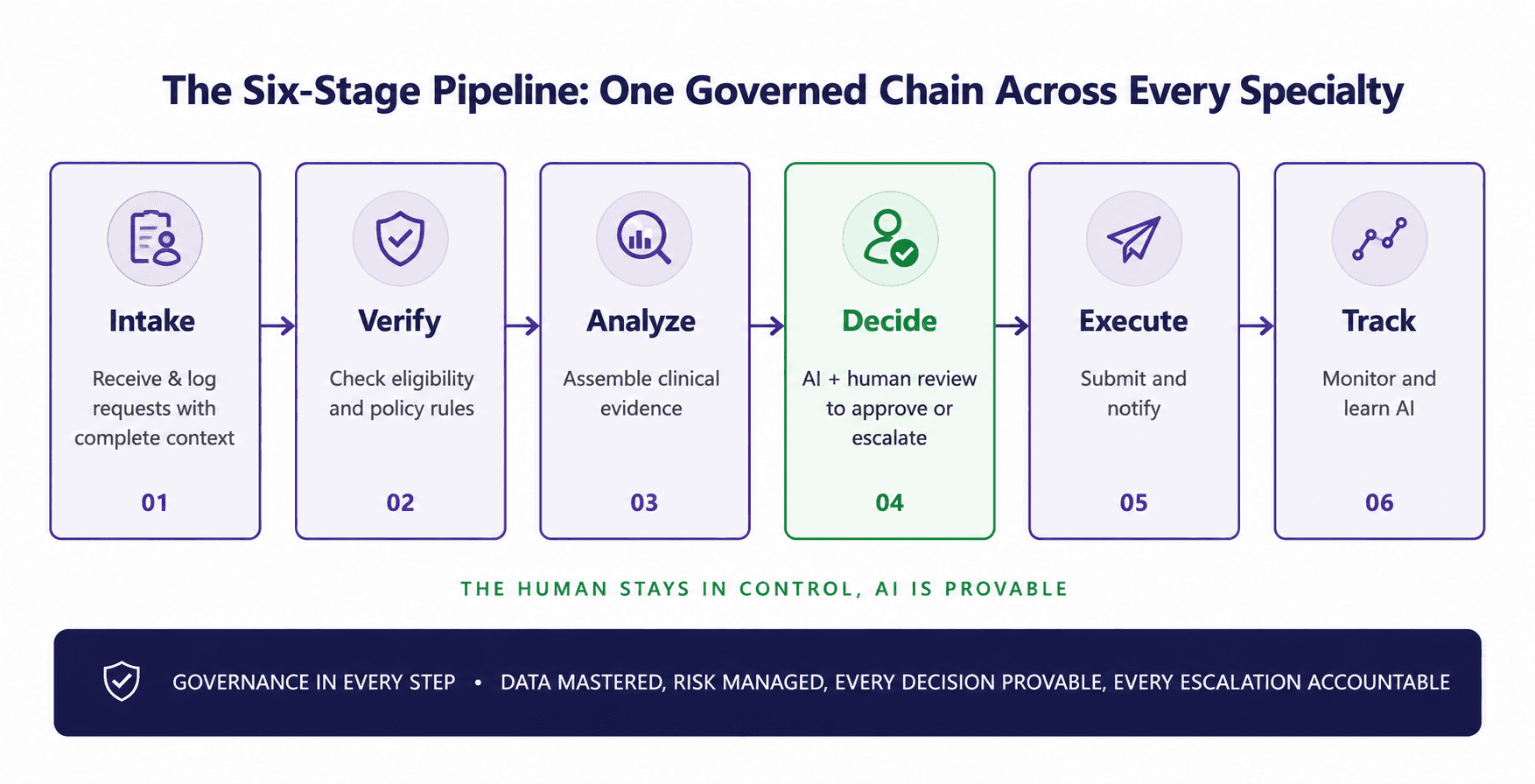
The architecture rests on a six-stage pipeline: Intake, Verify, Analyze, Decide, Execute, and Track. Each stage is handled by a specialised agent, and each agent passes its finished, verified work forward as the starting point for the next stage. Because the intake agent's output is exactly what the verify stage needs as its input, a cardiology intake record never has to be re-entered when it becomes the basis for a prior authorization request. The same holds as the record moves toward coding and coordination.
This forward-passing of context is what allows the architecture to work across specialties rather than within just one. The pipeline does not care whether the patient is in orthopaedics or oncology. Each specialty's data runs through the same six stages, and the record accumulates detail as it goes, so that by the Track stage there is a single, complete picture of the patient's episode across every department they touched.
Walking through it stage by stage makes the coordination benefit concrete. At Intake, demographics, insurance, and clinical history are gathered from every channel, with patient data reduced to what the next step needs before anything is written. At Verify, eligibility and payer rules are checked for that specialty and that payer, with the rule version and time recorded. At Analyze, the clinical picture is assembled and any cross-specialty dependencies are identified. At Decide, a named clinician reviews anything that needs judgment. At Execute, the request goes to the right payer through the right channel and referral communications are routed. At Track, status is visible across every specialty in one place, and patterns worth attention, such as a run of denials appearing in two related specialties, surface in the same view rather than staying hidden in separate systems.
Patient intake in a multi-specialty environment
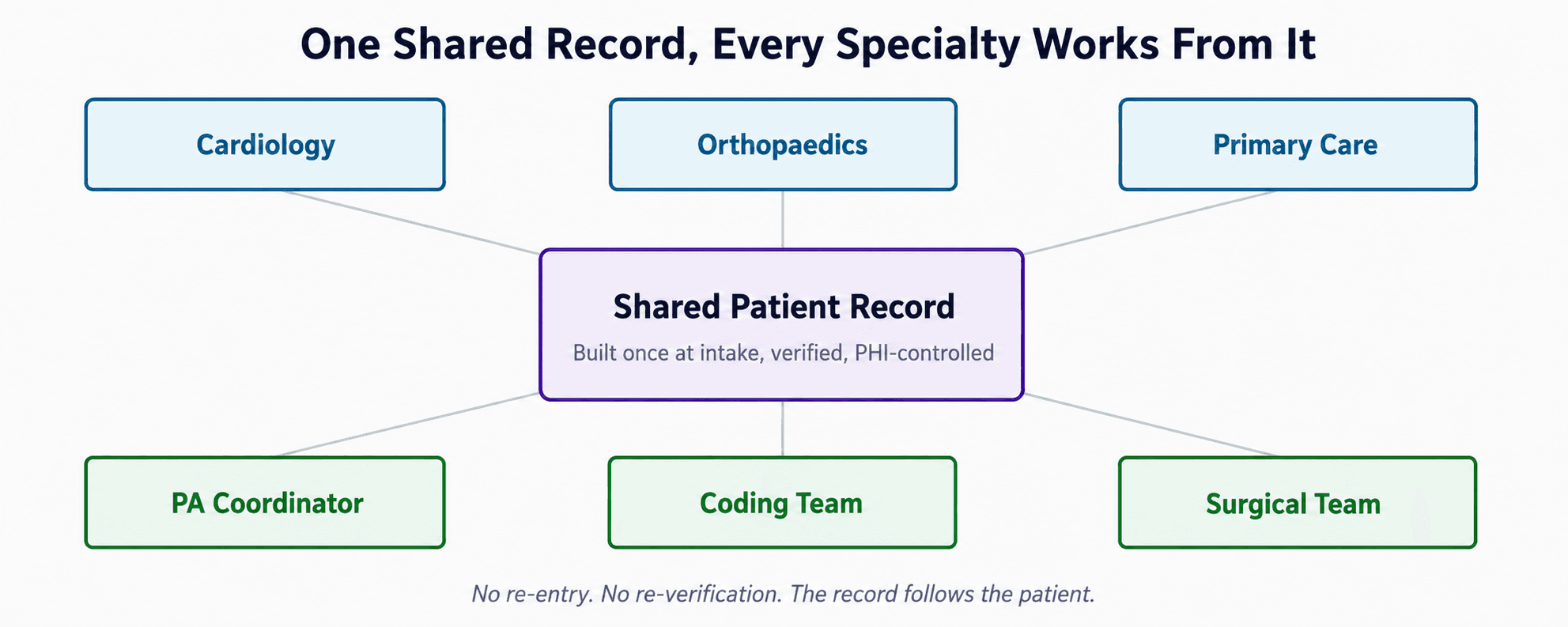
In most multi-specialty clinics, a patient's first visit to cardiology creates one intake record, their orthopaedics visit creates a second, and their pre-surgical clearance creates a third. None of these connect unless the intake architecture is built to create a single shared record from the first point of contact. That single record is the foundation everything else in the pipeline depends on.
The Patient intake agent gathers demographics, insurance details, clinical history, and referral documents from wherever they live, whether that is the EHR, the scheduling system, or a form the patient filled in. Patient data is kept to the minimum each downstream step actually requires, and boundary controls are applied before the record is written, so sensitive information is not carried further than it needs to be. The result is one verified record that the authorization coordinator, the cardiology team, the orthopaedics team, and the surgical team all work from, none of them re-entering what another has already captured.
Prior authorization across specialties
Prior authorization is where the per-department burden shows itself most clearly. A practice running orthopaedics, cardiology, and oncology typically manages three separate authorization workflows, each with its own payer rules, its own documentation requirements, and its own cycle times, and each handled by a different coordinator working in isolation. The AI prior authorization agent replaces that fragmentation by running all of them through the same pipeline.
Within the six stages, the authorization work draws on the shared intake record at the Verify stage to confirm eligibility for the specific specialty and payer. At the Analyze stage it assembles the clinical context and identifies what each payer will need to see. At the Decide stage, anything borderline routes to the named clinical reviewer for that specialty, so the human judgment stays with the right person. At Execute, the request goes to the correct payer, and at Track, the coordinator sees the status of every specialty's authorizations in one view rather than logging into three separate queues.
The practical shift for the coordinator is that prior auth automation stops being three disconnected jobs and becomes one monitored process. When a denial pattern appears, it is visible across specialties, so a documentation gap showing up in both orthopaedics and cardiology can be caught and corrected once rather than discovered three times.
Governance that applies the same way across every specialty
The governance problem in multi-specialty settings is rarely that governance is missing. It is that governance is set up separately for each department, so the audit record for cardiology sits in one system, orthopaedics in another, and surgical clearance in a third. When an audit or a denial dispute calls for the full record of a patient's episode, someone has to reassemble it from three different places, and that reconstruction is slow, incomplete, and hard to defend.
A governed pipeline solves this by applying one standard everywhere. The same policy rules run on every agent action regardless of specialty. A single audit trail records intake, eligibility, clinical review, approvals, submissions, and outcomes across all departments in one continuous record. And the same human oversight applies to borderline decisions in every specialty, without anyone having to configure it department by department. This is what makes elsai a governed execution layer rather than a collection of separate department tools. The audit and observability layer is described at elsai.ai/foundry/arms, and the policy enforcement layer at elsai.ai/foundry/guardrails.
Underneath that consistency sits a governance model built on three pillars: knowing who acted and within what limits, being able to show exactly what happened with proof, and keeping a person in the path of every decision that needs one. All three apply identically whether the patient is in primary care or in oncology.

The reason this matters for a practice is that when a decision anywhere in the system is questioned, the answer is already on hand. What data did the agent use, what rule applied, and who signed off are all recorded as the work happens, so producing that record for an auditor or a payer takes minutes rather than a scramble across systems. That is the standard multi-specialty practices need, and it is the one that per-department tools consistently miss.
Deploying the architecture: a practical path to a first live workflow
The way to get here is not a large migration. It is a staged rollout that starts with a single workflow. The first phase is short and focused: pick the one workflow where cross-specialty coordination is breaking down most visibly, usually prior authorization or patient intake, measure where things stand today, and agree on what success looks like. The second phase deploys the agents inside the existing environment, connecting to the EHR and payer systems already in place, such as Epic, Cerner, Athena, or Meditech, and configuring the governance and human review to match the practice's own policies. The workflow then runs live and is measured against the goals set in the first phase.
From there, the practice moves the workflow into full production and expands to the next specialty or the next workflow. The important architectural point is that the agents sit between the existing systems rather than replacing them, so this is not an EHR migration and the clinical staff do not have to learn a new system of record. The governance configuration set up for the first workflow carries forward to every workflow added after it, which is what allows coordination to scale across specialties without a fresh implementation each time.
Building AI agents for multi-specialty care coordination is not about replacing your EHR or deploying another standalone tool. It is about connecting patient intake, prior authorization, and care coordination through a governed execution layer that works across every specialty while maintaining consistent oversight, auditability, and human review.
Book a personalized demo to see how elsai helps health systems build governed AI workflows for multi-specialty care coordination, integrate with existing EHRs and payer systems, and scale automation without compromising clinical governance.
FAQ
How does care coordination differ across multiple specialties?
A shared intake record supports every specialty, reducing repeated data entry and disconnected handoffs. The same governance, approval, and audit standards apply across the full care journey.
How does a shared patient intake record work?
The intake agent captures demographics, insurance, clinical history, and referral documents once. Each downstream workflow uses the same verified record as the patient moves between primary care, cardiology, orthopaedics, or surgery.
How are different prior authorization requirements managed?
The prior authorization agent applies the relevant payer rules and documentation requirements for each specialty. Teams can track every request through one coordinated workflow with consistent human review.
How is the audit trail maintained across specialties?
ARMS records agent actions, human approvals, submissions, and outcomes in one continuous audit trail. This provides a complete, review-ready record across the patient’s care episode.





We’d love to chat with you about how your team can secure and govern Ai agents everywhere