
elsai team
Table of contents
Why AI observability for agents matters now
What AI observability for agents means
Why traditional monitoring falls short for AI agents
What ARMS tracks across an AI agent workflow
How ARMS helps leaders manage risk
How ARMS helps control AI costs
How ARMS speeds up root-cause investigation
How ARMS keeps humans in control
Where ARMS fits in the enterprise AI stack
Final takeaway: AI agents need a flight recorder
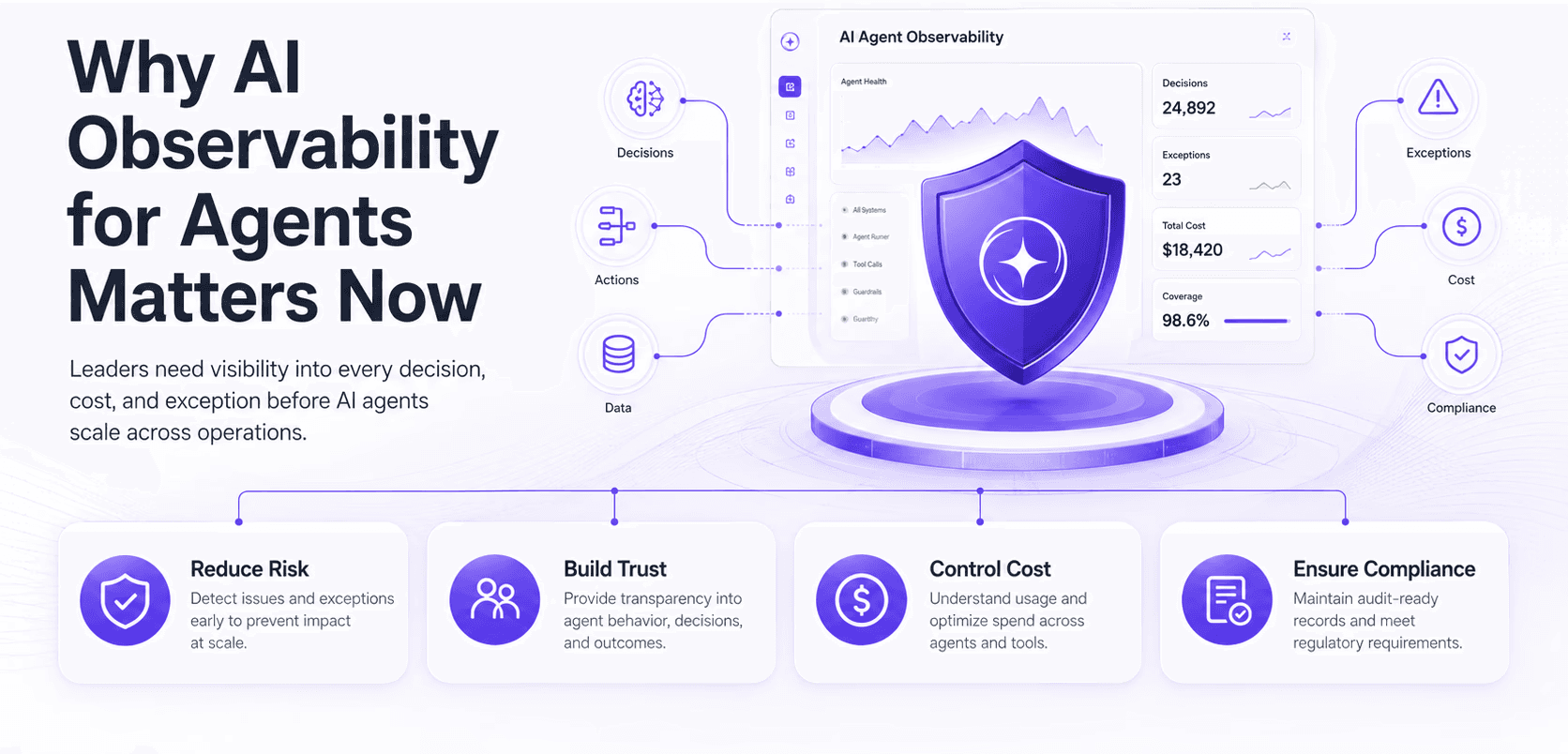
AI observability for agents means knowing what an AI agent did, why it acted, what systems it used, what it cost, and whether it followed policy. As moves from experimentation into production, visibility becomes a critical requirement. Enterprise leaders need evidence that AI workflows remain accountable, auditable, and cost-effective, not just that they produce outputs.
McKinsey’s 2024 State of AI survey found that 65% of organizations regularly use generative AI in at least one business function, nearly double the level reported in 2023. At the same time, Ibm’s global AI adoption Index reports that concerns around governance, compliance, explainability, and risk management remain significant barriers to broader enterprise deployment. Without observability, enterprises struggle to explain agent decisions, identify failures, control costs, or meet regulatory requirements.
For enterprise leaders, this is not a technical nice-to-have. It is the control layer that makes AI agents safe enough to run inside real business workflows. This blog explains what AI observability for agents really means, why traditional monitoring approaches are insufficient for autonomous AI systems, and how organizations can gain end-to-end visibility into agent behavior, resource usage, compliance, and business outcomes.
elsai ARMS, or Agent Resource Management System, gives enterprises that control. It helps teams observe, govern, and audit AI agents across prompts, tool calls, data sources, model responses, costs, escalations, and human approvals. Through this guide, you’ll see how a structured observability framework enables enterprises to deploy AI agents with confidence while maintaining accountability, security, and operational excellence.
Why AI observability for agents matters now
AI agents are moving from demos into operational workflows. They are being used to process documents, check policies, route exceptions, support clinical reviews, monitor procurement steps, and coordinate tasks across systems.
That shift creates a new leadership question. It is not enough to ask whether the AI agent completed the task. Leaders need to know whether it completed the task correctly, safely, within policy, and at an acceptable cost.
Traditional software gives leaders a clear operating model. Applications have logs, permissions, release notes, audit records, and escalation paths. AI agents need the same level of operational discipline because they interact with prompts, models, tools, documents, business rules, and people.
Without observability, AI adoption becomes difficult to govern. Teams may know that an agent produced an output, but they may not know which prompt shaped the response, which document was retrieved, which tool was called, which policy check passed, or why a human was asked to intervene.
That gap creates risk for the business. It slows down production rollout, weakens trust with compliance teams, makes cost difficult to control, and leaves operations teams guessing when something fails.
What AI observability for agents means
AI observability for agents is the ability to trace, inspect, and govern the full path of an AI agent workflow from input to outcome.
That includes the prompt used, the model response, the data retrieved, the tools called, the cost incurred, the policy checks applied, the exception raised, and the final action taken.
For a C-level leader, the simplest way to frame it is this:
Can we explain what the agent did?
Can we prove it followed our controls?
Can we see what it cost?
Can we improve it based on evidence?
If the answer is unclear, the organization does not yet have production-grade control over AI agents.
Why traditional monitoring falls short for AI agents
Traditional monitoring was built for applications, infrastructure, APIs, uptime, latency, and error rates. It tells a team whether a system is available and whether a transaction failed.
AI agents create a different challenge because their work is context-driven. A single workflow may involve a prompt, a retrieved document, a model response, a policy rule, an API call, a database lookup, and a human approval.
A normal application usually follows fixed logic. An AI agent may plan the next step based on the request, available data, business rules, and prior context. That makes the workflow harder to inspect using standard monitoring alone.
This does not make AI agents unmanageable. It means they need agent-specific observability.
A business leader should not have to accept vague explanations such as “the model responded that way.” The organization should be able to trace the issue to a specific prompt version, source document, tool call, policy rule, approval step, or data gap.
That is where ARMS becomes important.
What is ARMS in elsai Foundry?
ARMS stands for Agent resource management system. It is elsai’s observability and governance layer for production AI agents.
ARMS gives engineering, operations, and compliance teams a shared view of how AI agents behave in live workflows. It captures the runtime signals that matter when an agent moves beyond a controlled demo and starts operating inside business processes.
In practical terms, ARMS helps answer four questions that matter to executives:
What happened in the workflow?
Why did it happen?
Who or what approved it?
What did it cost?
This matters because AI agents often touch areas where accountability is critical. In healthcare, an agent may support prior authorization workflows. In procurement, it may process vendor documents or track contract obligations. In insurance, it may validate documents and route exceptions. In each case, the business needs more than speed. It needs control.
What ARMS tracks across an AI agent workflow
ARMS tracks the key signals that help enterprises understand and govern agent behavior.
Ø It tracks prompts and prompt versions, so teams can see which instruction shaped the agent’s response. This is important because a small prompt change can affect workflow behavior, escalation logic, output quality, or compliance handling.
Ø It tracks tool calls and system actions, so teams know which APIs, databases, applications, or workflow systems the agent used. This gives operations leaders a clear view of what the agent did beyond generating text.
Ø It tracks retrieval steps and source context, so teams can see which documents, records, or knowledge sources influenced the output. This is especially important when the agent uses enterprise documents, policy files, clinical records, contracts, vendor data, or customer records.
Ø It tracks model responses and workflow flow, so teams can inspect the agent’s output in context. This helps identify whether a quality issue came from the model, prompt, source data, tool, or orchestration logic.
Ø It tracks latency and runtime performance, so production teams can see where workflows slow down. Slow agent workflows can create business friction, especially in time-sensitive areas such as approvals, claims, service operations, or procurement.
Ø It tracks token usage and cost, so leaders can understand consumption by workflow, team, agent, or use case. Organizations struggle to manage costs when agents scale across departments. ARMS helps leaders see where budget is going and whether usage is tied to business value.
Ø It tracks policy exceptions and risk signals, so governance teams can detect when an agent hits a guardrail, handles sensitive data, triggers an exception, or requires review.
Ø It tracks human review and approvals, so the organization knows when people intervened, who reviewed the case, what decision was made, and why.
Ø It tracks audit-ready records, so enterprises can provide a defensible history of AI-assisted decisions, access, actions, and outcomes.
This is the difference between running AI agents as experiments and running them as controlled business systems.
How ARMS helps leaders manage risk
Enterprise AI risk rarely comes from one large failure. It usually builds from small gaps that go unnoticed.
A prompt changes without review. A document source becomes outdated. A policy check fails silently. A tool call returns incomplete data. A sensitive case gets handled without escalation. A model produces an answer that appears confident but is not grounded in the right source.
Without observability, these issues are hard to detect. Teams may only discover them after a customer complaint, an audit request, a delayed workflow, a denied claim, or a compliance review.
ARMS reduces that blind spot by giving leaders a structured view of agent behavior. The goal is not to slow down AI adoption. The goal is to make AI adoption operationally safe.
For regulated enterprises, governance cannot exist only as a policy document. It must show up inside the workflow. ARMS helps connect governance rules to real agent actions, so teams can prove how a decision was reached and whether the right control was applied.
How ARMS helps control AI costs
Many organizations begin AI pilots with small usage volumes. Cost feels manageable at that stage. The challenge starts when AI agents move across teams, workflows, and departments.
Agent workflows can consume cost through repeated model calls, long prompts, document retrieval, retries, tool usage, and multi-step execution. If leaders cannot see cost by workflow, they cannot manage it with confidence.
ARMS helps make AI spend visible at the point where it is created. Instead of viewing AI cost as a broad monthly line item, leaders can connect usage to specific agents, teams, workflows, and business outcomes. This gives finance and technology leaders a better operating model. They can identify high-cost workflows, compare consumption against value, and decide where optimization is needed.
The right question is not only, “Is the agent working?” The stronger question is, “Is this workflow producing value at the cost level we expected?”
How ARMS speeds up root-cause investigation
When an AI workflow gives the wrong answer or takes the wrong path, the cause may sit in many places. It may be the prompt, model selection, retrieval source, tool response, memory, policy rule, integration, or human review path. Without a trace, teams end up guessing.
ARMS helps teams move from guesswork to investigation. It gives them the ability to inspect the full path of an agent run and locate the failure point.
Consider a prior authorization workflow. If an agent recommends that a case is ready for submission, the organization needs to know what clinical records were checked, what payer rule was applied, what missing-document risk was detected, and whether a human reviewed a borderline case.
In a procurement workflow, if an agent flags a vendor as qualified, the team may need to know which documents were extracted, which fields were low confidence, what compliance rule was checked, and who approved the qualification.
In both examples, the value is not only automation. The value is accountable execution.
How ARMS keeps humans in control
AI agents can reduce manual work, but people must remain responsible for important decisions. This is especially true in workflows that involve patient access, financial exposure, compliance risk, supplier risk, legal obligations, or sensitive data.
ARMS supports human-in-the-loop governance by making review points visible and traceable. When a case requires human attention, the system should show why it was escalated, what information was used, who reviewed it, and what decision was made.
This helps leaders avoid two common problems.
The first problem is over-automation, where the agent handles cases that should involve human judgment. The second problem is under-automation, where people are pulled into every case because the organization does not trust the system.
The right operating model sits between those extremes. AI should handle volume, and people should handle judgment. ARMS helps define and track that boundary.
Where ARMS fits in the enterprise AI stack
Final takeaway: AI agents need a flight recorder
Enterprises have spent decades building governance around applications, infrastructure, and data. As AI agents become operational participants rather than productivity tools, they deserve the same level of discipline. Organizations need to see what the agent did, why it acted, what it used, what it cost, where it escalated, and whether it followed policy.
ARMS gives enterprises a flight recorder for AI agent workflows. It brings visibility, governance, and accountability into the operating layer, so teams can move from experimentation to controlled production adoption.
Observability isn't another dashboard. It's how organizations build trust, maintain accountability, and scale AI responsibly.
FAQ
What is AI observability for agents?
AI observability for agents is the ability to track and inspect what an AI agent does across prompts, tools, data sources, model responses, costs, policy checks, human reviews, and outcomes.
Why is traditional monitoring not enough for AI agents?
Traditional monitoring tracks application and infrastructure health. AI agents need deeper visibility because they use prompts, retrieve information, call tools, follow policies, escalate exceptions, and make workflow decisions.
What does elsai ARMS track?
elsai ARMS tracks prompts, prompt versions, tool calls, retrieval steps, model responses, latency, token cost, policy exceptions, human approvals, escalations, and audit-ready records.
How does ARMS support AI governance?
ARMS supports AI governance by giving teams a traceable record of agent actions, policy checks, approval steps, exceptions, data access, and workflow outcomes. This helps leaders prove that controls were applied during real operations.
Does ARMS replace existing monitoring tools?
No. ARMS complements existing monitoring tools by adding AI agent-specific visibility across prompts, models, tools, cost, risk, and governance events.





We’d love to chat with you about how your team can secure and govern Ai agents everywhere