
Why healthcare revenue cycleteams need AI-driven PA agents
in 2026
Published on April 8, 2026
Table of contents
Executive summary
Why prior authorization workflows are increasingly complex
How prior authorization inefficiencies impact revenue cycle operations
How AI-driven PA agents improve authorization accuracy
How AI-driven PA agents reduce turnaround time
Strengthening revenue cycle governance with AI
Summary
FAQ
Prior Authorization Agents for Oncology: One Agent Across 100+ Physicians
A multi-specialty oncology group can build a strong prior authorization operation and still watch it buckle the moment the group grows. A coordinator clears the morning queue;, the afternoon queue refills, and somewhere in that churn a chemotherapy authorization for physician number eighty-six sits exactly as long as one for physician number six. The clinical work is the same either way. The queue does not know the difference.
This is the real constraint behind prior authorization AI agent adoption in oncology: it was never how good any single reviewer is. It's that manual review time is a fixed resource, and every physician a group adds, asks that same fixed resource to stretch further. In oncology specifically, where a delayed authorization is a delayed treatment start, that stretch has a patient on the other end of it, not just a metrics dashboard.
Across ambulatory oncology and specialty care, manual prior authorization runs 35 to 45 minutes per request, with turnaround stretching 3 to 5 business days against a payer-mandated 72-hour standard for non-urgent cases. The AMA's 2024 physician survey found the pattern industry-wide: the process consumes 12 to 13 hours of physician and staff time per physician per week, with 80.7% of denials ultimately overturned on appeal, meaning most initial denials were avoidable rather than clinically justified in the first place.
This blog looks at where that review bottleneck actually sits as an oncology group scales past a handful of physicians, why adding coordinators doesn't fix it, and how one governed AI agent can run the same eight-stage authorization pipeline for every physician in the group, without asking any one person's queue to hold the whole organization's volume.
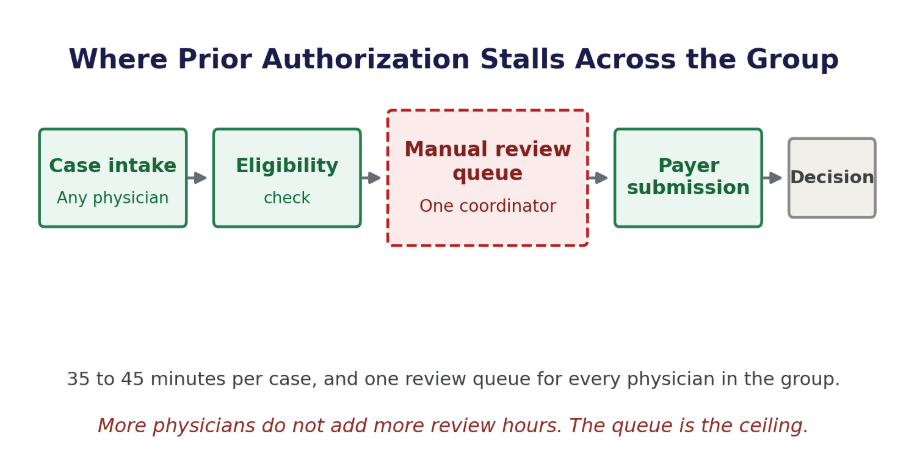
Where the Bottleneck Actually Sits as a Group Scales
To fix this you have to see where the constraint actually lives, and it is not where most people look. It is not that the clinical logic is wrong, that's a different problem, and not that any single coordinator is slow. The bottleneck sits in how many cases one review capacity can hold, and that capacity does not grow just because the group signs another physician.
Requests arrive through fax, email, payer portals, and EDI feeds, and someone has to manually log, read, and enter each one into the claims system before eligibility, clinical review, or decisioning can even start. In a single-physician practice that intake load is a manageable queue. Across an oncology MSO running prior authorization for dozens or hundreds of oncologists, it's a structural ceiling: the group can add physicians faster than it can add trained reviewers, and the gap between those two growth rates is exactly where turnaround slips.
Insurance eligibility and benefit verification compounds the same way. It's typically performed by phone or through separate payer portals, requiring staff to manually cross-reference plan documents to determine whether prior authorization is even required for a given procedure. Multiply that by 100+ physicians, each with a different patient panel and payer mix, and the same payer rule ends up applied slightly differently depending on who is working the case that day, which is its own quiet source of denials.
Prior Authorization Agents for Oncology: One Agent Across 100+ Physicians
A multi-specialty oncology group can build a strong prior authorization operation and still watch it buckle the moment the group grows. A coordinator clears the morning queue;, the afternoon queue refills, and somewhere in that churn a chemotherapy authorization for physician number eighty-six sits exactly as long as one for physician number six. The clinical work is the same either way. The queue does not know the difference.
This is the real constraint behind prior authorization AI agent adoption in oncology: it was never how good any single reviewer is. It's that manual review time is a fixed resource, and every physician a group adds, asks that same fixed resource to stretch further. In oncology specifically, where a delayed authorization is a delayed treatment start, that stretch has a patient on the other end of it, not just a metrics dashboard.
Across ambulatory oncology and specialty care, manual prior authorization runs 35 to 45 minutes per request, with turnaround stretching 3 to 5 business days against a payer-mandated 72-hour standard for non-urgent cases. The AMA's 2024 physician survey found the pattern industry-wide: the process consumes 12 to 13 hours of physician and staff time per physician per week, with 80.7% of denials ultimately overturned on appeal, meaning most initial denials were avoidable rather than clinically justified in the first place.
This blog looks at where that review bottleneck actually sits as an oncology group scales past a handful of physicians, why adding coordinators doesn't fix it, and how one governed AI agent can run the same eight-stage authorization pipeline for every physician in the group, without asking any one person's queue to hold the whole organization's volume.
Where the Bottleneck Actually Sits as a Group Scales
To fix this you have to see where the constraint actually lives, and it is not where most people look. It is not that the clinical logic is wrong, that's a different problem, and not that any single coordinator is slow. The bottleneck sits in how many cases one review capacity can hold, and that capacity does not grow just because the group signs another physician.
Requests arrive through fax, email, payer portals, and EDI feeds, and someone has to manually log, read, and enter each one into the claims system before eligibility, clinical review, or decisioning can even start. In a single-physician practice that intake load is a manageable queue. Across an oncology MSO running prior authorization for dozens or hundreds of oncologists, it's a structural ceiling: the group can add physicians faster than it can add trained reviewers, and the gap between those two growth rates is exactly where turnaround slips.
Insurance eligibility and benefit verification compounds the same way. It's typically performed by phone or through separate payer portals, requiring staff to manually cross-reference plan documents to determine whether prior authorization is even required for a given procedure. Multiply that by 100+ physicians, each with a different patient panel and payer mix, and the same payer rule ends up applied slightly differently depending on who is working the case that day, which is its own quiet source of denials.