
Designing production-ready prior authorization agents for enterprise healthcare
elsai team
Table of contents
The architecture principle: a six-stage pipeline, not a single tool
The six-stage pipeline: design requirements at each stage
Intake agent design: data boundaries, document integrity, and why silent failures are dangerous
Clinical intelligence design: evidence traceability and the mandatory clinical gate
Pre-submission design: denial risk scoring and the approval gate
Integration and infrastructure: what a production agent connects to
The audit infrastructure that makes the agent production-grade
The architecture is the decision

Physicians and their staff spend an average of 34 percent of clinical time on administrative work rather than on patients, and prior authorization is one of the heaviest contributors to that load. That number is exactly why prior authorization automation looks so attractive in a pilot, and exactly why so many of those pilots come apart when they reach production.
The pattern is familiar to anyone who has run a health IT rollout. A tool is deployed in a single department, the results in that controlled setting look strong, and the decision is made to scale it across three specialties and into full production. A few months later the picture has changed. Clinical review documentation is inconsistent from one coordinator to the next, approved authorization codes are missing from the EHR, denials are being classified by hand in a spreadsheet, and when a payer asks how a specific case was handled, nobody can produce the record.
The pilot worked because it automated one task inside one team's control. The production rollout struggled because coordination across specialties, consistent clinical oversight, and a defensible audit trail are architecture problems, not task problems. Scaling a point tool multiplies its blind spots rather than its benefits. This guide sets out how to design a prior authorization automation agent that holds up when the volume and the scrutiny are real.

The architecture principle: a six-stage pipeline, not a single tool
A tool that submits authorization requests faster is not a production-ready prior authorization agent. A production-ready agent runs the complete workflow, from validating the intake data through capturing the payer response and writing the authorization code back to the EHR, and it verifies each stage's output before that output becomes the next stage's input. The value is not in any single step. It is in the chain holding together.
The pipeline has six stages, and context passes forward through all of them. The intake data feeds the eligibility check. The eligibility result feeds the clinical analysis. The clinical output feeds the document assembly. The assembled package feeds the submission. When one stage passes unverified work to the next, every downstream stage builds on a weak foundation, and the error only surfaces at the payer or, worse, at an audit. That is the exact failure mode that breaks production deployments.
The governing design rule follows from this. Every stage must be able to halt the pipeline when something is wrong, with a specific and actionable reason, rather than letting the case move forward on incomplete or contradictory data. A production agent is defined as much by how it stops as by how it runs.
The six-stage pipeline: design requirements at each stage
The pipeline below is the reference architecture for the rest of this guide. Each stage names the agent that handles it, what that agent does in production terms, the point where a human decision is mandatory, and the condition that halts the pipeline if it is not met. Read it as a design checklist to hold your own environment against.
The stages divide into two halves. Intake, Verify, and Track are coordinator-owned and data-centric. Analyze, Decide, and Execute are where clinical judgment and irreversible actions live, which is why the mandatory human gates cluster there.
What makes this production-grade rather than a diagram is that each halt condition is enforced, not advisory. A missing document holds the case at Intake. An inactive coverage result stops it at Verify. An absent clinical review record blocks submission at Decide. The pipeline is designed so that the unsafe path is the one the system will not take.

Intake agent design: data boundaries, document integrity, and why silent failures are dangerous
The intake stage sets the foundation every later stage depends on, so three design decisions matter here more than anywhere else. The first is the data boundary. Only the fields the next step actually needs should pass forward, and that limit should be enforced by the workflow itself at the point of ingestion, not by an access policy that assumes staff will apply it correctly under load. Patient data that never enters the pipeline cannot later leak from it.
The second is document integrity. Every document received at intake should be fingerprinted at the moment it is retrieved, so there is a verifiable record that the package submitted later is the same one that was approved. This fingerprint becomes the evidence, further down the pipeline, that nothing was altered between approval and submission. The third decision is how failure is handled. A missing mandatory document must stop the case and name the specific document that is missing, rather than raising a generic error that a coordinator has to decode. Silence at intake is the most dangerous failure of all, because it means clinical work begins on an incomplete record and nobody knows it yet.
The operational value of getting this right shows up at audit time. If a payer later asks whether the practice held the patient's insurance information when the case opened, the intake log with its timestamp is the answer, available in seconds rather than reconstructed from memory.
Clinical intelligence design: evidence traceability and the mandatory clinical gate
The clinical stage is where most prior authorization implementations fail a compliance review, and the reasons are consistent. The first requirement is evidence traceability. Every clinical finding the agent puts forward must trace back to the specific document, the date, and the source system it came from. The agent should not be able to assert that a diagnosis is confirmed without recording the note that supports it, when it was written, and where it lives. A finding without a source is a finding that cannot be defended.
The second requirement is conservative treatment verification, which is the single most common cause of denial. Checking that a course of physical therapy took place is not enough on its own. The agent has to check both the session count and the documented outcome against the specific payer's coverage criteria, because a session count with no recorded outcome will be read as insufficient. Catching that gap before a clinician reviews the case is a core part of the design, not an afterthought.
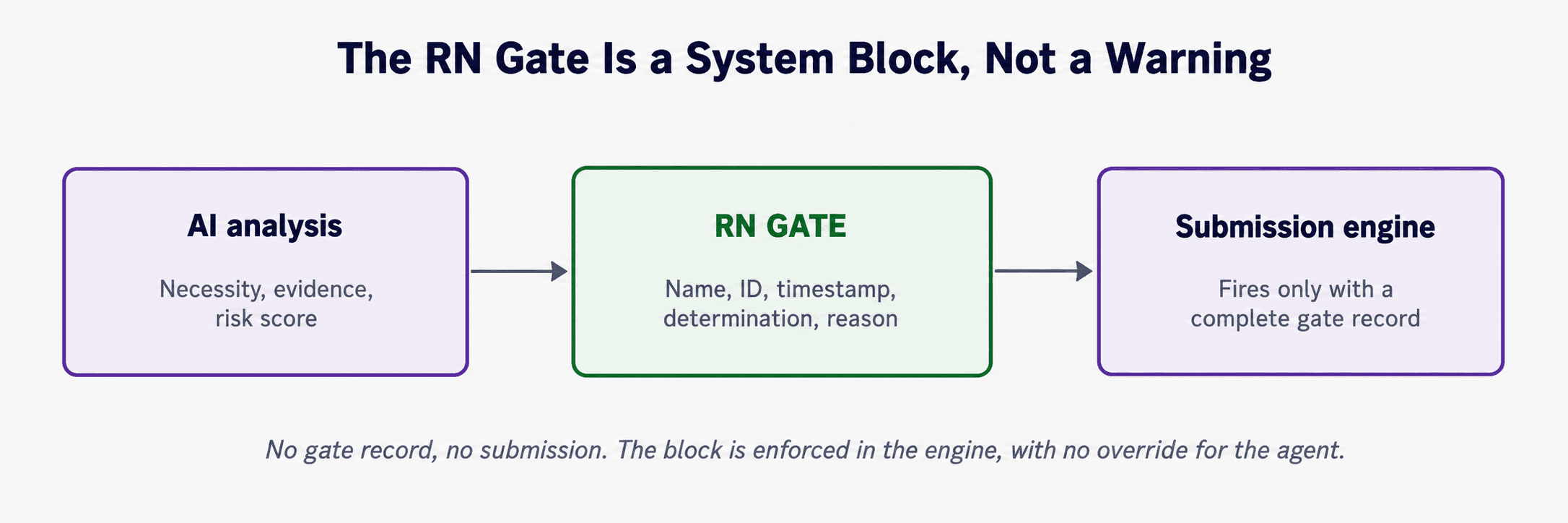
The third requirement is the clinical gate itself, and it is the one that must never be optional. The submission engine has to be blocked when the clinical review record is absent, with no path for the agent to proceed on its own. That record needs to hold the reviewing nurse's name, their user ID, the exact time of the review, the determination they reached, and the reason for it. An agent that advances an authorization without that record is a compliance exposure, not merely a process gap, and if the case is ever audited, that record is the answer to the question of who reviewed it.
Pre-submission design: denial risk scoring and the approval gate
Two design requirements sit between a finished clinical review and a submitted request. The first is denial risk scoring. Before anything is transmitted, the agent should score the assembled package against the historical denial patterns for that payer, that procedure, and that clinical profile, and every factor in the score should trace to a specific document, data point, or coverage clause rather than a vague warning. The design implication is that the scoring threshold should change what the engine does. A case in the most severe risk band should stop and require explicit sign-off from both a coordinator and a clinician, recorded as a deliberate override rather than a dismissed pop-up.
The second requirement is the approval gate. A coordinator has to actively approve the assembled package, and that approval record captures who approved it, their user ID, the exact time, and the version of the package they saw. From that point forward, any change to any document in the package should raise an alert and force re-approval. At transmission, the system compares the fingerprints of the queued documents against the approved version, so the package the payer receives is provably the one the coordinator signed off. This closes the gap between what was approved and what was actually sent.
Integration and infrastructure: what a production agent connects to
A production prior authorization agent does not replace the systems a health system already runs. It sits between them as a governed workflow layer, and its integration design has two sides. On the clinical data side, it connects to the major EHRs, Epic, Cerner, Athena, and Meditech, through their standard interfaces for retrieving clinical records, to health information exchanges for outside records, and to lab systems for results, with a defined retrieval priority so the agent knows which source to trust first. Every document it retrieves is fingerprinted at the point of retrieval, which is what makes the later integrity checks possible.
On the payer side, it connects through the standard electronic channels for checking eligibility and for submitting the authorization request and receiving the response. Each transmission records its transaction identifier and the payer's reference number, and these are kept not as a logging courtesy but as the record of receipt, so a later dispute about whether a request arrived can be settled from the data. The authorization code that comes back must be written into the EHR and confirmed with a timestamp, because an approved authorization that never reaches the billing system is a revenue risk even though the payer said yes. The governance records and human review queues stay inside the organisation's own environment rather than in an outside service, which is a requirement most enterprise health systems treat as non-negotiable.
The audit infrastructure that makes the agent production-grade
The line between a production-grade agent and a workflow tool that happens to keep logs is the audit infrastructure. In elsai this is ARMS, and it records every agent action at every stage as that action happens: the upload and its timestamp at intake, the eligibility transaction at verify, the reasoning behind each clinical finding at analyze, the reviewer's name and decision at the clinical gate, the approval and document fingerprint at execute, and the payer response, the write-back confirmation, and the denial reason at track.
The important design property is that this record is built during execution, not assembled afterward from scattered system logs. Each entry is linked to the one before it so that any later alteration is detectable, and any date range can be exported on demand for an audit or an appeal. This is what makes elsai a governed execution layer rather than an automation script with a log file attached.
The practical payoff arrives the first time a payer questions a specific case. Instead of a scramble across the EHR, email, and the billing system, the complete evidence chain from intake through resolution is already in one place and retrievable in minutes. Audit readiness stops being a project and becomes a property of the system.

The architecture is the decision
Prior authorization automation at enterprise scale is an architecture decision before it is a tool selection. The six-stage pipeline, the governance checkpoint at each stage, the mandatory clinical review, the evidence traceability, the document integrity checks, and the audit record that is written as the work happens are not features to add later. They are the structure that determines whether the system holds up the first time a payer, an auditor, or a compliance officer asks a hard question about a specific case.
The health systems that treat these as design requirements from the start are the ones whose automation still stands when the volume and the scrutiny arrive. The ones that bolt governance, clinical oversight, and audit capability onto a point tool after the fact spend more effort on remediation than they ever saved on speed. The difference between those two outcomes is decided at the architecture stage, not in production.
elsai is the governed execution layer that runs prior authorization this way, with specialised agents handling the volume across the full pipeline and the clinical and revenue teams keeping the decisions that matter.
If you are designing an AI prior authorization capability and want to see the architecture running on a real workflow request a demo.
FAQ
What separates a production-ready prior authorization agent from a PA automation point tool?
A point tool automates one step, such as submission, status checking, or eligibility. A production-ready agent runs all six workflow stages as a connected pipeline where each stage's verified output becomes the next stage's input. The defining requirement is that a failure halts the pipeline with a specific reason rather than passing bad data forward to stages that then act on it.
How should the clinical review gate be designed to satisfy oversight requirements?
The gate has to be enforced by the system, so the submission engine is blocked whenever the review record is missing, with no way for the agent to proceed on its own. The record must hold the reviewing nurse's name, user ID, exact timestamp, the determination reached, and the reason for it. That record is the evidence that a qualified clinician reviewed the AI's output before the authorization went out.
What does the pre-submission denial risk score evaluate, and how should it change what happens next?
The score evaluates the assembled package against the historical denial patterns for that payer, procedure, and clinical profile, with each risk factor traced to a specific document, data point, or coverage clause. The design requirement is that a case in the most severe band should stop and require documented sign-off from a coordinator and a clinician before the pipeline resumes, rather than showing a warning the user can wave away.
How does document integrity checking work, and why does it matter for audit defence?
Each document in the package is fingerprinted when it is retrieved, and a snapshot of the full package is taken at the point of coordinator approval. Before transmission, the system compares the documents queued for submission against that approved snapshot, and any change forces re-approval. This closes the gap between what a coordinator approved and what was actually sent to the payer, which is exactly the question an audit asks.
How does a production agent integrate with Epic, Cerner, and payer systems without replacing them?
The agent layer sits between the existing EHR systems and the workflow, connecting through the standard clinical-record interfaces on the EHR side and the standard electronic channels on the payer side. The EHR remains the system of record. The agent layer adds the governed workflow, the audit trail, and the human review framework on top of it, without requiring changes to the underlying EHR configuration.





We’d love to chat with you about how your team can secure and govern Ai agents everywhere