
elsai team
Table of contents
What is a shadow agent — and why should enterprise leaders care?
Why traditional enterprise AI governance doesn’t catch shadow agents
The five layers of governance-first agentic engineering
What governance-first agentic engineering looks like in practice
Why most enterprise teams can’t build this in-house — and what it costs to try
Start with a governed workflow — not a shadow agent
FAQ
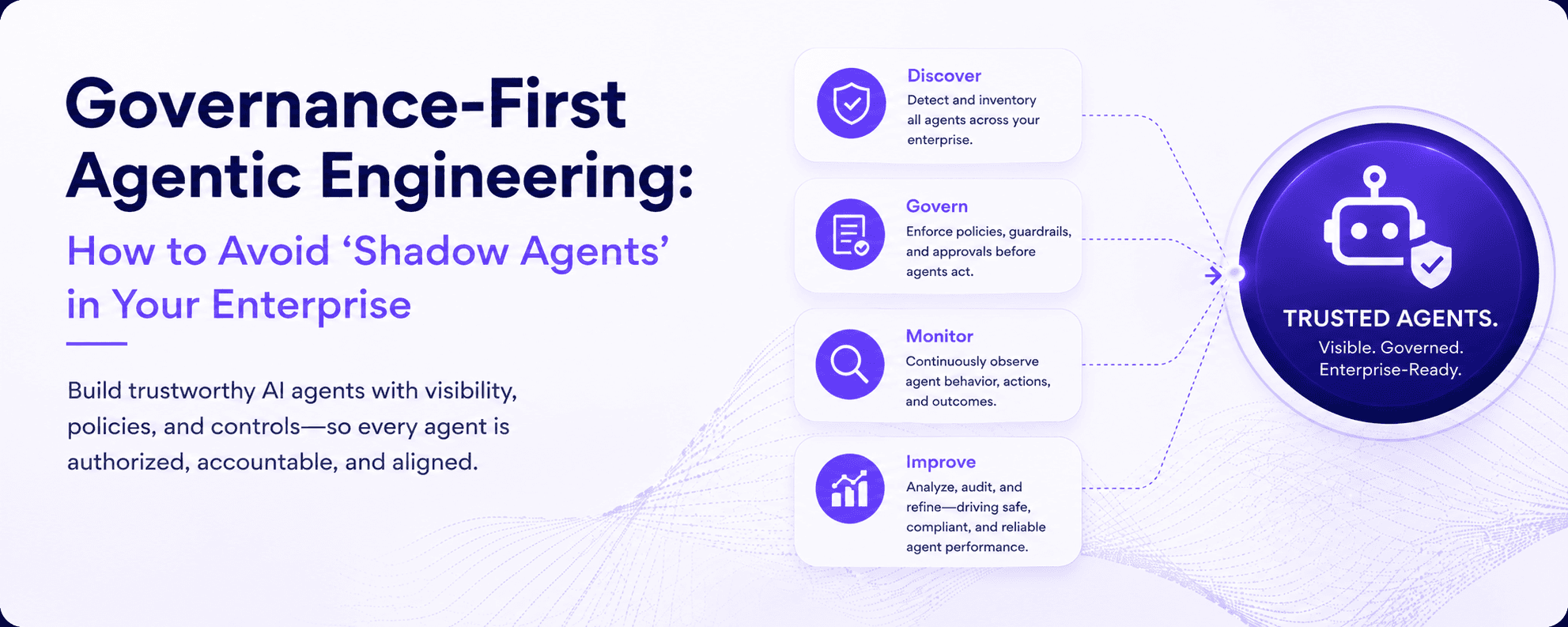
Shadow agents — AI agents deployed without governance, audit trails, or accountable ownership — are the fastest-growing compliance and operational risk in enterprise AI. The fix is not more policy documents. It is governance-first agentic engineering: building accountability, observability, and human control into the workflow architecture from day one, before a single agent reaches production.
Most enterprise AI failures are not model failures. The model works. The problem appears when an AI workflow moves from a demo into production without governance, ownership, auditability, or human oversight.
This is the shadow agent problem: AI agents operating inside enterprise systems without clear accountability. As organizations accelerate AI adoption, shadow agents are becoming one of the fastest-growing operational and compliance risks.
What is a shadow agent — and why should enterprise leaders care?
A shadow agent is any AI agent operating in an enterprise environment without documented ownership, explicit governance controls, an audit trail, or a defined human escalation path. It may be performing useful work. That is precisely what makes it dangerous.
The term is borrowed from 'shadow IT' — the unauthorised software that proliferated in enterprises before cloud governance matured. Shadow agents follow the same pattern, but with a higher risk ceiling. A shadow spreadsheet causes data inconsistency. A shadow agent connected to a CRM, database, or payer portal can act at machine speed. Without review controls or audit logs, teams may never know what decisions it made.
They emerge in predictable ways. The four most common patterns in enterprises currently deploying agentic AI workflows are:
Shadow Agent Pattern
Prototype that went live
Third-party tool with embedded agents
Rogue pipeline in a data platform
LLM in a workflow no one owns
How It Starts
A team demos an LLM workflow, stakeholders love it, it gets connected to a production system without an engineering review.
A SaaS vendor silently adds an AI agent layer to their product. Procurement signs off without flagging it to engineering.
A data scientist builds an agent to automate a reporting workflow. It runs on a production database with write access.
An automation workflow is built by a contractor and handed over. The team that received it doesn't understand the model layer.
What It Costs the Enterprise
No audit trail. No rollback. No one knows what the agent is doing when it fails.
Data leaves your perimeter. PHI or IP processed by an external model endpoint you didn't approve.
Unvalidated SQL, no human review gate, no versioning. A schema change breaks it silently.
No one can explain a decision when a regulator or internal audit asks. Explainability gap becomes a compliance risk.
Why traditional enterprise AI governance doesn’t catch shadow agents
Most enterprise AI governance frameworks are built around model risk — bias evaluations, model cards, fairness audits. These are necessary, but they operate at the wrong layer for agentic deployments. An agent is not a model. It is a workflow that uses a model. Governing the model without governing the workflow is like auditing a car's engine without checking whether the driver has a licence.
Agentic AI governance requires controls at the execution layer: who instructed the agent, which tools it called, which data it read, which decision it made, which human approved it, and what happened next. None of these questions are answered by a model card or a bias audit.
The gap is an engineering problem, not a policy problem. Policies that say 'all AI deployments must have an audit trail' do not create audit trails. Engineers who build the audit trail into the workflow architecture from day one do. This is the distinction that separates governance-first agentic engineering from compliance-as-documentation.
The five layers of governance-first agentic engineering
A governed agentic workflow is not a single feature. It is an architecture with five interdependent layers, each addressing a different category of enterprise AI risk. The elsai platform and its agentic engineering team build all five into every production deployment:
Layer
Observability
Policy Enforcement
Human-in-the-Loop
Domain Intelligence
Multi-Agent Coordination
What It Covers
Every prompt, tool call, agent handoff, and output — logged, timestamped, attributed to a named role.
Compliance rules applied at every input and output. No agent acts before its guardrails clear.
Mandatory review checkpoints for borderline and high-risk decisions. Hard gates, not soft suggestions.
Agents that understand the context they operate in — regulatory, clinical, financial, operational.
When multiple agents work in sequence, handoffs are explicit, versioned, and traceable.
elsai Implementation
ARMS (Agent Resource Management System) — the flight recorder for every governed workflow.
Guardrails — configured per workflow, per domain, per risk level. Not bolted on after deployment.
HITL architecture — every governed workflow has defined escalation paths and named approval roles.
Vertical-first engineering — elsai engineers build for the domain, not for a generic LLM wrapper.
Agent-to-Agent comms — coordinated execution with no context loss between workflow stages.
What makes these five layers a governance-first approach rather than a compliance retrofit is sequencing. They are designed into the agentic workflow architecture before a single agent is connected to a production system — not added afterward when an audit or incident forces the issue.
What governance-first agentic engineering looks like in practice
The abstraction becomes clearer with a concrete example. Consider an enterprise deploying an AI agent to handle supplier onboarding in a regulated procurement environment. Without governance-first engineering, the typical trajectory looks like this:
A data engineer builds an agent that ingests supplier documents, extracts compliance fields, and updates a master vendor list
The agent works correctly in testing and gets promoted to production with minimal review
Six months later, a supplier's compliance certification lapses — the agent continues approving that supplier because the update logic was not governed by a versioned rule engine
A compliance audit surfaces the gap. No one can produce a log of what the agent approved and when. The audit trail does not exist
With governance-first agentic engineering, the same workflow is built differently from the start:
The The onboarding agent applies version-controlled compliance rules. Teams can track every policy update and see exactly which rules influenced each approval decision.
Every agent decision is logged in ARMS with the rule version, the confidence score, and the data sources it read
Low-confidence supplier assessments are routed to a human reviewer through a hard escalation gate — not a soft notification
The audit trail is inspection-ready on demand, not reconstructed from email logs when a regulator asks
To an end user, the output may look identical. The difference is entirely in the engineering architecture — and it surfaces the moment something unexpected happens, a policy changes, an exception needs explaining, or a regulator asks for evidence.
Why most enterprise teams can’t build this in-house — and what it costs to try
The talent profile required for governance-first agentic engineering is narrow and genuinely scarce. It sits at the intersection of three skill sets that rarely overlap in a single hire: agentic AI workflow architecture, regulated-domain expertise, and production-grade observability engineering.
According to data from the elsai hiring intelligence, most senior agentic engineers who combine these three areas take 4–6 months to hire and cost $250K–$400K+ annually. For an enterprise deploying one or two governed workflows, a full-time hire rarely justifies the investment, particularly when the first production deployment should be validating the use case before committing to headcount.
The more common outcome is that enterprises hire a strong LLM engineer who can prototype agentic workflows, but lacks the production experience to build the governance layer correctly from the start. The prototype The prototype ships. The governance retrofit begins six months later, triggered by an incident or an audit. By that point, the cost is not just engineering time — it is the shadow agent risk that accumulated in the interim.
elsai provides experienced agentic AI engineers who build, deploy, and scale governed workflows on the elsai platform — the governed execution layer for enterprise agentic operations. Every engagement is structured to get to production fast without accumulating governance debt.
Week 1–2 (Discovery & Scoping): Pick one workflow with a clear business case. Map governance requirements — data boundaries, approval flows, audit obligations. Agree on success metrics.
Week 2–4 (Configured Build): Deploy the governed workflow inside your infrastructure. Connect to your systems of record. Build ARMS observability, HITL checkpoints, and guardrails into the architecture — not as modules, but as structural components.
Week 8+ (Production & Expansion): Move to production. Hand the playbook to your team. Expand to adjacent workflows with quarterly outcome reviews.
The engagement model is fixed-fee and fixed-timeline. There is no open-ended retainer before you see a production result. The platform supports deployment on your AWS account, your Azure tenant, your on-premises infrastructure, or a private VPC — your data does not leave your perimeter.
LLM selection is agnostic: GPT, Claude, Llama, Gemini, or your own fine-tuned models. The governance layer is consistent regardless of which model runs underneath.
Start with a governed workflow — not a shadow agent
The enterprises that will compound the most value from agentic AI are not the ones who deploy fastest. They are the ones who deploy with governance built in from the start — because governed workflows are the only ones that survive an audit, scale to additional use cases, and maintain stakeholder trust when something unexpected happens.
If your team is planning an agentic AI deployment — in healthcare, life sciences, insurance, procurement, supply chain, or any regulated environment — the question to ask before a single agent touches a production system is: who owns every decision this agent makes, and can they prove it?
If the answer is unclear, that is where to start. Explore the elsai agentic engineering service or speak with an elsai engineer directly at https://www.elsai.ai/contact-form.
FAQ
What is a shadow agent and how is it different from a standard AI integration risk?
A shadow agent is an AI agent operating in a production environment without documented governance controls — no audit trail, no named ownership, no human escalation path, and no versioned rule logic. Unlike a misconfigured API or an unsecured data connection, a shadow agent is actively making decisions and taking actions. The risk is not just exposure — it is autonomous action at machine speed with no accountability layer.
What does governance-first mean in the context of agentic engineering?
Governance-first means observability policy enforcement, human review gates, and audit trail infrastructure are designed into the workflow architecture before the first agent is connected to a production system. It is an engineering approach, not a policy document. The difference shows when something goes wrong or when a regulator asks for evidence of how a decision was made.
What is the enterprise AI governance gap that most organizations currently have?
Most enterprise AI governance frameworks cover model risk — bias evaluations, fairness audits, model cards. These do not apply to the execution layer of an agentic workflow: who instructed the agent, what tools it called, what data it read, which human approved the decision, and what happened next. That execution-layer gap is where shadow agents accumulate.
Why is it hard to hire agentic AI engineers with governance expertise?
Agentic engineering at production scale requires three overlapping skill sets that rarely exist in one candidate: agentic AI workflow architecture, regulated-domain expertise, and production observability engineering. Most candidates who respond to agentic engineer job postings can prototype — very few have shipped governed workflows in regulated environments. Most senior hires in this space take 4–6 months to find and cost $250K–$400K+ annually.
How does elsai's agentic AI platform ensure governance at the workflow level?
The elsai platform builds five governance layers into every workflow: ARMS observability (a full audit trail of every agent action), guardrails (policy enforcement on every input and output), HITL checkpoints (mandatory human review gates on escalated decisions), domain intelligence (vertical-specific rule logic), and multi-agent coordination with explicit, versioned handoffs. These are structural components, not add-on modules.





We’d love to chat with you about how your team can secure and govern Ai agents everywhere