
How elsai guardrails, prompt manager, and ARMS work together on azure AI for regulated use cases
How elsAI guardrails, prompt manager, and ARMS work together on azure AI for regulated use cases
Published on May 28, 2026
How elsAI guardrails, prompt manager, and ARMS work together on azure AI for regulated use cases
Published on May 28, 2026
How elsAI guardrails, prompt manager, and ARMS work together on azure AI for regulated use cases
Published on May 28, 2026
Executive summary
Regulated enterprises face the same problem when deploying AI in 2026: the model performs well in the sandbox but breaks down in production. The issue is rarely the model itself. Most organizations lack the governance, observability, and prompt controls required to operate AI safely in regulated environments.
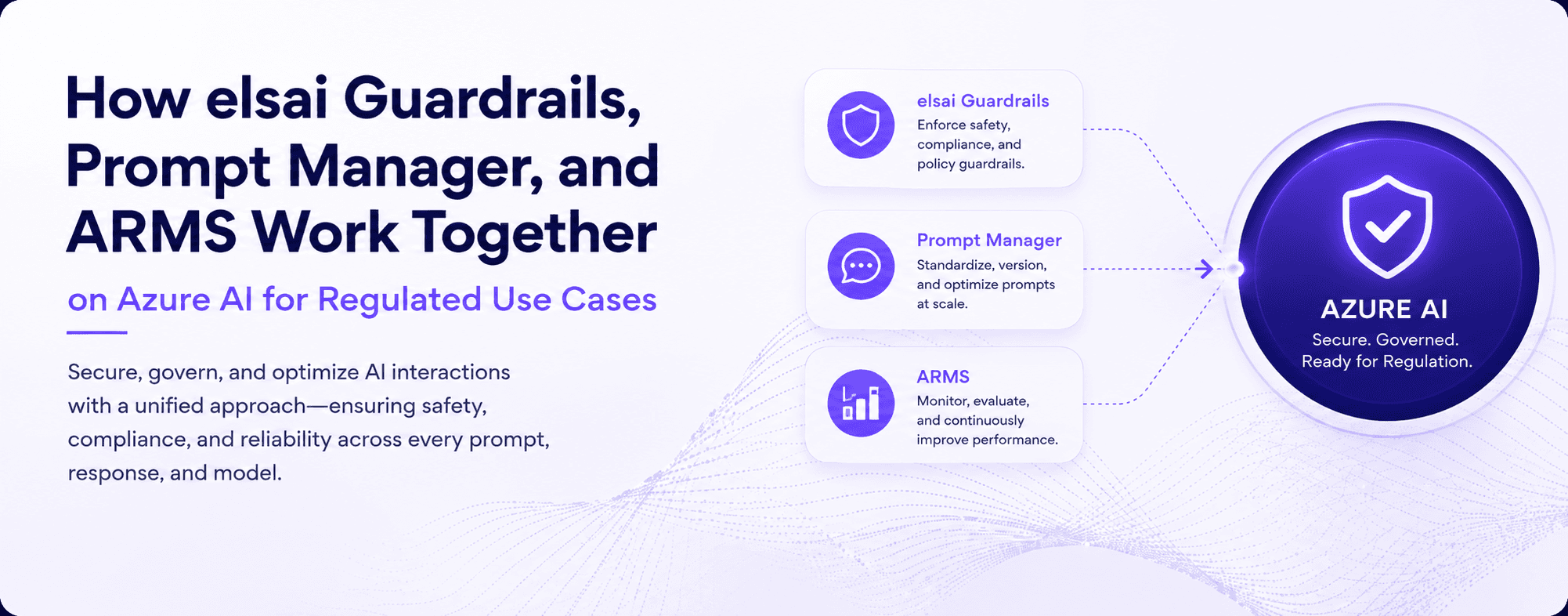
elsai Foundry solves this problem through three integrated components: Guardrails, Prompt Manager, and ARMS. Together, they create a governed execution layer on Azure AI where every agent action remains controlled, traceable, and reviewable from the first workflow run.
This article explains exactly how those three components operate together and why that architecture matters specifically for healthcare and life sciences use cases.
Why most enterprise AI deployments stall before production
Enterprise AI adoption continues to stall between pilot and production. According to elsai's own platform data, 38% of enterprises are currently piloting AI agents, yet only 11% have ever reached production. The biggest problem is not model quality. It is the lack of operational controls around the model.
For regulated industries, this gap carries direct business consequences. According to research from PAREXEL and Tufts CSDD 2024, manual EU CTR submission preparation takes 10 to 14 weeks per country package, with 40% of that time attributable to avoidable rework and duplication. On the healthcare operations side, McKinsey and CMS 2024 put the annual cost of administrative overhead from manual authorisations and redundant data entry at $8.3 billion across the US healthcare system.
These delays happen because organizations deploy AI without strong controls for policy enforcement, prompt consistency, and decision traceability. The model runs. The output is produced. But without policy enforcement, prompt consistency, and full decision traceability, the organisation cannot defend what the AI did, when it did it, or why.
elsai Foundry was built specifically to close that gap, and Azure AI is one of its primary deployment targets.
What elsai foundry actually is
What elsAI foundry actually is
elsai Foundry is an enterprise platform for building and running governed AI agents across healthcare, life sciences, BFSI, and other regulated industries.
Unlike generic AI toolkits, Foundry embeds governance at its core, not as an afterthought. Every deployment ships with policy-as-code compliance, PII redaction, real-time observability through ARMS, and full LLM-agnostic flexibility. The platform supports 200+ pre-built tools and connects to 100+ LLMs, including models hosted on Azure AI, AWS bedrock, Anthropic, and Google Gemini, all through a single unified interface.
Grounded in 16+ years of enterprise delivery through OptiSol Business Solutions, with 450+ engineers and 200+ clients across 24 countries, elsai brings the operational depth that regulated environments require.
The three components that make this possible in practice are Guardrails, Prompt Manager, and ARMS.
Component 1: guardrails — policy enforcement before the agent acts
In most AI deployments, compliance is checked after an output has already been produced. By that point, the risk has already materialised. elsai Guardrails component inverts this entirely. Policy is enforced before any agent acts on any input.
Guardrails in the Foundry architecture provides protection against 10+ vulnerability types, covering both input and output boundaries of every agent interaction. In a healthcare prior authorization workflow, this means PHI is redacted at the point of ingestion, not during a downstream review. In a life sciences submission workflow, it means cross-document compliance checks are run before a country pack is generated, not after a national competent authority sends an RFI.
This is what enterprise-grade guardrails AI looks like in practice. The platform applies compliance and policy controls before workflows proceed, not after risks appear downstream. Guardrails flag the issue, logs the event, and routes the workflow to a human reviewer before processing continues.
On Azure AI, Guardrails operates inside the customer’s own tenant, with zero data egress by design. Sensitive data and IP never travel to a third-party model endpoint. The customer brings their own keys, their own models, and their own audit logs.
Component 2: prompt manager — consistent, versioned, auditable agent behaviour
Prompt drift is one of the least discussed but most damaging failure modes in production AI. When agent prompts are managed informally stored in code comments, shared via spreadsheets, updated without version control the behaviour of the agent changes unpredictably across runs. In a regulated environment, that inconsistency is a compliance problem, not just an engineering inconvenience.
elsai Prompt Manager treats prompt engineering with the same operational rigour applied to software deployment. It provides prompt versioning, prompt testing and simulation, an auto prompt optimiser, and a full CI/CD pipeline for prompt lifecycle management. Prompt Manager versions every prompt change automatically. Every version is testable in a controlled simulation environment before it goes to production. Teams can trace every deployment back to a specific prompt version.
For AI Agentic Applications for the Enterprise operating in healthcare and life sciences, this matters at the audit level. When a regulator or an internal compliance team asks why an agent made a specific recommendation on a specific date, the answer must be reproducible. With Prompt Manager, it is. The exact prompt version active at the time of any agent decision is logged and retrievable on demand.
Prompt Manager also supports the multi-agent architecture that complex regulated workflows require. When different specialised agents handle different stages of a workflow — intake, validation, generation, review, submission — each agent operates from its own governed prompt set. Changes to one agent’s behaviour do not propagate unpredictably to others.
Component 3: ARMS — real-time observability across every agent action
elsai ARMS, the Agent Resource Management System, is the AI observability layer at the heart of the Foundry platform. The elsai team describes it as functioning like a flight recorder for AI every token generated, every decision made, every tool called, and every cost incurred is tracked in real time and stored in an immutable audit log.
This is what differentiates genuine ai enterprise governance from dashboard-level reporting. Most enterprise AI monitoring tools show you aggregate metrics — latency, error rates, token counts. ARMS goes deeper. It records the reasoning trace of every agent decision, the specific rule version that was active at the time of each check, the human approval events with timestamps and user identities, and the outcomes fed back into the system for continuous learning.
In a life sciences context, ARMS generates inspection-ready evidence packages on demand, covering document versions, review decisions, approval events, and submission actions, all under the electronic signature framework aligned with 21 CFR Part 11 and EU Annex 11. In a healthcare context, ARMS ensures that every prior authorization decision is traceable to the rule set, the model version, and the clinician or compliance lead who signed off on any borderline case.
Why azure AI is a natural deployment target for this architecture
Azure AI provides the infrastructure that regulated enterprises already operate on, and elsai Foundry integrates with it without requiring a rip-and-replace. The platform runs inside the customer's Azure tenant as a private VPC deployment. The customer brings their own keys and their own perimeter. All workloads execute inside the customer's infrastructure and data does not leave.
elsai Foundry supports Azure-hosted models as one of 100+ LLM options, meaning organisations already running Azure OpenAI or other Microsoft AI services can connect them directly to the Foundry orchestration and governance layer. The compliance posture aligns with HIPAA controls for protected health information, SOC 2 and ISO 27001-aligned operational controls, and GDPR-compliant data handling and residency requirements.
For CTOs and CIOs in healthcare and life sciences, this means the governed agent infrastructure they need does not require a separate cloud environment or a new vendor relationship with model providers. It layers on top of the Azure stack they already trust.
What this means for regulated enterprise buyers in 2026
AI Agentic Applications for the Enterprise has reached a point where model capability is no longer the primary challenge. Most organizations already have access to capable models. The real challenge is deploying those models safely inside operational workflows.
That requires:
policy enforcement
prompt governance
auditability
human oversight
infrastructure control
Elsai Foundry delivers these controls through Guardrails, Prompt Manager, and ARMS operating together inside Azure AI environments. On Azure AI, all three operate inside the customer's existing infrastructure with zero data egress, full compliance posture, and a path from pilot to production workflow in 4 to 6 weeks.
If your organization is evaluating how to move regulated AI workflows from pilot to production on Azure, the starting point is the governance architecture, not the model selection. Explore elsai Foundry or request a live demo at info@elsai.ai.
FAQ
Does elsai Foundry work with Azure OpenAI or other Azure-hosted models?
Yes. elsai Foundry is LLM-agnostic and supports 100+ language models including those hosted on Azure AI, AWS Bedrock, Anthropic, and Google Gemini, all through a single unified interface. Customers can connect Azure-hosted models without changing the governance or observability layer.
How quickly can elsai be deployed in a regulated environment on Azure?
The average time from engagement to first production workflow is 4 to 6 weeks. This is achieved through 200+ pre-built tools, a three-phase delivery model (discovery, configured pilot, production rollout), and native connectors to clinical and regulatory systems including Epic, Veeva Vault, Medidata Rave, and CTIS.
Why is AI observability important in regulated industries?
AI observability provides full visibility into agent decisions, model behaviour, prompt usage, and workflow actions. In regulated sectors like healthcare and life sciences, this helps organisations maintain audit readiness, improve accountability, and support compliance investigations.
Can elsai Foundry integrate with existing healthcare and clinical systems?
Yes. elsai Foundry supports integrations with enterprise and clinical systems including EHRs, eTMF platforms, CTMS, payer systems, Veeva Vault, Medidata Rave, Epic, and regulatory submission environments.
What types of regulated workflows can elsai automate?
Elsai supports workflows across prior authorization, IRB readiness, protocol validation, clinical trial submissions, regulatory review, document compliance checks, healthcare operations, and enterprise governance-driven AI automation.
Ready to move regulated AI workflows from pilot to production on Azure?
Ready to move regulated AI workflows from pilot to production on Azure?
Request free demo →
Executive summary
Regulated enterprises face the same problem when deploying AI in 2026: the model performs well in the sandbox but breaks down in production. The issue is rarely the model itself. Most organizations lack the governance, observability, and prompt controls required to operate AI safely in regulated environments.
elsai Foundry solves this problem through three integrated components: Guardrails, Prompt Manager, and ARMS. Together, they create a governed execution layer on Azure AI where every agent action remains controlled, traceable, and reviewable from the first workflow run.
This article explains exactly how those three components operate together and why that architecture matters specifically for healthcare and life sciences use cases.
Why most enterprise AI deployments stall before production
Enterprise AI adoption continues to stall between pilot and production. According to elsai's own platform data, 38% of enterprises are currently piloting AI agents, yet only 11% have ever reached production. The biggest problem is not model quality. It is the lack of operational controls around the model.
For regulated industries, this gap carries direct business consequences. According to research from PAREXEL and Tufts CSDD 2024, manual EU CTR submission preparation takes 10 to 14 weeks per country package, with 40% of that time attributable to avoidable rework and duplication. On the healthcare operations side, McKinsey and CMS 2024 put the annual cost of administrative overhead from manual authorisations and redundant data entry at $8.3 billion across the US healthcare system.
These delays happen because organizations deploy AI without strong controls for policy enforcement, prompt consistency, and decision traceability. The model runs. The output is produced. But without policy enforcement, prompt consistency, and full decision traceability, the organisation cannot defend what the AI did, when it did it, or why.
elsai Foundry was built specifically to close that gap, and Azure AI is one of its primary deployment targets.
What elsai foundry actually is
What elsAI foundry actually is
elsai Foundry is an enterprise platform for building and running governed AI agents across healthcare, life sciences, BFSI, and other regulated industries.
Unlike generic AI toolkits, Foundry embeds governance at its core, not as an afterthought. Every deployment ships with policy-as-code compliance, PII redaction, real-time observability through ARMS, and full LLM-agnostic flexibility. The platform supports 200+ pre-built tools and connects to 100+ LLMs, including models hosted on Azure AI, AWS bedrock, Anthropic, and Google Gemini, all through a single unified interface.
Grounded in 16+ years of enterprise delivery through OptiSol Business Solutions, with 450+ engineers and 200+ clients across 24 countries, elsai brings the operational depth that regulated environments require.
The three components that make this possible in practice are Guardrails, Prompt Manager, and ARMS.
Component 1: guardrails — policy enforcement before the agent acts
In most AI deployments, compliance is checked after an output has already been produced. By that point, the risk has already materialised. elsai Guardrails component inverts this entirely. Policy is enforced before any agent acts on any input.
Guardrails in the Foundry architecture provides protection against 10+ vulnerability types, covering both input and output boundaries of every agent interaction. In a healthcare prior authorization workflow, this means PHI is redacted at the point of ingestion, not during a downstream review. In a life sciences submission workflow, it means cross-document compliance checks are run before a country pack is generated, not after a national competent authority sends an RFI.
This is what enterprise-grade guardrails AI looks like in practice. The platform applies compliance and policy controls before workflows proceed, not after risks appear downstream. Guardrails flag the issue, logs the event, and routes the workflow to a human reviewer before processing continues.
On Azure AI, Guardrails operates inside the customer’s own tenant, with zero data egress by design. Sensitive data and IP never travel to a third-party model endpoint. The customer brings their own keys, their own models, and their own audit logs.
Component 2: prompt manager — consistent, versioned, auditable agent behaviour
Prompt drift is one of the least discussed but most damaging failure modes in production AI. When agent prompts are managed informally stored in code comments, shared via spreadsheets, updated without version control the behaviour of the agent changes unpredictably across runs. In a regulated environment, that inconsistency is a compliance problem, not just an engineering inconvenience.
elsai Prompt Manager treats prompt engineering with the same operational rigour applied to software deployment. It provides prompt versioning, prompt testing and simulation, an auto prompt optimiser, and a full CI/CD pipeline for prompt lifecycle management. Prompt Manager versions every prompt change automatically. Every version is testable in a controlled simulation environment before it goes to production. Teams can trace every deployment back to a specific prompt version.
For AI Agentic Applications for the Enterprise operating in healthcare and life sciences, this matters at the audit level. When a regulator or an internal compliance team asks why an agent made a specific recommendation on a specific date, the answer must be reproducible. With Prompt Manager, it is. The exact prompt version active at the time of any agent decision is logged and retrievable on demand.
Prompt Manager also supports the multi-agent architecture that complex regulated workflows require. When different specialised agents handle different stages of a workflow — intake, validation, generation, review, submission — each agent operates from its own governed prompt set. Changes to one agent’s behaviour do not propagate unpredictably to others.
Component 3: ARMS — real-time observability across every agent action
elsai ARMS, the Agent Resource Management System, is the AI observability layer at the heart of the Foundry platform. The elsai team describes it as functioning like a flight recorder for AI every token generated, every decision made, every tool called, and every cost incurred is tracked in real time and stored in an immutable audit log.
This is what differentiates genuine ai enterprise governance from dashboard-level reporting. Most enterprise AI monitoring tools show you aggregate metrics — latency, error rates, token counts. ARMS goes deeper. It records the reasoning trace of every agent decision, the specific rule version that was active at the time of each check, the human approval events with timestamps and user identities, and the outcomes fed back into the system for continuous learning.
In a life sciences context, ARMS generates inspection-ready evidence packages on demand, covering document versions, review decisions, approval events, and submission actions, all under the electronic signature framework aligned with 21 CFR Part 11 and EU Annex 11. In a healthcare context, ARMS ensures that every prior authorization decision is traceable to the rule set, the model version, and the clinician or compliance lead who signed off on any borderline case.
Why azure AI is a natural deployment target for this architecture
Azure AI provides the infrastructure that regulated enterprises already operate on, and elsai Foundry integrates with it without requiring a rip-and-replace. The platform runs inside the customer's Azure tenant as a private VPC deployment. The customer brings their own keys and their own perimeter. All workloads execute inside the customer's infrastructure and data does not leave.
elsai Foundry supports Azure-hosted models as one of 100+ LLM options, meaning organisations already running Azure OpenAI or other Microsoft AI services can connect them directly to the Foundry orchestration and governance layer. The compliance posture aligns with HIPAA controls for protected health information, SOC 2 and ISO 27001-aligned operational controls, and GDPR-compliant data handling and residency requirements.
For CTOs and CIOs in healthcare and life sciences, this means the governed agent infrastructure they need does not require a separate cloud environment or a new vendor relationship with model providers. It layers on top of the Azure stack they already trust.
What this means for regulated enterprise buyers in 2026
AI Agentic Applications for the Enterprise has reached a point where model capability is no longer the primary challenge. Most organizations already have access to capable models. The real challenge is deploying those models safely inside operational workflows.
That requires:
policy enforcement
prompt governance
auditability
human oversight
infrastructure control
Elsai Foundry delivers these controls through Guardrails, Prompt Manager, and ARMS operating together inside Azure AI environments. On Azure AI, all three operate inside the customer's existing infrastructure with zero data egress, full compliance posture, and a path from pilot to production workflow in 4 to 6 weeks.
If your organization is evaluating how to move regulated AI workflows from pilot to production on Azure, the starting point is the governance architecture, not the model selection. Explore elsai Foundry or request a live demo at info@elsai.ai.
FAQ
Does elsai Foundry work with Azure OpenAI or other Azure-hosted models?
Yes. elsai Foundry is LLM-agnostic and supports 100+ language models including those hosted on Azure AI, AWS Bedrock, Anthropic, and Google Gemini, all through a single unified interface. Customers can connect Azure-hosted models without changing the governance or observability layer.
How quickly can elsai be deployed in a regulated environment on Azure?
The average time from engagement to first production workflow is 4 to 6 weeks. This is achieved through 200+ pre-built tools, a three-phase delivery model (discovery, configured pilot, production rollout), and native connectors to clinical and regulatory systems including Epic, Veeva Vault, Medidata Rave, and CTIS.
Why is AI observability important in regulated industries?
AI observability provides full visibility into agent decisions, model behaviour, prompt usage, and workflow actions. In regulated sectors like healthcare and life sciences, this helps organisations maintain audit readiness, improve accountability, and support compliance investigations.
Can elsai Foundry integrate with existing healthcare and clinical systems?
Yes. elsai Foundry supports integrations with enterprise and clinical systems including EHRs, eTMF platforms, CTMS, payer systems, Veeva Vault, Medidata Rave, Epic, and regulatory submission environments.
What types of regulated workflows can elsai automate?
Elsai supports workflows across prior authorization, IRB readiness, protocol validation, clinical trial submissions, regulatory review, document compliance checks, healthcare operations, and enterprise governance-driven AI automation.
Ready to move regulated AI workflows from pilot to production on Azure?
Book a free demo →
Recent blogs
Recent blogs





Secure your agents
Secure your agents
We’d love to chat with you about how your team can secure and govern Ai agents everywhere


Scale enterprise operations with governed intelligence you own.
Scale enterprise operations with governed intelligence you own.
Scale enterprise operations with governed intelligence you own.