
Own your intelligence: sovereign AI starts with the harness

Every enterprise is about to make the same decision, whether it realizes it or not: rent intelligence, or own it.
Renting looks appealing at first. Call an API, get an answer, ship a feature. But the companies that will still be differentiated in three years won't be the ones that called the best model first. They'll be the ones that built something around the model that nobody else can copy — a system that knows their business, runs on their terms, and gets sharper every time someone uses it.
That system has a name in the elsai platform: the Harness. And the terms it runs on are what "sovereign AI" actually means once you get past the buzzword.
A generic model doesn't know your business — and it doesn't answer to you
A frontier model can read a prior authorization request, summarize the diagnosis, and explain what a deductible is. It cannot tell you whether this payer's medical policy, this patient's plan tier, and this clinical documentation add up to an approval — because that logic was never in its training data. It lives in your payer contracts, your formulary rules, your escalation paths, and the judgment calls your best reviewers make every day.
For a healthcare, BFSI, life sciences, or logistics organization, that gap isn't cosmetic. It's the entire workflow. The model supplies raw reasoning ability. Everything that turns that reasoning into a decision you can stand behind — the rules, the context, the audit trail — has to come from somewhere else.
There's a second gap that matters just as much: where does that reasoning actually run? A generic API call means your claims data, your clinical notes, and your financial records pass through infrastructure you don't control, governed by terms you didn't write. For regulated industries, that's not just a cost question. It's a sovereignty question — over data residency, over model behavior, over what happens if a provider changes its terms, deprecates a model, or has an outage during your busiest hour.
Owning your intelligence means owning both gaps: the business logic, and the ground it runs on.
What ownership looks like on elsai
Ownership doesn't mean building a model from scratch. It means controlling the three layers that determine how intelligence actually behaves inside your business: the model, the harness, and the context.
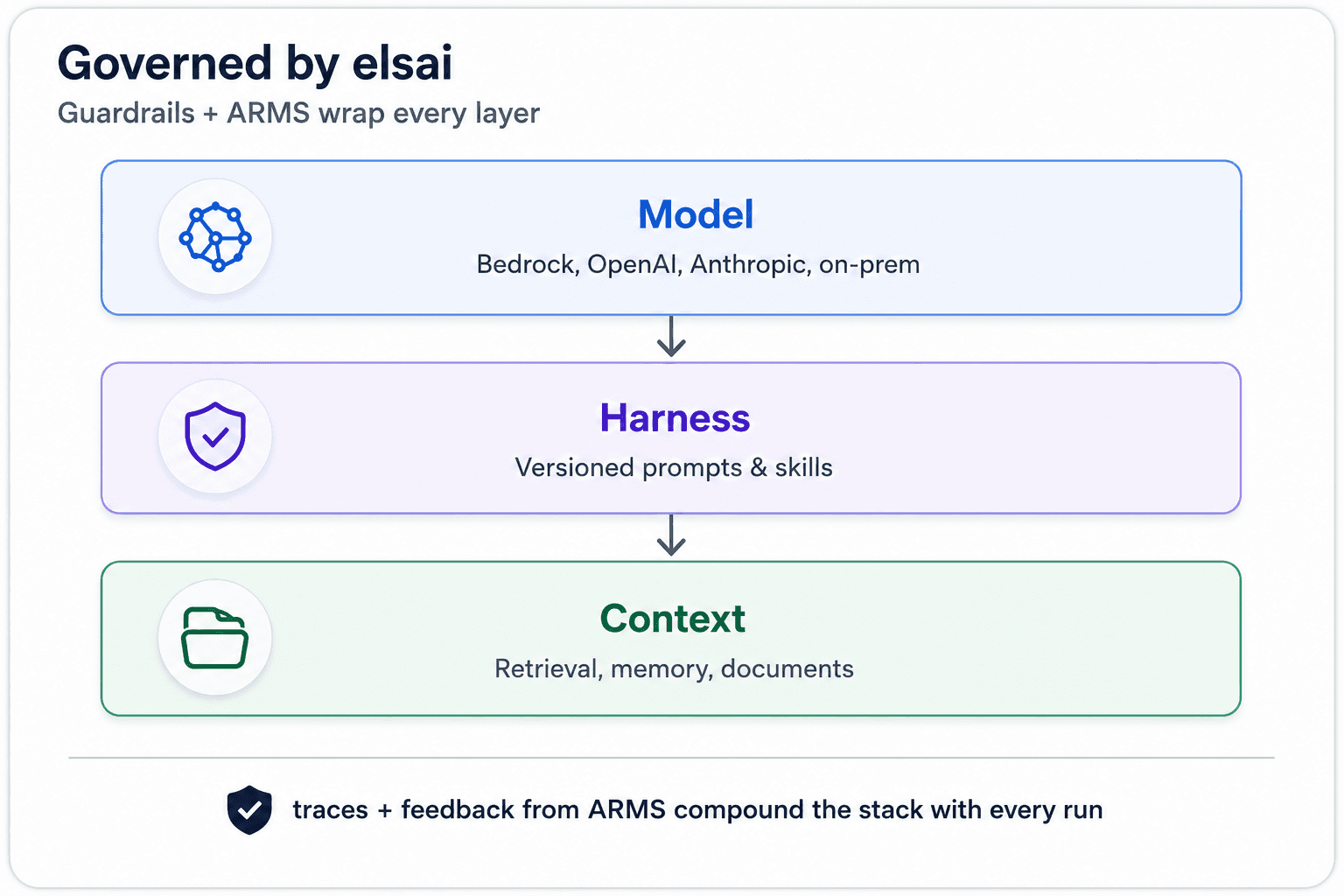
The model layer: sovereignty as a deployment choice, not a slogan
elsai is built LLM-agnostic and cloud-agnostic on purpose. The same governed workflow can run against AWS Bedrock, Azure OpenAI, Anthropic, Gemini, or a locally hosted model through Ollama or LiteLLM — and it can run on AWS, GCP, Azure, on-prem, or private cloud, including on-prem SLM deployment for organizations that cannot let certain data leave their own infrastructure.
That's what sovereignty means in practice: if a provider raises prices, deprecates a model, or simply isn't available in a region your data has to stay in, you switch — you don't rebuild. The workflow, the guardrails, and the audit trail stay exactly where they are.
The Harness layer: where your business logic actually lives
This is the layer most companies underestimate, and it's the one elsai names explicitly. The Harness is the scaffolding of reusable, versioned prompts and skills that turns a general-purpose model into your prior-authorization reviewer, your claims analyst, or your compliance auditor. It's where your escalation logic, your tone, your domain vocabulary, and your institutional judgment get encoded — not as a one-off prompt someone wrote six months ago, but as a governed asset a domain expert can open, edit, and version without touching application code.
If your harness is closed — if you can't see or change the logic that decides what your agent does with a given input — you don't actually control your agent. You're renting someone else's assumptions about how your business should run.
The context layer: elsai Core
Context is what makes a model specific to you: your documents, your policies, your historical cases, your organizational memory. elsai Core is where that lives — retrieval, embeddings, vector stores, Graph RAG, and document processing, connected to the systems that already hold your data (SharePoint, PostgreSQL, S3, Azure Blob, Textract and Mistral OCR for anything still trapped in scanned paperwork). Own this layer, and every agent you build draws from the same accumulated institutional knowledge instead of starting cold.
Model, Harness, Context — control all three, and you control how intelligence behaves. Outsource any one of them, and you've outsourced the part of the system where your actual advantage was supposed to live.
Own the economics, the quality, and the risk
Once agents are doing real work, they need to be managed like any other operating system — with visibility into what they cost, how well they perform, and where they're allowed to act on their own.
Cost is the first thing that gets away from teams. Multiple model calls, long contexts, retries — spend adds up fast without per-agent, per-user visibility. ARMS, elsai's Agent Resource Management System, tracks token consumption, latency, and cost for every run, so spend is a dashboard, not a surprise on next month's invoice.
Quality has to be measured, not assumed. elsai's evaluation layer — datasets built from real and edge-case scenarios, a metrics library, experiment suites, and LLM-as-judge scoring — exists so that a prompt change, a model swap, or a new tool doesn't ship on faith. If you can't tell whether the new version is better, you can't actually own its improvement.
Risk is where Guardrails do the work. Every input and output gets checked in real time for toxicity, hallucination, PHI/PII exposure, jailbreak attempts, and prompt injection — at sub-100ms latency, blocking violations at execution rather than flagging them after the fact. Human-in-the-loop routing sends anything high-risk or low-confidence to a named reviewer automatically, and every one of those escalations is logged: who reviewed it, what they decided, and when.
Put together, this is what turns "the agent gave an answer" into "we can show exactly why, and we controlled what it was allowed to do."
Compound it: the 100th run should beat the first
The whole point of owning this loop is that the system gets better with use, and you're the one who owns the improvement, not a vendor's black box.
ARMS captures the trace of every run — what context the agent saw, what tools it called, where it struggled. Guardrail violations and human review decisions attach feedback to those traces. That combination — trace plus feedback — is the raw material for the next iteration: a new evaluation case, a revised skill in the Harness, an updated prompt pushed through the Instruction Manager with full version history and instant rollback if it underperforms.
None of that learning is trapped inside one model. Because the harness, the context, and the governance layer are yours, that accumulated judgment ports forward even if the underlying model changes next quarter.
A checklist for owning your intelligence on elsai
• If a better model shipped tomorrow, could you switch to it without rebuilding your workflow?
• If your current model provider deprecated a model, could you host an alternative on your own infrastructure instead?
• Can you open your Harness and see exactly what logic, prompts, and skills are driving each agent decision?
• Can you run the same governed workflow on AWS, on Azure, and fully on-prem, without three separate builds?
• Can you see AI spend broken down by agent, team, or user — not just a total bill?
• If a regulator or auditor asks why an agent approved or denied something, can you produce the full trace and the policy that authorized it?
• Do you have evaluation datasets in place so a model or prompt change gets tested before it reaches production?
• Will the agent your team uses on day 100 be measurably better than the one they used on day one?
• When your agents learn something, is that improvement stored somewhere you own — not locked inside a single vendor's session history?
• Do you control which actions require human review, and can you change that boundary yourself?
Buy the generic, own the compounding
Nobody needs to build their own foundation model, their own GPU fleet, or their own vector database from scratch. That layer is commodity, and buying it is the right call.
What you can't outsource is the layer where advantage actually accumulates: the Harness that encodes how your business thinks, the governance that makes every action defensible, and the feedback loop that makes the whole system sharper with every case it handles. That's the part elsai is built to keep in your hands — on your cloud or on-prem, on the model of your choosing, with the full trace to prove it.
Generic intelligence is available to everyone. Owned intelligence — sovereign, governed, and compounding — is the only kind that's actually yours.
Recent blogs


We’d love to chat with you about how your team can secure and govern Ai agents everywhere