
From Fragmented Systems to Agent-Ready Data: A Data Readiness Roadmap for Data for AI Adoption

Most enterprise AI projects do not fail because the agent is not capable. They fail, or quietly stall, because the data underneath the agent was never ready. An organisation buys or builds an impressive AI agent, points it at the business, and discovers that the information it needs to reason is scattered across a dozen systems, trapped in PDFs and spreadsheets, inconsistent between departments, and governed by no one. The agent is ready. The data is not. That gap, between an organisation's ambition and the state of its own information, is a data readiness problem, and it is the single most common reason enterprise AI does not make it to production.
The pattern is familiar to any data or platform leader. A promising pilot works on a clean, curated dataset, then falls apart from the moment it meets the real estate of ERP exports, CRM records, scanned contracts, shared drives, and departmental databases that do not agree with each other. The problem is not the model; it is the data silos and the unstructured data the model must work through, and no amount of prompting fixes data that was never unified or structured in the first place. Industry analyses of agentic AI projects point to the same culprit: a large share is expected to be abandoned, and poor data readiness is near the top of the reasons why.
This is why data readiness has moved from a back-office concern to a board-level priority. Agents raise the stakes on data quality because an agent does not just display bad data on a dashboard for a human to sanity-check; it reasons and acts on it. A flawed enterprise data strategy that an organisation could tolerate in the dashboard era becomes a liability in the agentic one. A robust enterprise AI platform depends on reliable, governed, and accessible data to support effective agentic workflows. The good news is that data readiness is not an all-or-nothing state you either have or do not; it is a ladder you climb, and there is a practical roadmap for climbing it.
This blog lays out that roadmap: why agents are only as good as the data beneath them, the five levels of data readiness from fragmented to agent-ready, the four practical steps to move up the ladder, and how a unified data layer closes the gap, without ripping out the systems you already run. It is written for the data, platform, or IT leader who owns the question of whether the enterprise is ready for the agents it wants to deploy.
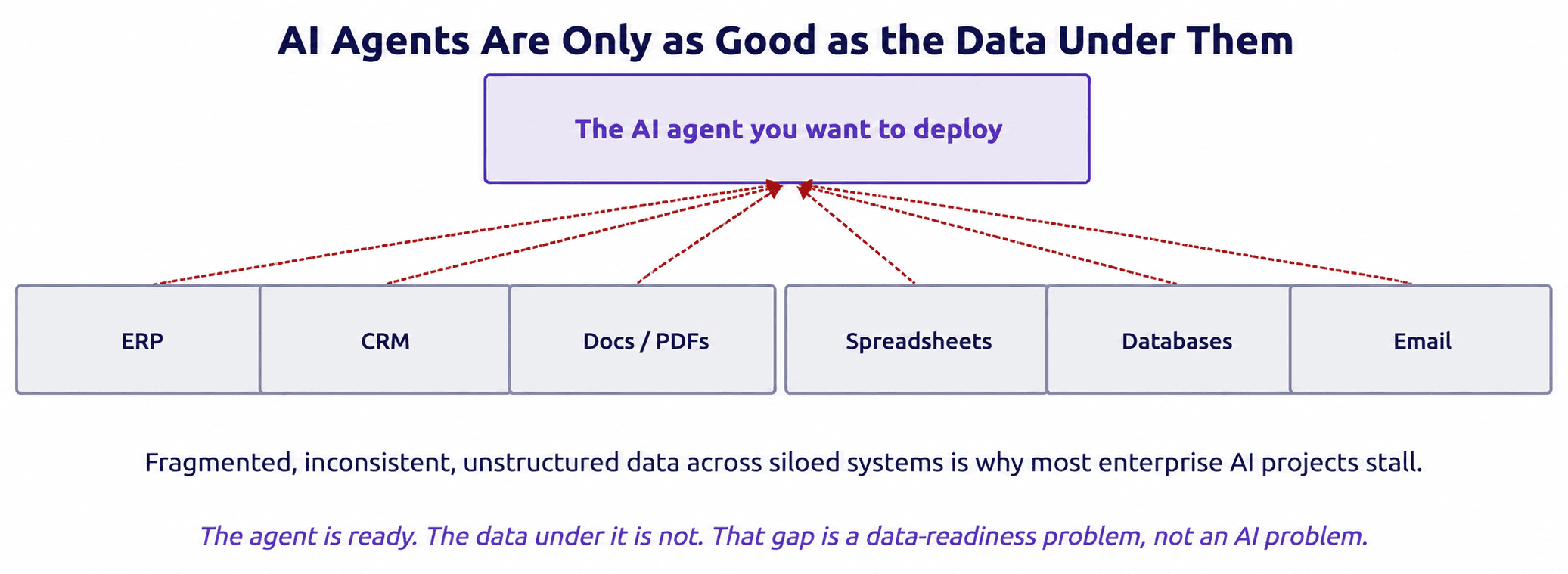
Enterprise AI rarely stalls on the model. It stalls on the data the model was given to work with.
Why Agents Are Only as Good as the Data Beneath Them
An AI agent is a reasoning and action system, and both depend entirely on the quality and structure of the data it can reach. A human analyst can compensate for messy data, cross-checking a suspicious number, chasing down a missing document, applying judgment to an inconsistency. An agent largely cannot, unless that judgment has been designed into it, so it inherits every gap, duplication, and inconsistency in the underlying data and acts on them at speed. This is why data quality and data governance stop being hygiene factors and become the determinant of whether an agent is trustworthy at all.
The practical consequence is that the hardest and most valuable work in enterprise AI is usually not building the agent; it is getting the data into a state the agent can reason over. This is especially important for AI agent platform for enterprise, where agents need reliable, accessible, and well-governed information to retrieve context and support decisions. That work is unglamorous, which is exactly why it is so often skipped, and why so many pilots that dazzle on curated data collapse on real data. Treating data readiness as the first-class problem it is, rather than an afterthought behind the agent, is the shift that separates enterprises that get AI into production from those that keep piloting.
The Five Levels of Data Readiness
Data readiness is best understood as a maturity ladder. Knowing which rung the enterprise is on turns a vague sense that the data is not ready into a specific, addressable gap.

At level one, data is fragmented, scattered across silos, formats, and departments with no unification. At level two it is accessible, the sources are connected but the data is still raw and inconsistent. At level three it is structured, parsed and normalised into a consistent form. At level four it is contextual, linked in a knowledge graph so the relationships between entities, a supplier and its contracts, a patient and their records, a part and its suppliers, are understood, not just stored. And at level five it is agent-ready: unified, governed, and queryable, so an agent can reason across it reliably. Most enterprises sit at level one or two and want to deploy agents that need level five, and the distance between those two is the work the roadmap organises. The value of the ladder is that it lets a data leader say precisely where the organisation is and what the next rung requires, rather than treating data integration as one undifferentiated mountain.
A Four-Step Roadmap to Agent-Ready Data
Climbing the ladder is a staged process, and the important point is that you do not need to complete all of it before you see value, you start where the operational pain is highest and build out. The roadmap has four steps, and each is a milestone a data readiness assessment can measure.

Step 1, Assess
Begin by mapping the terrain: which sources hold the data an agent would need, in what formats, with what gaps, duplications, and governance status. A data readiness assessment produces an honest picture of the current level and identifies the specific workflow where readying the data would release the most value. This is where you decide where to start, rather than trying to fix everything at once.
Step 2, Connect
Unify the fragmented sources into one layer. This means connecting the systems where the data already lives, the ERP, the document stores, the databases, the shared drives, so the data can be worked with together rather than in isolation. The goal is not to migrate everything into a new repository; it is to reach the data where it is and bring it into a common layer, which is how you dissolve data silos without a costly rip-and-replace.
Step 3, Structure and extract
Turn raw and unstructured data into something an agent can use. Documents and PDFs are parsed and their content extracted into structured form, records are normalised into a consistent shape, and the entities and relationships are linked into a knowledge graph so the data carries context, not just values. This is the step that moves the organisation from merely accessible data to structured and contextual data, levels three and four of the ladder.
Step 4, Govern and serve
Finally, make the unified, structured data queryable, governed, and ready for agents to use. Governance is not a final coat of paint; it is what makes the data safe for an agent to act on, access controls, audit trails, and traceability so you can see what the agent read and why it acted. Strong data governance at this step is what turns a technically unified dataset into a genuinely AI ready data layer that an agent, and the people supervising it, can trust.
Closing the Gap With a Unified Data Layer
Executing that roadmap with a stack of separate tools, one for integration, one for OCR, one for the knowledge graph, one for governance, is itself a project most data teams do not have the capacity to assemble and maintain. The more direct path is a single data layer that does the unifying, structuring, and governing as one capability, on top of the systems the enterprise already runs. This is what elsai Data for AI is built to be: it unifies fragmented sources and systems into an AI ready data layer for decision intelligence, so agents work on unified enterprise data rather than raw silos.
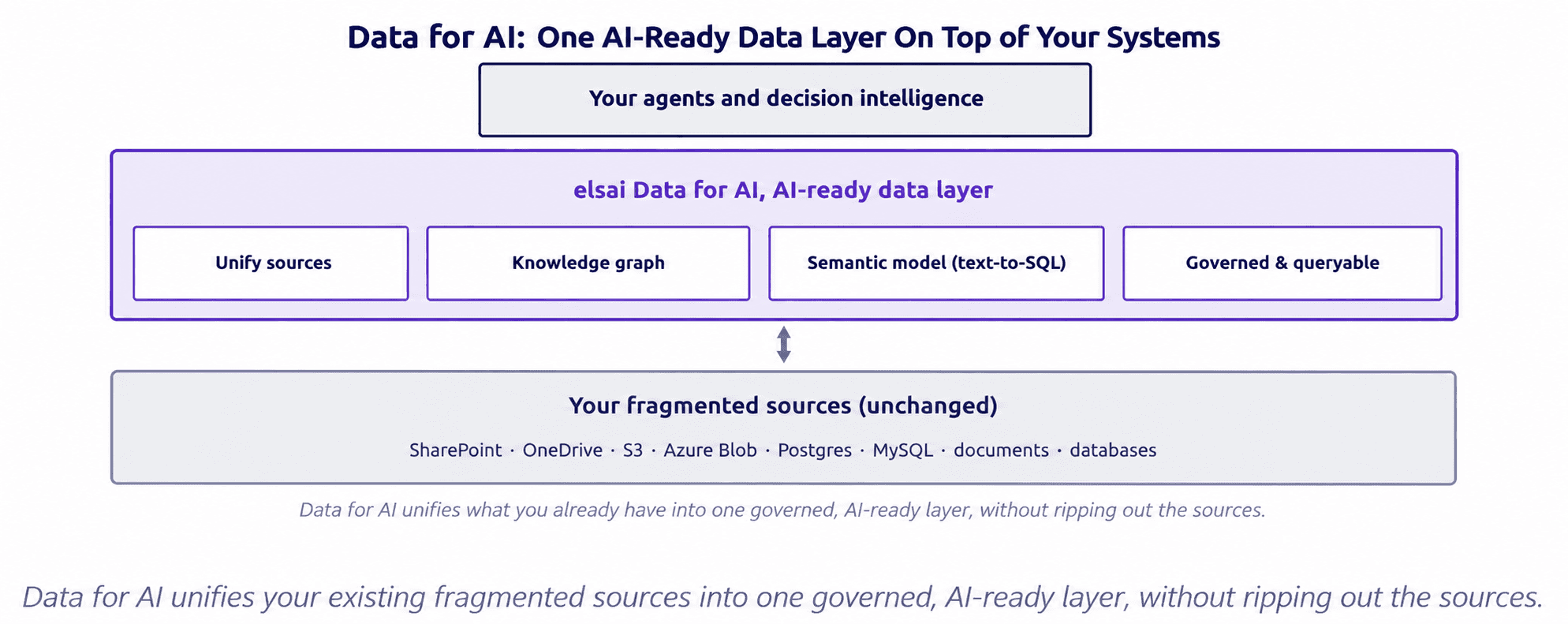
In practice, Data for AI connects to the sources an enterprise already has, document stores like SharePoint and OneDrive, object storage like S3 and Azure Blob, and databases like Postgres and MySQL, and turns them into one queryable layer. It builds knowledge graphs that span documents, databases, and even codebases, and provides a semantic model that lets a question in plain language be answered as a query over the connected databases (text-to-SQL), so the data is not just unified but usable. Document parsing and extraction turn the unstructured material into structured, AI-ready data. Because it operates as a layer on top of the existing systems rather than a replacement for them, an enterprise closes the readiness gap without a data-migration programme, which is what makes agentic AI platforms enterprise knowledge management realistic rather than a multi-year rebuild. And because it runs on the organisation's own infrastructure, on-premises or in its own cloud, the data never has to leave the enterprise boundary to become agent-ready.
Ready the Data, and the Agents Follow
The enterprises that succeed with AI agents are not the ones with the cleverest models; capable models are now available to everyone. They are the ones that did the less glamorous work of making their data ready, moving it from fragmented and siloed to unified, structured, governed, and queryable, so the agents they deploy can actually reason on the business as it really is. A data readiness roadmap is how that work gets organised into a staged, measurable plan instead of an open-ended cleanup, and it is the highest-return investment most enterprises can make before scaling agents at all.
This is the gap elsai Data for AI is designed to close, as the data foundation of the elsai platform. It unifies your fragmented sources and systems into one governed, AI-ready data layer, builds the knowledge graphs and semantic model that let agents reason and query across your enterprise data, and runs on your own infrastructure so nothing leaves your boundary. It sits on top of the systems you already use rather than replacing them, which is what turns a daunting data-readiness programme into a staged rollout you can start this quarter. For a data or platform leader who wants the enterprise genuinely ready for the agents it plans to deploy, rather than piloting forever on curated data, that unified data layer is where to begin. It is also what makes an enterprise AI agent platform and the AI agent platform for enterprise roadmap behind it deliver in production rather than in the demo. Explore the data wider platform at elsai.ai/platform.
FAQ
What does data readiness mean for AI agents?
Data readiness is the degree to which an enterprise's data is unified, structured, governed, and queryable enough for an AI agent to reason and act on reliably. It runs on a ladder from fragmented data scattered across silos, up through accessible, structured, and contextual, to agent-ready: one unified, governed layer an agent can trust. Most enterprises are at the bottom of that ladder and want to deploy agents that need the top.
Why do AI projects stall on data rather than the model?
Because capable models are now widely available, while the data they need is usually fragmented across systems, trapped in documents, and inconsistent between departments. A pilot on curated data works; the same agent fails on the real estate of ERP exports, scanned contracts, and departmental databases. The hard, valuable work is readying the data, which is unglamorous and therefore often skipped, and that is where projects stall.
Do we have to migrate all our data into one system to become agent-ready?
No. The practical approach is a layer that connects to the sources where your data already lives, documents, object storage, databases, and unifies them into one governed, queryable layer, rather than a migration into a new repository. This dissolves the silos without a rip-and-replace, and it is why a unified data layer is faster and less costly than consolidating everything into a single platform.
What is the role of a knowledge graph in data readiness?
A knowledge graph moves data from merely structured to contextual: it links entities and their relationships, a supplier and its contracts, a patient and their records, so the data carries meaning an agent can reason over, not just values in tables. It is the difference between an agent that can look up a field and one that can understand how the pieces of your business relate, which is what agentic reasoning requires.
How does a unified data layer keep our data governed and secure?
By building governance into the layer itself: access controls, audit trails, and traceability over what is read and how it is used, and by running on the enterprise's own infrastructure so the data does not leave the boundary. Strong governance is what makes unified data safe for an agent to act on, and it is the step that turns a technically integrated dataset into one a regulated enterprise can actually put agents on.
See how elsai helps enterprises build a unified, governed, agent-ready data foundation for AI.
Request free demo →


We’d love to chat with you about how your team can secure and govern Ai agents everywhere
Get a demo →