

Defence and aerospace suppliers lose more time to proving compliance than almost any other part of a bid. Industry research puts the scale of it plainly. Deloitte's analysis of aerospace and defence supply chains has repeatedly flagged compliance and traceability as among the sector's heaviest administrative burdens, and McKinsey estimates that procurement teams still spend well over half their time on manual, low-value coordination rather than sourcing decisions. A widely cited Hackett Group benchmark finds procurement workloads rising faster than headcount year on year, which means the gap between what a bid demands and what a team can prove is widening, not closing.
For local-content compliance specifically, that burden concentrates at the worst possible moment. Proving where content originates means assembling evidence from across a supplier base right when a bid deadline or an audit is bearing down, and when the evidence lives in email and spreadsheets, that reconstruction routinely costs teams several days they do not have. The result is bids submitted late, or won on price but exposed on compliance. This is not a sourcing problem. It is an evidence and coordination problem, and that is exactly the kind of problem procurement intelligence is built to remove.
The problem: local-content proof lives everywhere except where you need it
Defence contracts increasingly require suppliers to prove local content, that a defined share of the work, the parts, or the value originates domestically or within an approved supplier base. The requirement is clear. Proving it is not, because the evidence behind it is scattered. Each subcontractor holds part of the story: a certificate here, a declaration there, an origin document in someone's inbox, a qualification record in a spreadsheet that may or may not be current.
When a bid deadline arrives, the team has to pull all of that together into a defensible pack, fast. In practice that means chasing subcontractors for documents, checking each one against the content requirement by hand, and hoping nothing has expired since it was last filed. It is slow, it is error-prone, and it happens under exactly the time pressure that makes mistakes most likely. The same scramble repeats at audit, when an inspection asks the supplier to show how it met the requirement and the evidence has to be reconstructed all over again.
The root cause is familiar to anyone in defence supply chain work: supplier operations are disconnected, compliance validation is manual, and monitoring is reactive, so gaps and expiries surface too late. Local-content compliance is just the sharpest version of that problem, because the deadline is a bid you either win or lose.

The Solution: Assemble the Proof as You Go, Not in a Scramble
The fix is to stop treating local-content evidence as something you reconstruct at bid time and start treating it as something the workflow assembles continuously. An agentic procurement workflow does exactly that. As suppliers are onboarded and managed, agents ingest their documents, extract the fields that matter, validate them against the content requirement, and keep the evidence pack current, so when a bid or an audit arrives, the proof is already assembled and traceable to its source.

Walking the coverage: the workflow ingests supplier documents, certificates, and origin declarations from wherever they live. It extracts more than forty fields from each, flagging any low-confidence item for a human rather than guessing. It validates the content against the requirement, checking that the documentation actually supports the claim. It assembles the evidence into a pack where every data point traces back to its source document. And it monitors continuously, tracking certificate and licence expiry so a supplier that drifts out of compliance is caught before the lapse becomes a finding. Onboarding that used to take 5 to 15 days compresses to under 24 hours, and the audit trail that used to take 3 to 10 days to rebuild is inspection-ready in minutes.
Two design points make this trustworthy for defence work. The evidence is traceable end to end, so nothing in the pack is an unsupported assertion. And the human keeps the final sign-off: agents assemble and validate, but the decision to certify compliance stays with an authorised person, with their approval recorded. Automation carries the scramble; people keep the judgment.
Product fit: the sourcing and contract intelligence that cover this
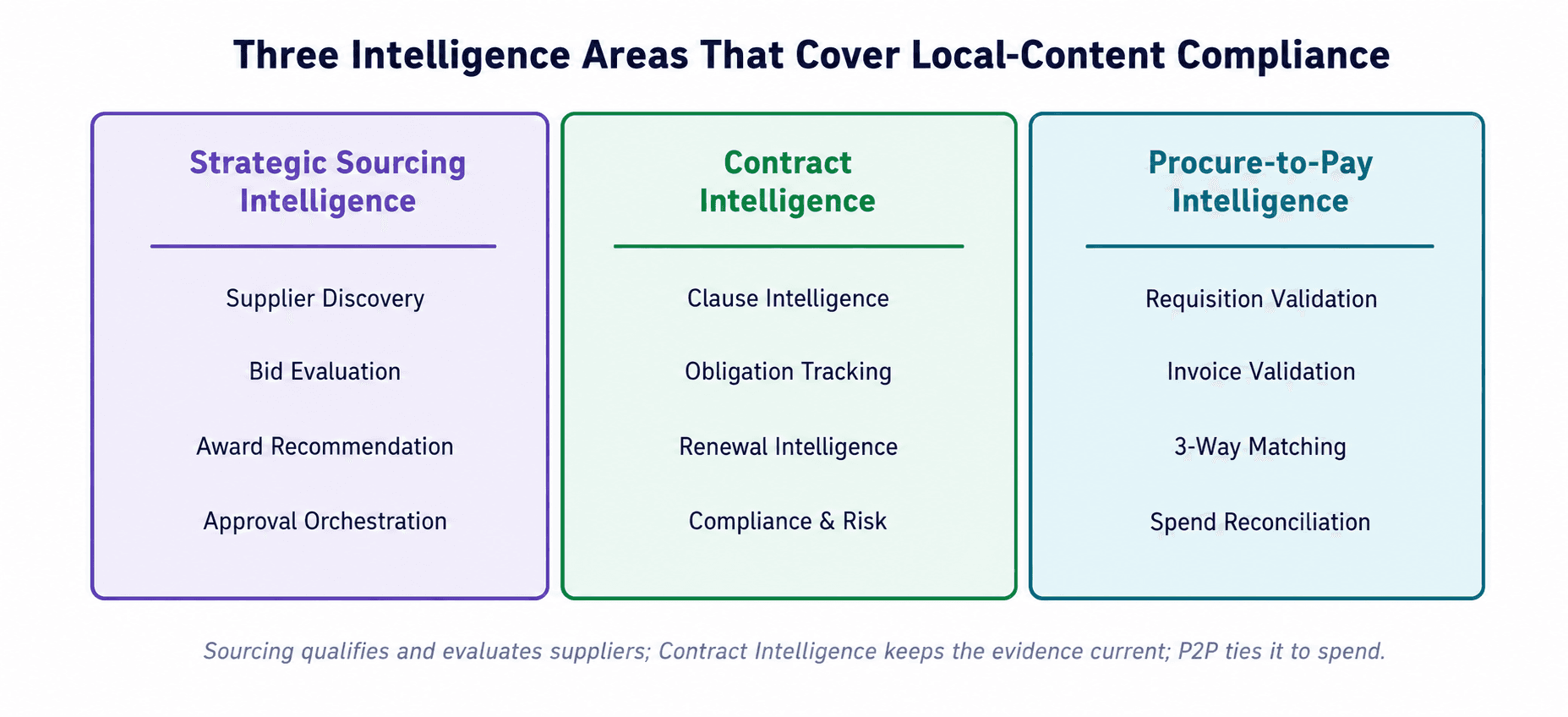
Proving local content is not one task, it is three connected ones: qualifying and evaluating the suppliers behind the content, keeping the contractual evidence current, and tying it all back to what was actually bought and paid for. An agentic procurement layer covers those through three intelligence areas that work across the ERP and procurement stack, and two of them do the heavy lifting for local-content compliance.
Strategic sourcing intelligence
This is where the local-content story begins, because it is where suppliers are qualified and chosen. Its agentic workflows run RFx and tender management, supplier discovery and shortlisting, bid collection and normalization, bid evaluation across commercial, technical, and risk dimensions, award recommendation, negotiation intelligence, and approval orchestration. For local content, the workflows that matter most are supplier discovery and shortlisting, which surface qualified domestic or approved-base suppliers, and bid evaluation, which weighs each bid against the content requirement alongside price and technical fit. The award recommendation and approval orchestration then keep the decision documented and routed to the right authority.
Contract intelligence
Once a supplier is selected, Contract intelligence keeps the local-content evidence live rather than letting it drift. Its workflows cover contract draft review, clause intelligence, contract comparison, approval workflow, obligation tracking, renewal intelligence, and compliance and risk monitoring. For local content, obligation tracking and compliance and risk monitoring are the workhorses: they watch the content commitments and the certificates behind them, and renewal intelligence makes sure a qualified supplier does not quietly lapse between the bid and the audit. Clause intelligence flags where a contract’s local-content terms sit and whether they are being met.
From manual scramble to standing proof
elsai is the intelligence layer that works across your ERP and procurement ecosystem to orchestrate governed agentic workflows for strategic sourcing, contract management, and procure-to-pay operations. Rather than replacing SAP, Oracle, Ariba, or Coupa, it continuously interprets enterprise data, automates the operational work, recommends decisions, and routes approvals with full auditability. For a defence supplier, that is precisely what turns local-content proof from a scramble into a standing, inspection-ready record: the sourcing workflows qualify and evaluate the suppliers, the contract workflows keep the obligations and certificates current, and every recommendation, action, and approval is logged and traceable through ARMS, the audit layer.
The positioning point that matters most for defence is sovereignty. Because the platform runs inside the supplier's own environment, on-premises or air-gapped if required, the supplier's data, its supplier intelligence, and its compliance record stay within its own walls and under its own control. For defence procurement, where controlled data cannot leave the organisation and traceability is non-negotiable, that combination, continuous evidence assembly, full traceability, and sovereign deployment, is what makes elsai a fit rather than a risk. Reported outcomes across these procurement workflows include an 80 to 90 percent reduction in document preparation time, a 70 to 85 percent reduction in procurement cycle time, and 95 percent-plus audit readiness, with every decision traceable. Request a demo to see how elsai can support governed procurement workflows, vendor onboarding, due diligence, and end-to-end auditability.
The suppliers who win defence work faster in the years ahead will not be the ones with the biggest compliance teams. They will be the ones who stop treating local-content proof as a fire drill and make it a by-product of how procurement already runs, assembled continuously, traceable on demand, and ready when a bid or audit calls for it. Request a demo to see how elsai can help make that shift from scrambling for evidence to always having it.
FAQ
How does agentic procurement speed up proving local-content compliance?
It assembles the evidence continuously as suppliers are onboarded and managed, rather than reconstructing it at bid time. When a bid or audit arrives, the evidence pack is already built and traceable to its source documents, so the team is not spending 3 to 10 days rebuilding a compliance trail from email under deadline pressure.
Does the AI decide whether a supplier meets the local-content requirement?
It does the assembly and validation, checking documents against the requirement and flagging gaps, but the decision to certify compliance stays with an authorised person, whose approval is recorded. The workflow removes the manual scramble; the human keeps the judgment and the accountability.
Will it work with our existing ERP and procurement systems?
Yes. The workflow connects to the ERP, procurement, and finance systems already in place, such as SAP, Oracle, and Coupa, and runs across them rather than replacing them. A supplier can start with subcontractor management, the workflow closest to local-content proof, and extend from there.
Can it run inside a secure or sovereign environment for defence work?
Yes, and for defence suppliers that is often the deciding factor. The platform can run inside the supplier's own environment, on-premises or air-gapped, so controlled data and supplier intelligence stay within the organisation's own walls, with the full audit trail held under its control.
How does it stop a qualified supplier from lapsing between bid and audit?
The workflow monitors compliance continuously, tracking certificate and licence expiry and supplier drift, and flags an issue the moment a supplier falls out of standard. That means a lapse is caught and corrected before it becomes an audit finding, rather than discovered after the fact.


We’d love to chat with you about how your team can secure and govern Ai agents everywhere
Get a demo →