

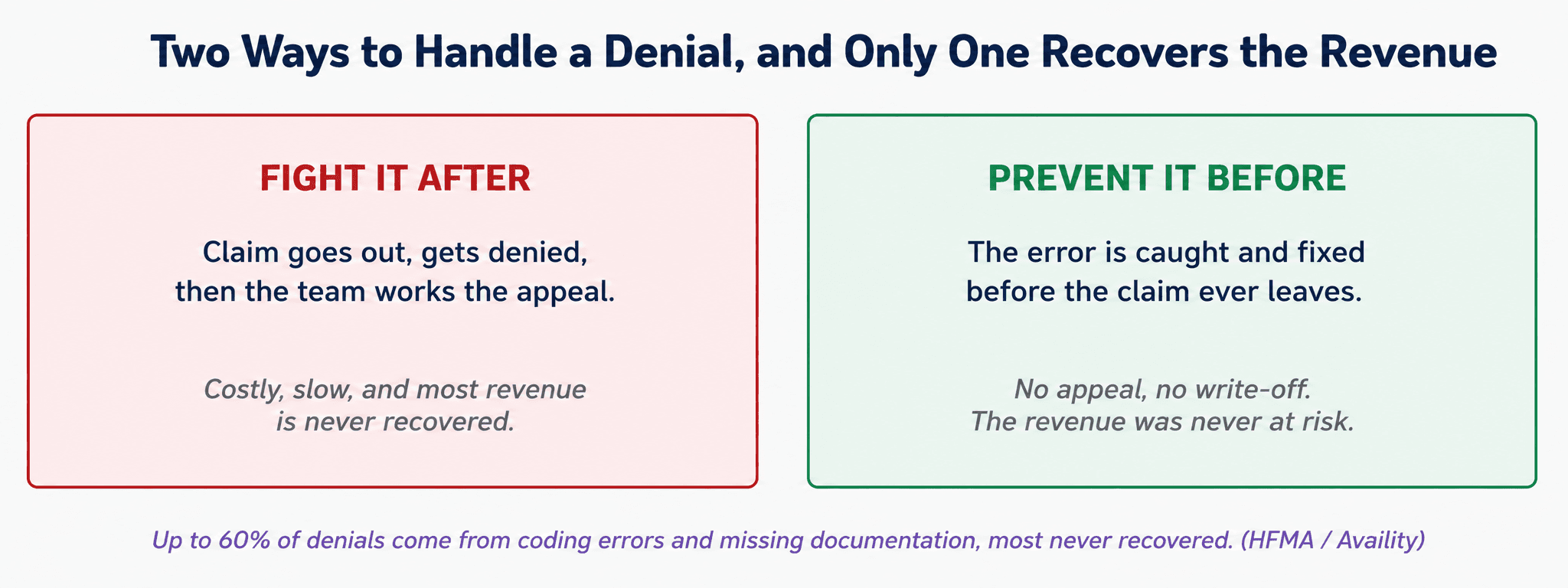
Revenue cycle leaders understand the financial impact of preventable denials. Industry studies estimate that up to 60% of denials are linked to documentation and coding issues. Industry analysis from HFMA and Availity has put that figure in front of the sector for years, and the McKinsey and CMS estimate of 8.3 billion dollars lost annually to administrative waste sits right behind it. For a VP of Revenue Cycle, those are not abstract numbers. They are the write-offs on this month's report.
Many organizations respond by expanding denial-management operation: more staff working appeals, faster rework, sharper follow-up. That helps at the margin, but it is addressing denials after they occur. The denials that actually protect revenue are the ones that never happen, because the error was caught before the claim went out. This is the shift from denial management to denial prevention, and for the teams that make it, the cheapest denial to recover is the one they never had to fight.
Why denial management will always lose ground
Back-end denial management is a losing race by design. By the time a denial arrives, the claim has already been submitted, adjudicated, and rejected, and the clock on timely-filing and appeal windows is running. The team has to diagnose why it was denied, gather the documentation that should have been there the first time, rework the claim, and resubmit it, all while new denials keep landing in the queue. Even a strong denial-management team recovers only a fraction of what was denied, and every hour spent on appeals is an hour not spent preventing the next batch.
The deeper problem is that denials are a lagging signal. A denial rate tells you what already went wrong weeks ago, at the point of service or in coding, long before the claim was rejected. Managing denials means managing the symptom. The revenue leakage that a revenue integrity leader actually wants to stop happens upstream, at eligibility, at documentation, at coding, and it can only be stopped there. That is why the highest-performing revenue cycles have been moving their attention to the front end, where a clean claim is made rather than a denied one is repaired.
What prevention actually looks like before a claim goes out
Denial prevention is not a mindset or a training initiative. It is a set of concrete checks that run on every claim before it is ever submitted, catching the specific errors that cause denials while the claim can still be fixed. An agentic revenue cycle workflow runs those checks automatically, so a claim only leaves the building once it is clean, and the ones that are not clean are flagged and corrected first rather than sent out to be denied.

Eligibility and authorization, confirmed up front
A large share of denials are eligibility and authorization failures that were knowable before the patient was ever seen. The workflow verifies coverage and confirms the prior authorization is in place at the front of the process, so a claim is never built on a service the payer was never going to cover. For a VP of Patient Access, this is where prevention starts, because a denial avoided at registration never reaches the billing office at all.
Documentation that supports what is billed
Missing or mismatched documentation is one of the two largest denial drivers. The workflow checks that the clinical record actually supports the service being billed before the claim is assembled, flagging the gap while it can still be closed with the provider rather than after a payer has rejected it. This is the documentation integrity that revenue integrity teams spend their days chasing, moved to the point where it prevents a denial instead of explaining one.
Coding accuracy, validated before submission
Coding errors are the other major driver, and they are the most preventable. The workflow generates ICD-10, CPT, and HCC codes with a confidence score on each and validates them against NCCI edits before the claim goes out, so the coding mistake that would have triggered a denial is caught at the source. Low-confidence codes route to a human coder rather than going out unchecked. The coder's judgment stays in the loop exactly where it adds value, on the cases that need it, while the routine, clean codes flow through.
A claim that clears eligibility, documentation, and coding before it leaves is a denial that never gets written.
What this changes for the revenue cycle team
For the leaders who own the denial number, prevention changes the shape of the operation rather than just the size of the appeals queue. The denial rate falls because the denials are being stopped at the source, and net collections rise on the same staff, because the team is no longer losing a fraction of every denied dollar to write-offs. The clean claim rate and first pass yield, the metrics that actually predict cash, climb instead of holding flat.
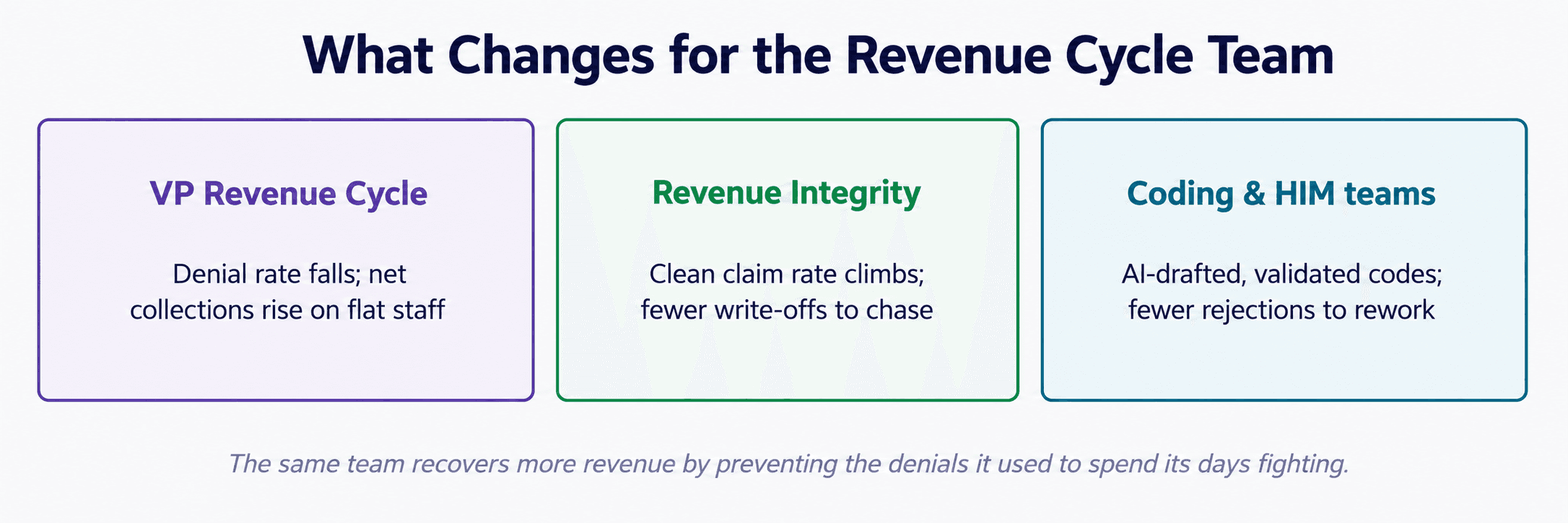
The work changes for everyone who touches the claim. Revenue cycle staff spend less of their week on payer follow-ups and appeals, because there are fewer denials to work. Revenue integrity teams see the clean claim rate rise and have fewer write-offs to chase. Coding and HIM teams get AI-drafted, validated codes and fewer rejections coming back for rework. And critically, the clinical and denial-risk judgment stays with people: the workflow prepares and validates, but the calls that need a coder, a physician, or a revenue integrity specialist go to them, with the case already documented.
Why this has to run inside your existing revenue cycle
A denial-prevention workflow is only useful if it works inside the revenue cycle a health system already runs. The realistic design connects to the EHR and RCM systems that hold the encounter, the eligibility feeds, and the payer rules, Epic, Cerner, athenahealth, eClinicalWorks and other leading EHR platforms, and runs the pre-submission checks across them without asking anyone to replace their system of record. For an enterprise health system or a physician group with a centralized revenue cycle, that is the difference between a capability that ships in weeks and one that stalls in a two-year platform migration.
Because it handles protected health information, the workflow runs inside the organization's own environment, and every validation is logged with its source, applied rule, and supporting rationale. is logged with its source and reasoning, so a denial that was prevented, or a code that was changed, is fully traceable. For a revenue integrity or compliance leader, that audit trail is what makes pre-submission automation safe to trust: the decision to prevent a denial is documented as clearly as the decision to submit a claim. Reported outcomes across elsai healthcare workflows include a 15 to 30 percent reduction in denial rates, a 40 to 60 percent reduction in turnaround time, and a 30 to 50 percent reduction in manual effort, with every decision traceable.

Stop recovering denials. start preventing them.
The revenue cycle teams that pull ahead over the next few years will not be the ones with the biggest denial-management operations. They will be the ones that quietly shrank those operations, because they moved the work upstream and stopped the denials before the claims went out. That is a different way to run a revenue cycle: not a bigger back end fighting a rising tide of rejections, but a front end that sends out clean claims in the first place.
This is where elsai runs the revenue cycle, as a set of governed agents that verify eligibility and authorization, validate documentation, and generate and check coding before a claim is ever submitted, all inside your existing EHR and RCM environment and with complete traceability. The denials get prevented, the clean claim rate climbs, and the revenue that used to leak out through write-offs simply stays. The team keeps the judgment calls that need a person and hands off the repetitive checks that never should have needed one. If your revenue cycle is still built to fight denials after they happen, the bigger opportunity is the denials you never have to fight at all. Request a demo to see how elsai’s governed AI agents can automate healthcare workflows, including prior authorization.
FAQ
What is the difference between denial prevention and denial management?
Denial management works denials after they happen: diagnosing the rejection, reworking the claim, and appealing. Denial prevention stops the denial before the claim is submitted, by catching the eligibility, documentation, or coding error while it can still be fixed. Management recovers a fraction of denied revenue; prevention keeps the revenue from being denied in the first place.
Which denials can actually be prevented before a claim goes out?
The two largest categories, coding errors and missing or mismatched documentation, are highly preventable, and so are eligibility and authorization failures that are knowable at registration. Together these account for a large share of denials. Pre-submission checks on eligibility, documentation, and coding catch them at the source, before the claim leaves.
Does the AI replace our coders and revenue cycle staff?
No. The workflow generates and validates codes and runs the pre-submission checks, but low-confidence codes and any case that needs judgment route to a human coder or revenue integrity specialist. The routine, clean work flows through automatically, and your team's expertise is focused on the cases that genuinely need it, with each case already documented.
Will this work with our EHR and RCM platform, or do we have to replace them?
It connects to them. The workflow integrates with the EHR and RCM systems already in place, such as Epic, Cerner, athenahealth, and eClinicalWorks, and runs the pre-submission checks across them. Nothing is replaced, and an organization can start with prior authorization or coding validation and expand across the front end from there.
How do we know a prevented denial was handled correctly?
Every check the workflow runs is logged with its source and reasoning, so a code that was changed or a claim that was held for documentation is fully traceable. That audit trail gives revenue integrity and compliance leaders the same visibility over a prevented denial that they have over a submitted claim, which is what makes pre-submission automation safe to rely on.


We’d love to chat with you about how your team can secure and govern Ai agents everywhere
Get a demo →