
elsai team
Table of contents
Why traditional healthcare RCM models are under pressure
From EHR systems to intelligent AI agents
The growing role of AI in healthcare BPO
How AI agents will transform the prior authorization process
Why EHR systems become more powerful with AI
Governance and trust will define AI adoption
The future of healthcare RCM is collaborative intelligence
Final note
Healthcare organizations have spent the last decade digitizing patient information, operational records, and financial workflows through EHR systems. While these systems successfully centralized healthcare data, they did not fully eliminate the administrative complexity surrounding healthcare operations. Today, healthcare providers, payers, and Business Process Outsourcing (BPO) partners still struggle with fragmented workflows, rising administrative costs, workforce shortages, and growing reimbursement pressures.
The pressure on healthcare RCM teams is becoming more intense every year. According to a 2025 survey by Waystar, 92% of healthcare revenue cycle leaders identified AI and advanced automation as a top strategic priority for overcoming operational challenges such as claim denials, administrative inefficiencies, and payer-related delays.
The prior authorization process remains one of the biggest operational bottlenecks across healthcare systems. Research published in 2025 estimated that prior authorization creates a $35–45 billion annual administrative burden on the U.S. healthcare system, with over 40 million authorization requests processed each year. At the same time, the market for AI-powered healthcare prior authorization solutions is rapidly growing as organizations search for ways to reduce delays, administrative fatigue, and denial rates.
Despite widespread adoption of EHR systems, many healthcare workflows still depend heavily on manual coordination between clinical, operational, and financial teams. Tasks such as eligibility verification, coding validation, denial management, claims processing, and the prior authorization process often require staff to move across disconnected platforms while reviewing large volumes of documentation.
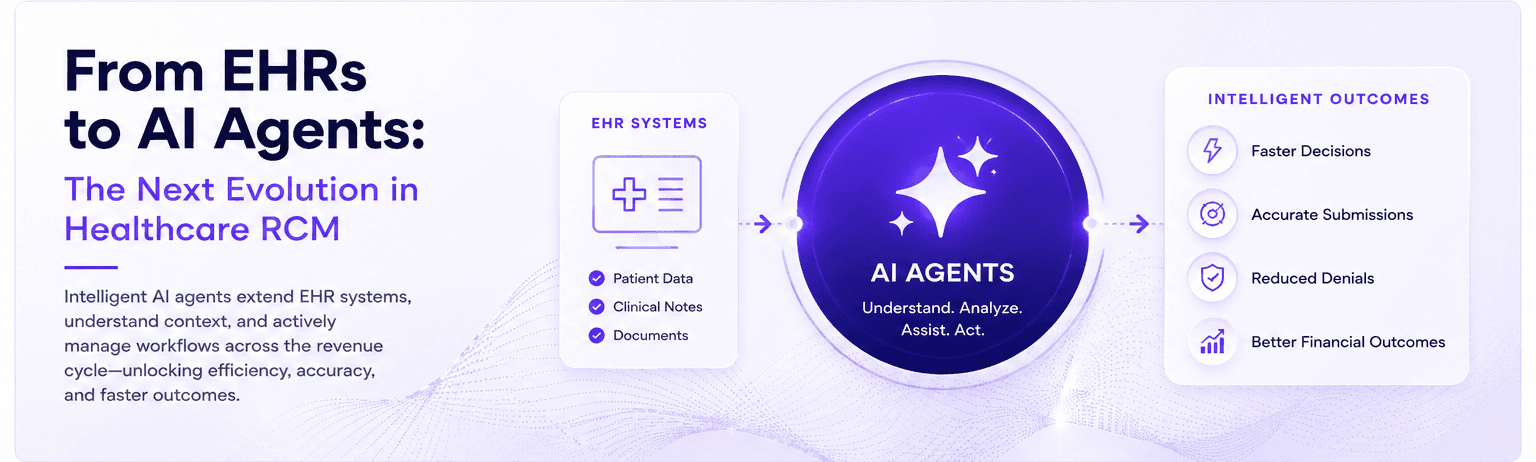
Over the next three years, healthcare organizations will move beyond traditional digital systems into a new operational model powered by AI agents. These AI-driven systems will not simply automate repetitive tasks. They will understand workflows, interpret clinical and financial context, assist operational teams, and proactively manage processes across healthcare ecosystems.
The shift from static EHR systems to intelligent AI-enabled operations is expected to redefine how healthcare BPO and healthcare RCM function in the near future.
Why traditional healthcare RCM models are under pressure
The healthcare industry is dealing with increasing financial and operational complexity. Providers are expected to improve patient care while simultaneously managing shrinking margins, rising labor costs, evolving payer rules, and growing administrative workloads.
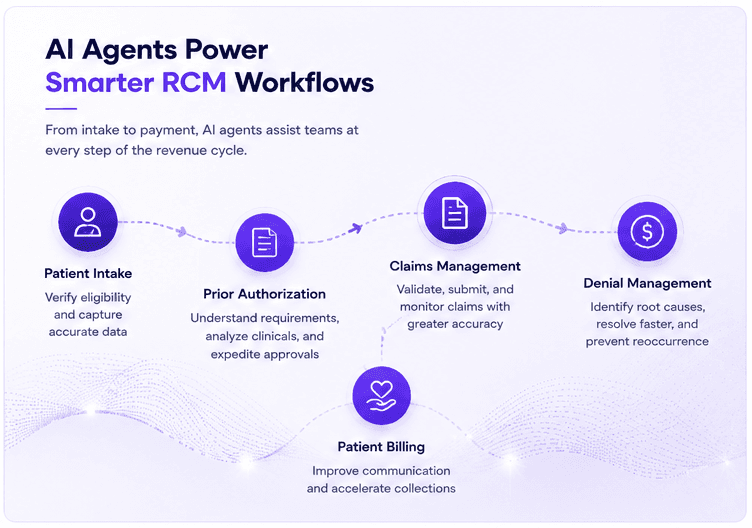
Healthcare RCM teams are often overwhelmed by operational inefficiencies caused by fragmented systems and manual processes. A single patient encounter may involve multiple operational touchpoints, including insurance verification, documentation review, coding validation, claims submission, denial resolution, and patient billing communication.
The prior authorization process remains one of the largest contributors to administrative delays and operational fatigue. Staff members frequently spend hours gathering documentation, reviewing payer requirements, communicating with insurance companies, and tracking approval statuses. Delays in authorization can directly impact patient care timelines and revenue realization.
Although EHR systems contain valuable clinical and patient information, they are often limited in their ability to actively support operational decision-making. They function primarily as systems of record rather than intelligent workflow engines.
This is where AI agents are expected to create the next major transformation in healthcare operations.
From EHR systems to intelligent AI agents
The future of healthcare operations is not about replacing EHR systems. Instead, it is about extending their value through AI-driven intelligence. AI agents can work across EHRs, payer platforms, operational databases, and communication tools to deliver workflow-level assistance. Unlike traditional automation tools that follow rigid instructions, AI agents can understand context, analyze data, interpret documentation, and support decision-making in real time.
In healthcare RCM environments, AI agents can review patient records, extract relevant clinical details, identify missing information, and assist teams in completing complex workflows faster and more accurately.
For example, during the prior authorization process, AI agents can analyze physician notes inside EHR systems, identify medical necessity indicators, compare documentation against payer requirements, and generate submission-ready summaries. Instead of manually searching through multiple records, operational teams receive contextual insights directly within their workflow.
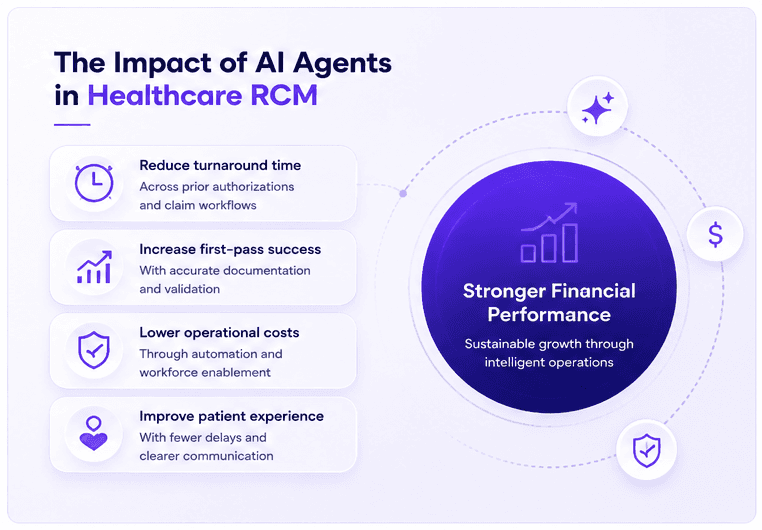
This transformation significantly reduces administrative burden while improving operational efficiency and turnaround times.
The growing role of AI in healthcare BPO
As AI adoption accelerates across healthcare RCM and healthcare BPO environments, governance will become a critical requirement.
Healthcare organizations operate within highly regulated environments where patient privacy, auditability, and operational accountability are essential. AI systems must therefore function within strict compliance and governance frameworks.
Organizations will increasingly demand AI platforms that provide observability, traceability, and human oversight throughout operational workflows. This is particularly important in workflows involving patient data, payer communication, and the prior authorization process.
Healthcare leaders are unlikely to trust AI systems that operate as black boxes without explainability or operational controls. Successful AI adoption will depend on building systems that support compliance, maintain workflow accountability, and enable secure collaboration between human teams and AI agents.
Over the next three years, governance capabilities may become just as important as AI performance itself.
How AI agents will transform the prior authorization process
The prior authorization process is expected to become one of the earliest and most impactful areas for AI adoption.
Today, prior authorization workflows remain highly manual and resource-intensive. Staff often navigate multiple payer portals, review lengthy documentation, gather supporting evidence, and manually track authorization requests. Delays in the prior authorization process contribute to treatment delays, provider frustration, and administrative burnout.
AI agents can significantly streamline this workflow by continuously monitoring patient records, analyzing clinical documentation, and matching requirements against payer-specific rules.
Instead of requiring staff to manually review every case, AI agents can surface missing information, recommend supporting evidence, and prepare authorization summaries based on existing EHR systems data. Operational teams can then focus on exception handling and high-priority escalations rather than repetitive administrative tasks.
As payer rules continue to evolve, AI-driven adaptability will become increasingly valuable for maintaining operational efficiency within healthcare RCM environments.
Organizations that treat agentic workflows as a layer on top of existing systems - rather than a replacement for them - tend to see faster deployment, less disruption, and cleaner results. The EHR stays the system of record. The agent becomes the system of action.
Why EHR systems become more powerful with AI
For years, EHR systems have primarily served as centralized repositories for patient information. While they improved data accessibility, they often created documentation-heavy workflows that increased administrative complexity for clinicians and operational teams.
AI agents are changing the role of EHR systems by transforming static data into actionable operational intelligence.
Instead of simply storing patient records, future EHR systems will function as active participants in healthcare workflows. AI agents will continuously analyze clinical and operational data to support reimbursement workflows, documentation accuracy, denial prevention, and patient communication.
In healthcare RCM, this means organizations can move from reactive issue resolution toward proactive operational optimization.
For example, AI agents may identify reimbursement risks before claims submission, detect missing clinical evidence before payer review, or recommend corrective actions before denials occur. These capabilities reduce manual review workloads while improving overall workflow quality.
The integration of AI with EHR systems will also improve interoperability between providers, payers, and healthcare BPO teams, enabling more connected and intelligent healthcare operations.
Governance and trust will define AI adoption
As AI adoption accelerates across healthcare RCM and healthcare BPO environments, governance will become a critical requirement.
Healthcare organizations operate within highly regulated environments where patient privacy, auditability, and operational accountability are essential. AI systems must therefore function within strict compliance and governance frameworks.
Organizations will increasingly demand AI platforms that provide observability, traceability, and human oversight throughout operational workflows. This is particularly important in workflows involving patient data, payer communication, and the prior authorization process.
Healthcare leaders are unlikely to trust AI systems that operate as black boxes without explainability or operational controls. Successful AI adoption will depend on building systems that support compliance, maintain workflow accountability, and enable secure collaboration between human teams and AI agents.
Over the next three years, governance capabilities may become just as important as AI performance itself.
The future of healthcare RCM is collaborative intelligence
Despite concerns about automation replacing jobs, the future of healthcare RCM will likely center on workforce augmentation rather than workforce replacement.
Healthcare operations involve significant complexity, regulatory nuance, and patient-sensitive decision-making. Human expertise will continue to play a critical role in exception handling, payer negotiations, escalations, and strategic oversight.
However, operational teams will increasingly work alongside AI agents that handle repetitive coordination tasks, information gathering,
documentation analysis, and workflow orchestration. This collaborative operational model allows healthcare organizations to improve efficiency without sacrificing accuracy or patient experience.
As AI agents become more deeply integrated into EHR systems and operational workflows, healthcare RCM teams will spend less time on administrative burden and more time focusing on strategic, patient-centered, and high-value activities.
Final note
The healthcare industry is entering a new operational era where EHR systems evolve from passive data repositories into intelligent workflow ecosystems powered by AI agents. Over the next three years, healthcare BPO and healthcare RCM organizations will increasingly adopt AI-driven operational models to address administrative complexity, workforce pressures, reimbursement challenges, and growing patient expectations.
The prior authorization process, denial management, coding support, and patient financial workflows are all expected to benefit significantly from AI-assisted operations. At the same time, governance, compliance, and human oversight will remain essential components of successful implementation.
Organizations that successfully combine AI intelligence with operational expertise will be better positioned to improve efficiency, reduce friction, accelerate reimbursement cycles, and deliver stronger patient and financial outcomes.
However, as AI agents become more deeply embedded into healthcare workflows, organizations will also need robust governance frameworks that ensure transparency, accountability, compliance, and operational control across every AI-driven decision and workflow. This is where elsai are becoming increasingly important by providing the futuristic governance layer healthcare organizations need today to safely scale AI adoption across complex operational environments.
The future of healthcare operations will not be defined solely by EHR systems or automation alone. It will be defined by intelligent collaboration between humans, data, and AI agents working together to create more adaptive, efficient, and connected healthcare ecosystems.





We’d love to chat with you about how your team can secure and govern Ai agents everywhere