
Prior Authorization Agents for Cardiology: Fixing “Insufficient Documentation” Denials Without Reworking Every Claim

A cardiology group submits a stress echocardiogram authorization, and the answer comes back as two words: insufficient documentation. Nothing in those words says whether a record never arrived, arrived without the symptom history the payer wanted, or was judged against criteria that changed last quarter. So, the team does what it always does. It pulls the chart and reworks the case from the beginning.
That habit is the real cost. The label is not a diagnosis. It is a bucket, and each cause inside it has a different fix. Treat the bucket as one problem, and every denial becomes a fresh investigation.
The scale makes that impossible to sustain. Medicare Advantage insurers decided nearly 53 million prior authorization requests in 2024 and denied 4.1 million of them in full or in part, a 7.7% denial rate. Only 11.5% of those denials were appealed, according to KFF's analysis of CMS data. Even Medicare's own contractor treats documentation as several separate failures: in its published review of stress echocardiography (CPT 93351), Noridian lists requested records not received, documentation that does not support medical necessity under the coverage requirements, and documentation that was incomplete or insufficient as three distinct top denial reasons.
This blog breaks the label into its five common causes, shows why classifying a denial before touching the claim removes most of the rework, and explains how a prior authorization AI agent turns each denial into a fix that applies to every future cardiology case, not only the one in front of you.
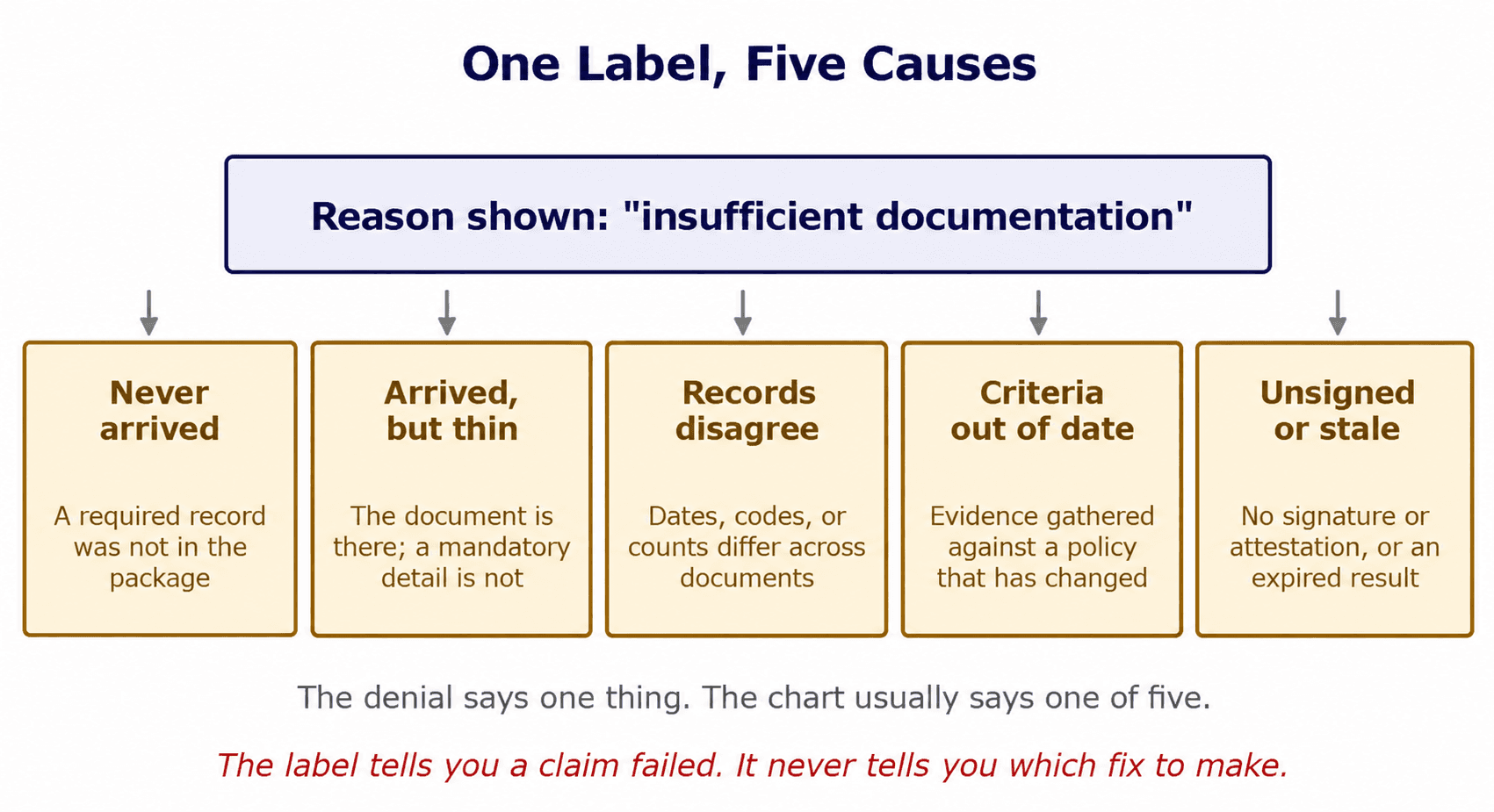
One Label, Five Different Failures
Open a cardiology denial that reads insufficient documentation and, in most cases, one of five things happened. Each is a different failure with a different owner, and each is caught by a different check in the elsai platform's prior authorization workflow.

Cardiology prior authorization is specific about what counts as evidence. Payers that send cardiac imaging through a benefit manager ask for signs and symptoms and the results of relevant tests, and their program lists name stress echocardiography, nuclear cardiac imaging, cardiac CT and MRI, and diagnostic catheterization among the services that can need approval. Every item on that list is a place where a record can be missing, thin, stale, or inconsistent.
The checks are criteria-driven rather than hard-wired to one specialty. They read the evidence in the record and compare it with whatever the payer rule on file for that plan, specialty, and procedure code requires.
Why Reworking Every Claim Cannot Be the Plan
Rework is claim-by-claim work, and claim-by-claim work has a ceiling. KFF's numbers show where it sits: about one denial in nine gets a formal appeal, and most of the denials that were appealed were at least partly overturned. Capacity is a large part of that gap, because working a denial by hand takes more time than most teams have.

Deadlines tighten the squeeze. In Noridian's prepayment review process, a requested record that has not arrived by day 46 means a denied claim, and the platform's denial workflow starts a 30-day appeal window timer the moment a payer response is captured. A team that investigates each denial from scratch burns part of that window on diagnosis.
Prior authorization automation that only speeds up submission does nothing about this ceiling, because the ceiling sits after the denial. For cardiology revenue cycle management teams, the practical question is not how to win more appeals. It is how to stop paying the diagnosis cost on every denial.
Classify the Denial Before You Touch the Claim
The platform captures a payer response in a structured way. A denial arrives with its reason code translated into a plain-English explanation, a 30-day appeal window timer starts, and a clinical denial notifies the physician with a timestamp. A pending request is more useful still: it lists the specific additional information the payer asked for and starts a resubmission timer, so the team knows exactly what to supply instead of rebuilding the case.
From there, denial management software that stops at the reason code leaves the hard part undone. Root cause classification maps each denial code to a standardized root cause category, using the payer's own definitions, the supporting case information, and the workflow history, and it links the denial to the workflow step where the problem began. The solution documentation gives one example in this form: a documentation gap at the clinical evidence step, where therapy records lacked a documented treatment outcome and the payer returned a medical necessity denial. The label said it was a medical necessity. The cause was a missing detail in the record. The same mapping applies when the missing detail is a symptom of history or a prior test result.
People stay in control of the classification. Staff can disagree and override it with a recorded reason, user ID, and timestamp, and a denial left unclassified for more than 24 hours goes to a supervisor automatically.

Consider a nuclear stress study denied as insufficient documentation. This is an illustrative scenario, not a customer result. Classification splits one label into three different jobs:
• If the package log shows the prior test report was never retrieved, it is a record that never arrived. The fix is one retrieval and a targeted supplement.
• If the report was there, but the symptom duration was missing from the note, it is a thin record. The fix sits with the ordering clinical documentation, and a physician may need to add the detail.
• If the policy version on record predates the payer's change, the criteria were out of date. The fix is a policy update and a clinician's confirmation of which criteria apply.
Three denials carried one label, and they needed three different people and three different repairs.
Repair the Cause Once, Not the Claim Every Time
provider turn a pile of individual denials into a short list of recurring causes, and the platform records denial frequency along exactly those dimensions. The classified causes also feed back into the clinical intelligence and document intelligence modules that build the next case, so the loop closes without a separate project.
Three fixes do most of the work, and each one reaches every future case rather than the one on the desk:
• The checklist. Mandatory documents are set per specialty by an administrator, and the configuration keeps who changed it, when, and the version. When a document keeps turning up missing on cardiology denials, adding it to the cardiology configuration means every new case asks for it at intake.
• The criteria. Each case records which payer policy version was applied and its effective date against the date of service. A mismatch holds the case for clinical review, and updating the policy once means later cases are judged against the current version. If a denial does occur, the record shows which version was applied on that date.
• The evidence rules. When classification shows the same detail missing across one payer and one procedure, the ordering clinic can fix how that detail is documented at the source, and the readiness check confirms the package is complete and signed before it goes out.

For denials already out the door, classification does the sorting. A denial caused by a record that never arrived, or by a mandatory detail the note lacked, can often move with a targeted supplement. A denial rooted in clinical judgment goes to a physician. Effort follows the denials that can actually change.
Human review stays where judgment is needed. A nurse review of the clinical evidence returns confirmed, escalate to physician, or send back, and a case pauses a person when a document is missing, a code fails validation; a signature cannot be verified, or the readiness score falls below 75.
From a Pile of Denials to a Short List of Causes
A denial that says insufficient documentation is the start of a diagnosis, not the end of one. Cardiology groups that treat it as a single problem pay for the same investigation repeatedly. Groups that classify it find that a handful of causes repeat, and a handful of fixes retire from most of them.
Prior authorization AI Agent that ends at submission leaves this loop open. AI prior authorization that reads the denial, traces it to a cause, and feeds that cause back into the checklist, the criteria, and the evidence rules closes it.
That is the work the elsai platform's prior authorization agent does between a payer response and the next case. It is one of the ai agents for prior authorization built for this stage, and it fits into the healthcare workflow automation a cardiology group already runs instead of replacing it. See how the platform handles denials at elsai.ai/agents/preauth-agent.
FAQ
What does insufficient documentation actually mean on a cardiology prior authorization denial?
It is a catch-all label. In practice, it covers five different failures: a record that never arrived, a record that arrived without a mandatory detail, records that disagree with each other, evidence gathered against outdated criteria, and a record that is unsigned or stale. Medicare's own contractor separates documentation denials for stress echocardiography into three reasons: records not received, documentation that does not support medical necessity, and documentation that is incomplete or insufficient.
What are the most common reasons for prior authorization denials in cardiology?
No public source ranks them reliably for cardiology, and vendor-reported percentages are hard to verify. What is documented is that payers ask for signs and symptoms and the results of relevant tests, and that Medicare's contractor lists missing records, documentation that does not support medical necessity, and incomplete documentation as top denial reasons for stress echocardiography. Counting your own denials by classified cause is more reliable than any benchmark.
How do you appeal a prior authorization denial for a cardiac test?
Start from the reason, not the claim. Read the denial notice for the payer's actual deadline, because deadlines vary and the notice controls. If the payer pended the request and named the information it needs, supply exactly that. If it denied the request, map your evidence to the payer's stated criteria and involve the physician for clinical denials. The platform starts a 30-day timer when a denial is captured, so the team sees the clock, but the payer's notice decides the real deadline.
Does fixing one denial cause help future cardiology authorizations?
Yes, for the upstream fixes. A change to the specialty checklist, the payer policy version, or an evidence rule applies to later cases. It does not change denials that are already out, which still need a targeted supplement or an appeal.
Does classifying denials replace the coordinator or the physician?
No. Staff can override any classification with a recorded reason, unclassified denials go to a supervisor after 24 hours, nurse review can confirm, send back, or escalate a case to a physician, and cases pause for a person on missing documents, failed code validation, unverifiable signatures, low readiness scores, or expired results. The platform sorts the work. People still make judgment calls.
See how elsai streamlines cardiology prior authorization with governed AI.
Request free demo →


We’d love to chat with you about how your team can secure and govern Ai agents everywhere
Get a demo →