
Prior Authorization Agents for Radiology: Clearing the Imaging PA Backlog

Order an MRI for one patient on a commercial plan and a CT for another on a different plan, and the prior authorization request for each one might not even go to the same reviewer. One routes to eviCore. The other routes to Carelon. A third patient's plan reviews imaging in-house. Each path has its own portal, its own criteria, and its own version of what counts as sufficient documentation, and a radiology group's PA staff are expected to know all of them, correctly, every time.
That's the part of prior authorization automation that generic PA tools tend to miss, and it's the specific reason radiology PA is harder than PA for most other specialties. It isn't just that imaging gets denied a lot. It's that the rules a request must satisfy depend on which reviewing entity the payer happens to have outsourced imaging review to, and that entity can change the criteria, the portal, or the required documentation without much notice.
Advanced imaging remains one of the most heavily prior-authorized categories in medicine, and Medicare Advantage imaging denial rates run close to 5%, meaningfully higher for spine MRI and PET studies specifically. Under the CMS Interoperability and Prior Authorization Final Rule, payers now must decide standard imaging requests within 7 calendar days and expedited ones within 72 hours, a clock that a manually staffed operation juggling multiple RBM portals must beat consistently, not just occasionally.
This piece looks at why the multi-reviewer routing problem makes radiology PA structurally different from other specialties, the specific validation checks an imaging request has to pass that a generic PA workflow would miss, and how a rules-based, explainable prior-authorization agent handles both.

Why Radiology PA Isn't One Workflow
Most specialties send a prior authorization request to the payer and get a payer's decision back. Radiology often doesn't work that way. Most major payers route advanced imaging, MRI, CT, and PET specifically, to a radiology benefits manager rather than reviewing it internally. eviCore and Carelon are the two largest of these, with NIA, operating as RadMD, handling a meaningful share of the remainder, and a number of payers, including some of the largest commercial and Medicare Advantage plans, still review imaging internally rather than outsourcing it.
The operational consequence is that a radiology group's PA staff aren't managing one rulebook;, they're managing several at once, and the correct one depends entirely on which plan the specific patient carries. A prior authorization AI agent built for radiology has to know that routing logic as a baseline requirement, not as an edge case, because getting the routing wrong before a request is even submitted guarantees a denial and a resubmission, regardless of how clinically appropriate the original request was.
The Checks That Are Specific to Imaging
Beyond routing, imaging requests carry their own category of denial causes that a general-purpose PA workflow, built around simpler procedure authorizations, typically isn't designed to catch before submission.
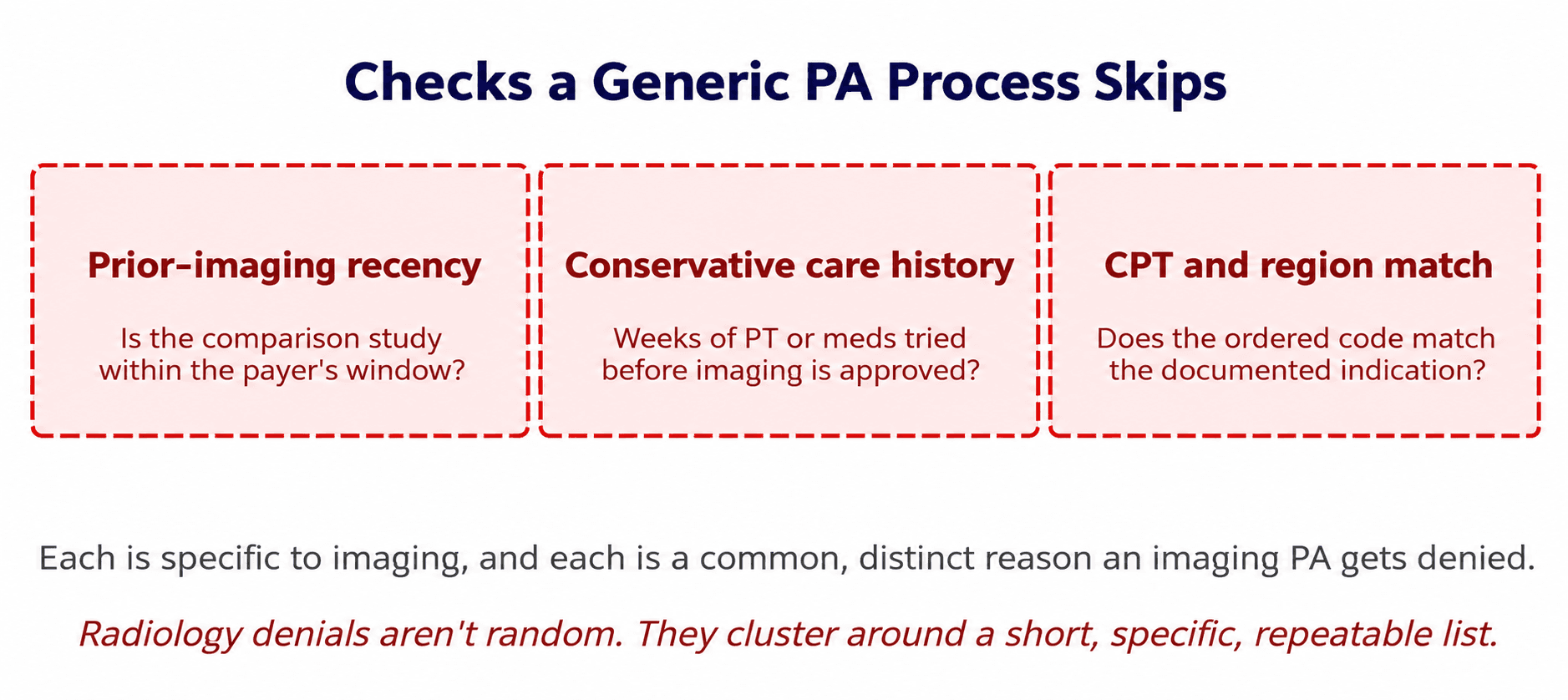
Prior-imaging recency shows up constantly in practice: a payer's rule might require a comparison study within a specific window, commonly around 90 days, and a study that falls just outside that window fails the requirement even though the clinical reasoning behind the order is sound. Conservative-care history is the most common MRI-specific denial driver: most commercial payers and RBMs expect to see a documented period, often four to six weeks, of physical therapy or medication trial before approving advanced imaging for musculoskeletal pain, and a missing PT date or medication outcome in the ordering note is enough to trigger a denial even when the underlying clinical picture is clear. CPT and body-region matching catch a subtle failure: the ordered procedure code doesn't align with the documented clinical indication, a mismatch that's easy for a person to miss under volume and easy for a system to flag immediately.
How the Rule-Match Actually Works
Underneath the routing and the imaging-specific checks sits a more basic mechanism: matching the specific request against the specific rule that applies to it. The system looks up the combination of payer, plan, specialty, and CPT code against a payer rules database and returns one of three outcomes.

An exact match returns the matched rule, a plain-language rationale, and the required document checklist immediately, so the coordinator has everything needed to submit correctly the first time. A closest match evaluates the applicable condition and records the result on the case for review. A no match found result escalates the case for manual payer policy research rather than guessing, which matters because a wrong guess costs more time than an honest escalation. Every one of these outcomes, including when authorization isn't required at all, gets logged with the specific rule of reference, so there's a documented justification on file rather than an unexplained gap.
A Denial-Risk Score That Explains Itself
Before a case is submitted, the same evidence, coverage status, clinical documentation, payer rule compliance, and historical denial data for that payer-procedure combination, feeds a pre-submission denial-risk score. What makes this useful rather than decorative is that every contributing factor is traceable to something specific: a documentation gap where a required field is present but incomplete, a criteria mismatch where the clinical evidence only partially satisfies the payer's requirements, a coding issue where the diagnosis-and-CPT combination has a historically high denial rate with that specific payer, or a late submission risk where the request is approaching the payer's allowable window.
When the case is flagged for a peer-to-peer risk, the system automatically prepares a P2P discussion brief, so the radiologist walks into that conversation with the relevant clinical evidence already organized rather than reconstructing it under time pressure. None of this makes a clinical call for the radiologist. It makes sure the coordinator and the radiologist see exactly which specific factor is driving the risk, before the case goes out, rather than finding out why a denial comes back.

Built on What's Already in the Chart
None of this works if it requires re-keying data from scratch. The clinical evidence behind each check, physician notes, imaging reports, medication trial records, PT documentation, is pulled directly from the systems where it already lives, with the system capturing which documents were reviewed, the date range covered, and the version of the clinical model used for the evaluation, so the reasoning behind a decision can be reconstructed later, not just asserted at the time.
That auditability matters for a category with this much routing complexity. When a denial does happen, and even with every check in place some will, having a specific, traceable record of which rule was matched, which risk factors were identified, and what evidence supported the original submission is what turns an appeal into a documented case rather than a reconstruction project.
Clearing the Backlog Starts with Getting the Request Right the First Time
Radiology's prior-authorization backlog isn't only a volume problem. It's a routing and validation problem specific to imaging: knowing which of several reviewers a given request actually goes to, catching the handful of imaging-specific requirements a generic checklist misses, and understanding exactly why a case is at risk before it's submitted rather than after it comes back denied.
This is what elsai Healthcare workflow automation for prior authorization is built to handle directly for a radiology group: payer-and-plan-specific rule matching with a clear exact-match, closest-match, or escalation outcome, the imaging-specific evidence checks that a general PA process misses, and a denial-risk score that names the specific gap instead of returning an unexplained number. See how the platform supports healthcare AI agents across prior authorization and revenue cycle workflows.
FAQ
Why does the same imaging study sometimes route to a different reviewer for different patients?
Because the routing depends on the patient's specific payer and plan, not on the imaging study itself. Most payers contract advanced imaging review out to a radiology benefits manager, chiefly eviCore or Carelon, with NIA/RadMD handling a further share, while some payers, including some of the largest commercial and Medicare Advantage plans, review imaging internally. A radiology group's PA workflow has to know which entity a given plan routes to before it can even determine the correct submission process.
What's the most common reason an MRI prior authorization gets denied?
Missing or incomplete conservative-care documentation is one of the most frequent causes for musculoskeletal MRI specifically: most commercial payers and RBMs expect a documented period of physical therapy or medication trial, often four to six weeks, before approving advanced imaging, and an ordering note that doesn't capture the specific dates, medications, or outcome is enough to trigger a denial even when the clinical reasoning is sound.
What happens when the system can't find a matching payer rule for a request?
The case is escalated for manual payer policy review rather than guessed at. A no-match result means the specific payer, plan, specialty, and CPT code combination isn't in the rules database, so a coordinator researches the actual current policy rather than the system assuming a rule that may not apply. This is deliberately conservative: an honest escalation costs less time than a wrong guess that turns into a denial.
How does a pre-submission denial-risk score differ from just predicting whether a case will be denied?
A prediction alone tells a coordinator there's risk without telling them what to do about it. A traceable risk score identifies the specific contributing factor, a documentation gap, a criteria mismatch, a coding issue tied to that payer's historical denial pattern, or a late-submission risk, so the coordinator knows exactly what to fix before submitting, rather than receiving an unexplained probability and having to guess at the cause.


We’d love to chat with you about how your team can secure and govern Ai agents everywhere
Get a demo →