Procurement Agents That Close the Gaps Between Sourcing, Contract, and P2P

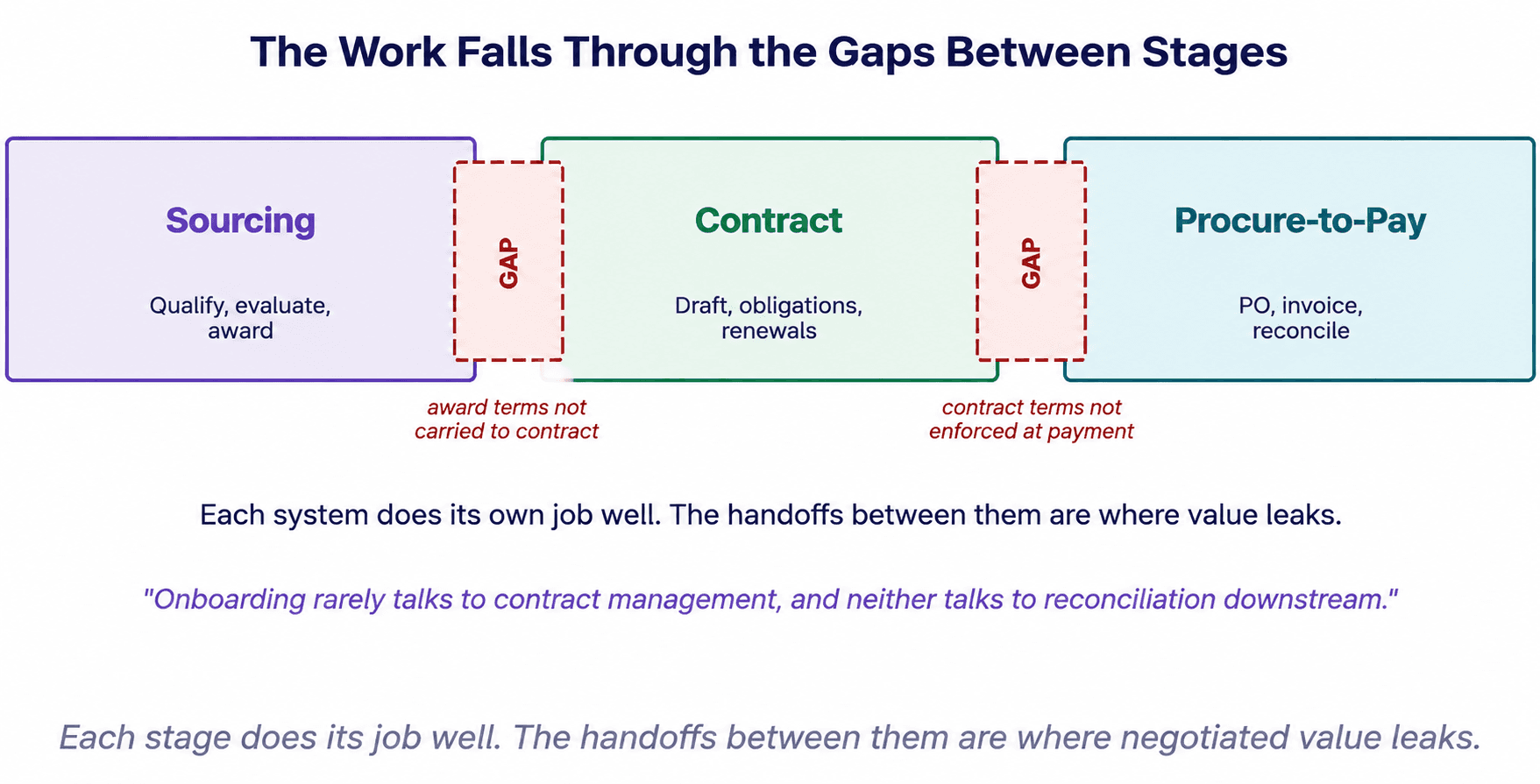
A procurement organisation can run each of its three core stages well and still lose money in the space between them. The sourcing team negotiates a strong award, the legal team turns it into a solid contract, and the accounts-payable team pays the invoices, and somewhere across those handoffs the value that was negotiated quietly leaks away. The negotiated price does not make it into the payment terms that get enforced. A service level agreed in sourcing is never checked against what the supplier actually delivered. An obligation written into the contract is never verified against the invoice. Each stage did its job; the gaps between them did not have an owner.
The mechanics are familiar to anyone who has traced a discrepancy back through the process. A single sourcing decision touches five or six disconnected tools before it is finalised, and each handoff is a chance for something to fall through. So the award terms live in the sourcing platform, the obligations live in the contract repository, and the invoices live in the finance stack, and no system holds the thread from one to the next. The result is not a dramatic failure. It is a slow, quiet leak that only shows up when finance closes the books and finds the mismatches.
The cost of that leak is measurable. Industry estimates put recoverable savings on addressed and tail spend at 5 to 15 percent, and much of it is lost precisely in these seams, in value negotiated but never enforced. The reason it persists is not a lack of tools; it is that the tools do not share context. Roughly 74 percent of procurement leaders say their data is not ready for AI, and more than 40 percent of agentic AI projects are expected to be abandoned by 2027, largely because the AI acts on fragmented data it cannot make sense of. The gap between sourcing, contract, and procure-to-pay is the sharpest example of that fragmentation.
This blog looks at where the value actually leaks in the handoffs between the three stages, why adding another tool does not close the gap, and how an ai agent in procurement, working as part of a governed layer across all three stages, can carry the context from the award into the contract and from the contract into payment, so the value negotiated at the start survives to the end. It is written for the procurement operations leader who owns the whole cycle and feels the leak, not any single stage of it.
Value is negotiated in sourcing and lost by the time the invoice is paid. The gap is the problem, not any one stage.
Where the Value Actually Leaks Between the Stages
To close the gaps you have to see them precisely, and there are two that matter most. The first is the sourcing-to-contract handoff. A sourcing team negotiates a price, a delivery schedule, service levels, and risk terms, and much of that detail has to be manually re-entered into the contract, if it makes it in at all. What was agreed in the award and what ends up enforceable in the contract are often not the same thing, and the difference is value that was won and then given back on paper.
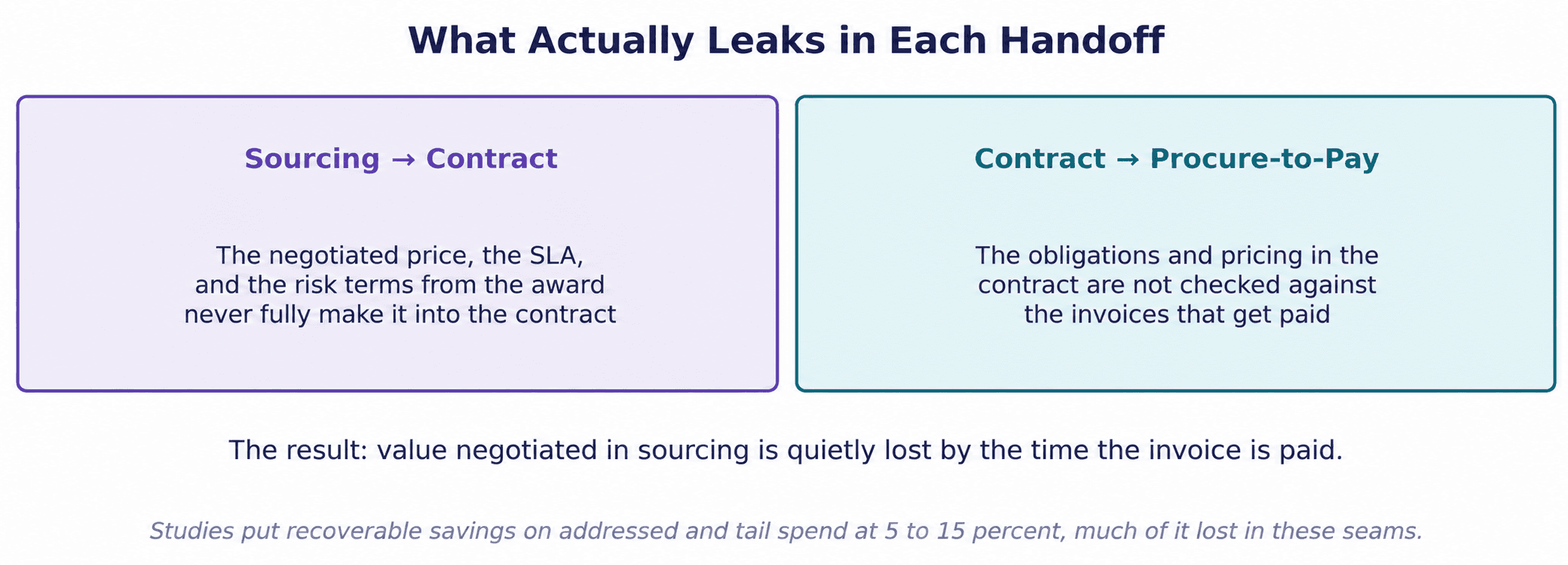
The two handoffs where value leaks: award terms not carried into the contract, contract terms not enforced at payment.
The second gap is the contract-to-payment handoff, and it is where the money physically leaves. The obligations, pricing, and service levels written into the contract are supposed to govern what gets paid, but in most operations the invoice is matched against the purchase order and little else. The contract itself is not in the loop at payment time, so an invoice that violates a negotiated price or bills for a service level that was never met is paid anyway, because nothing checked it against the contract. Continuous reconciliation of pricing, volumes, and service levels against invoices is exactly what catches this, and it is exactly what a disconnected P2P process cannot do.
Why Adding Another Tool Does Not Close the Gap
The instinct, when a gap appears, is to buy a tool for it: a better contract system, a smarter invoice-matching engine, another module. Each of those can be good in isolation and still leave the seam open, because the problem is not that any one stage lacks a tool. It is that the stages do not share context. Adding a sixth disconnected tool to five disconnected tools does not connect them; it adds another place for the thread to break.

This is the limit of the automation most procurement teams already have. ERP systems are excellent systems of record, but they store data rather than interpret it: an ERP will tell you an invoice was posted, not that it violates a term three stages upstream. Procurement Ai agent adds workflow structure within sourcing, or within contracting, or within reconciliation, but the modules operate in isolation. And robotic process automation and generic AI copilots speed up individual tasks without understanding how one stage's output should govern the next. Closing the gap requires something none of these provide on its own: a layer that carries context across all three stages and reasons about how they connect.
How Procurement Agents Carry Context Across the Gaps
The way to close the seam is not another module but a governed agentic layer that spans all three stages and keeps the context flowing between them. Instead of each stage running in its own tool, specialized agents share a continuously updated picture, so the award informs the contract and the contract governs the payment, without anyone re-keying data or hoping the thread holds. A procurement AI agent working this way does not replace the ERP or the contract system; it connects them, reading from each and writing governed outcomes back. This is the difference an ai agent for procurement automation makes only when it spans the stages rather than sitting inside one.

In practice, this runs across the three intelligence areas as one connected flow. In Strategic Sourcing Intelligence, agentic AI sourcing evaluates bids and produces an award recommendation with its reasoning and the negotiated terms captured as structured data, not buried in a document. Those terms carry directly into Contract Intelligence, where the obligations, pricing, and renewal dates are tracked from day one rather than re-entered, and monitored continuously against the supplier's performance. And in Procure-to-Pay Intelligence, the invoices are matched not just against the purchase order but against the contract, so a bill that breaks a negotiated term is flagged before it is paid. A multi agent procurement ai platform is what makes this possible: the agents in each area share context, so the value negotiated in the first stage is enforced in the last. A human stays in the loop at every material decision, and every action is traceable through ARMS, the AI observability layer, so nothing is carried across the gap without a record.
Close the gaps and the value negotiated at the start finally survives to the end.
What This Changes for a Procurement Operation
For a procurement leader who owns the full cycle, closing the gaps changes the economics rather than just the workflow. The value negotiated in sourcing is actually captured, because the contract enforces it and the payment respects it, which is where a meaningful share of that 5 to 15 percent of recoverable spend comes back. The finance close stops being a monthly investigation into mismatches, because the discrepancies are caught as they happen rather than after payment. And the team stops spending its time re-keying data between stages and chasing the exceptions that fragmentation creates, which is what lets the same team handle a growing supplier base and transaction count without growing in proportion.
This is also where supply chain ai agents earn their place beyond a single stage. Because the agents share context across the cycle, a risk flagged during sourcing informs the contract terms, and a contract obligation informs what the payment process checks for. An ai agent for supply chain management that only optimises one stage leaves the seams open; the value is in the cross-stage visibility that no single-stage tool can provide. That connected picture, rather than any one automated task, is what turns three disconnected stages into one governed operation.
One Governed Layer, End to End
Procurement does not usually slow down or leak value because a team lacks an ERP or a contract system. It leaks because the context is fragmented across sourcing, contract, and payment, and no system carries the thread from the award to the invoice. Close that gap, and the improvement is not a faster version of one stage; it is a procurement operation where the value negotiated at the start is still there at the end, and where the finance close is a confirmation rather than an investigation.
This is the work the elsai platform is built for. It runs as a governed intelligence layer across your existing ERP, procurement, contract, and finance systems, from SAP to Oracle to Coupa, rather than replacing them, and its agents share context across Strategic Sourcing, Contract, and Procure-to-Pay Intelligence so the award informs the contract and the contract governs the payment. Every recommendation is explained, every action is traceable through ARMS, the AI observability layer, and a human keeps the judgment at every material decision. For a procurement operation tired of watching negotiated value leak out through the seams between its own systems, that connected, governed layer is how the gaps finally close. Explore the procurement intelligence layer at elsai.ai/agents/procurement, and how the platform fits your stack at elsai.ai/platform.
FAQ
What do we mean by the gaps between sourcing, contract, and P2P?
They are the handoffs where one stage's output is supposed to govern the next but does not, because the systems are disconnected. The two costliest are sourcing-to-contract, where negotiated price, service levels, and risk terms are not fully carried into the enforceable contract, and contract-to-payment, where the contract's terms are not checked against the invoices that get paid. Value negotiated at the start leaks out in these seams.
Doesn't better software for each stage fix this?
Not on its own. A better contract tool or invoice-matching engine improves one stage, but the gap is between stages, not within them. Adding another isolated tool to a stack of disconnected tools adds another handoff rather than closing one. What closes the gap is a layer that shares context across all three stages, so the award informs the contract and the contract governs the payment.
Does an ai agent in procurement replace our ERP or contract system?
No. It runs as a governed layer on top of the ERP, procurement, contract, and finance systems you already use, reading from each and writing governed outcomes back. The systems of record stay authoritative; the agents add the cross-stage context and reasoning that the individual systems were never designed to provide, without a rip-and-replace.
How does the agent catch an invoice that breaks a negotiated term?
Because the contract's terms are carried into the payment stage as structured context, the procure-to-pay checks match each invoice not only against the purchase order but against the contract's pricing, volumes, and service levels. An invoice that violates a negotiated price or bills for an unmet service level is flagged before payment rather than discovered during the finance close, and the flag routes to a person to resolve.


We’d love to chat with you about how your team can secure and govern Ai agents everywhere
Get a demo →