
elsai team
Table of contents

How do you engineer a secure procurement workflow for naval shipbuilding?
You build the security controls into the workflow itself rather than wrapping them around it afterward. That means limiting what every person and agent can see to only the data their task requires, logging the provenance of every action so nothing is unattributable, routing every high-impact or uncertain decision to an authorised human, keeping a tamper-evident audit trail, and running the whole pipeline inside your own infrastructure so sensitive programme data never leaves your walls. For a naval programme, where the supply chain is itself a target, security is not a layer on top of procurement. It is how the procurement workflow is engineered.
Why naval procurement is a security problem, not just a logistics one
Procurement for a naval programme is unlike procurement almost anywhere else. The parts being sourced are often subject to export control. The drawings and specifications attached to a request for quotation can be controlled technical data. The subcontractors being onboarded may need to meet defence cybersecurity standards before they can be trusted with a single document. And the supply chain itself, the network of hundreds of vendors feeding a single hull, is a recognised target for compromise, from counterfeit components to the theft of design data.
This changes what a procurement workflow has to do. In a commercial setting, the job is to source the right part at the right price on time. In naval shipbuilding, the workflow also has to protect controlled information, prove who touched what and when, keep unqualified or compromised suppliers out, and stand up to the scrutiny of a defence audit. Supply chain security and procurement are the same problem here, and treating them separately is how programmes get exposed.

Why bolted-on security fails in procurement
The common approach is to run procurement in the usual disconnected tools and add security controls around the edges: access rules on the document store, a review step before an award, a periodic audit to check compliance. The problem is that the security lives outside the workflow while the sensitive work happens inside it. A controlled drawing is emailed between a sourcing tool and a contracts team with no record of who opened it. A subcontractor is onboarded in one system while the compliance check sits in another, and nobody notices the gap until an audit finds it.
Agentic AI security takes a different starting point. Instead of wrapping controls around a fragmented process, it treats the procurement workflow as the thing to be secured, and it engineers the controls into every step. Because agents carry out the work, and every action an agent takes can be constrained and logged, the security properties become part of how the work happens rather than a checkpoint bolted on after the fact. That is the shift that makes a naval procurement workflow defensible.
The controls that have to be engineered in
A secure agentic procurement workflow rests on a small set of controls, each applied at every step rather than at a single gate. Together they turn procurement from an exposure into something that can be defended and audited.

Least-privilege access for people and agents
The first control is that no person and no agent sees more than their task requires. When a qualification agent processes a new subcontractor's documents, it works with only the fields that qualification needs, and a controlled drawing attached to a request is exposed only to the roles cleared for it. This is the same principle behind zero trust and vendor risk management, applied inside the procurement workflow rather than only at the network boundary. Least-privilege access limits what a compromised account or a careless handoff can reach.
Provenance on every action
The second control is that every action carries its provenance. When an agent pulls a specification, scores a bid, or flags a compliance gap, the source of the data and the reasoning behind the result are recorded as the action happens. In a naval programme, this is what lets a security team answer the question that matters after an incident or during an audit: who touched this, what did they use, and how was the decision made. Provenance is not reporting added later. It is written at the moment of the action.
A human gate on every decision that carries risk
The third control is that judgment stays with people. High-impact decisions, an award, a sole-source justification, the acceptance of a subcontractor, and any decision the agent is not confident about, route to an authorised person before they proceed. The agents handle the volume and the coordination, and the human stays in the loop exactly where the stakes or the uncertainty are highest. This is both a security control and a compliance one, because it produces the documented human accountability a defence audit expects.
Securing the supplier base itself
The hardest part of naval supply chain security is not the yard. It is the hundreds of subcontractors and lower-tier suppliers feeding it, each of which is a potential way in. Third party risk management in this setting cannot be an annual review, because a supplier that was compliant last quarter may have let a certification lapse, changed ownership, or fallen out of a security standard since. The risk is continuous, so the monitoring has to be continuous too.
An agentic workflow handles this by treating supplier qualification and monitoring as an ongoing process rather than a one-time gate. Onboarding a new subcontractor, an agent extracts and verifies the documents, checks the required certifications, and flags anything low-confidence for a human, compressing an onboarding cycle that normally runs one to two weeks into under a day without lowering the bar. Once a supplier is in, the same intelligence keeps watching, tracking certificate and licence expiry, monitoring compliance and performance, and raising an alert the moment a supplier drifts out of standard, so a lapse is caught before it becomes a breach rather than after. For a naval programme, that continuous view across the supplier base is the difference between managing supply chain risk and discovering it.
Sovereignty: the control that makes the rest meaningful
Every control described so far, least-privilege access, provenance, human oversight, continuous supplier monitoring, depends on one thing being true: that the data and the AI acting on it stay within your control. For a naval yard or a defence prime, that is not a preference. A programme handling controlled technical data cannot send its supplier information, its drawings, and its contract terms to an outside cloud service and trust that a governance policy will hold. It needs control over where the data lives, which models process it, and who beyond its own walls can reach any part of the pipeline.
This is why sovereign deployment is the control that makes the rest meaningful. The same governed agentic workflow can run entirely inside your own infrastructure, operate in an air-gapped environment with no external connectivity, stay within approved data-residency boundaries, and meet export-control constraints, with full control over model selection and the whole agent pipeline. Nothing about the security architecture changes when it is deployed this way. It is the same access controls, the same provenance, the same audit trail, drawn inside a boundary that sensitive programme data never crosses.

The point worth being clear about is that this is not a reduced version of the platform for a narrow audience. A commercial supplier gets the same governance and the same security engineering. A naval programme gets those same capabilities without ever having to send its data outside its environment. Sovereignty is what turns a well-governed workflow into one a defence programme can actually adopt.
What secure, governed procurement changes
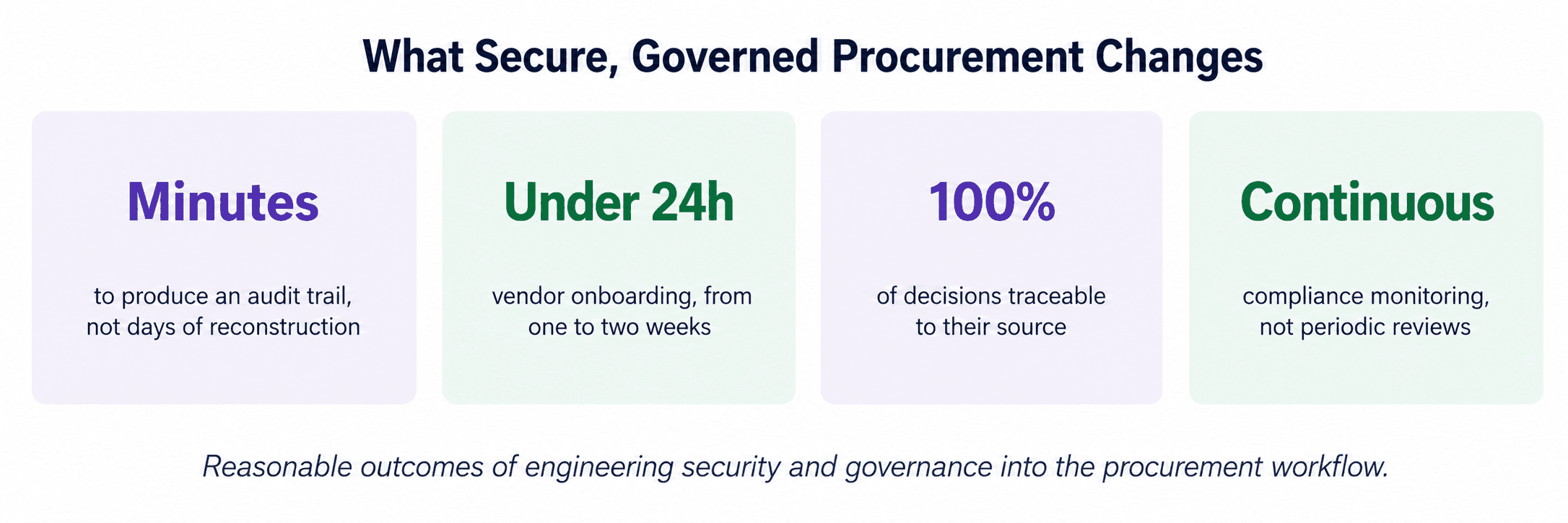
Engineered this way, procurement stops being a security liability and becomes something a programme can defend. The audit trail that once took days to reconstruct from email threads is available in minutes. Vendor onboarding that ran for one to two weeks compresses to under a day without weakening the compliance check. Every decision is traceable to its source, and compliance is monitored continuously rather than in periodic reviews that leave gaps between them. These are reasonable, reported outcomes across governed procurement workflows, and for a naval programme they translate directly into reduced exposure.
Where elsai Fits
elsai is the governed execution layer that runs procurement this way. Its specialised agents handle vendor onboarding, due diligence, negotiation, and contract management across the procurement cycle, with least-privilege access, provenance on every action, and a human gate on every material decision built into how they work. Every action is logged and made traceable through ARMS, the audit layer, and policy guardrails are enforced on every agent step. It connects to the ERP, procurement, and finance systems a yard already runs rather than replacing them.
For naval shipbuilding and the defence work around it, the deciding capability is sovereignty. elsai can be deployed on-premises or air-gapped, inside your own infrastructure, so the agents, the domain models, the audit trail, and the human review all run within your walls and no controlled data leaves them. That is what lets a defence-adjacent programme adopt agentic procurement at all, and it is the same governed architecture a commercial supplier would use, deployed to meet the strictest requirements a regulated programme faces. If you're engineering secure procurement for a naval or defence programme, request a demo to see how elsai can help.
FAQ
What does agentic AI security mean in a procurement context?
It means building the security controls into the agentic workflow itself: constraining what each agent can access, logging the provenance of every action, and routing risky or uncertain decisions to a human. Because agents carry out the work and every agent action can be governed, the security becomes part of how the procurement happens rather than a checkpoint added around a fragmented process.
Can this run in an air-gapped or on-premises environment for a naval programme?
Yes, and for most naval and defence programmes that is the deciding factor. The workflow can be deployed entirely inside your own infrastructure, operated air-gapped with no external connectivity, and kept within data-residency and export-control boundaries. The agents, the audit trail, and the human review all run inside your walls, so controlled technical data never leaves your environment.
How does an agentic workflow handle controlled or export-controlled technical data?
Through least-privilege access and provenance. A controlled drawing or specification is exposed only to the roles and agents cleared for it, and every access is logged with who reached it and why. Combined with sovereign deployment, this keeps controlled technical data inside the boundary and produces the record a defence audit requires.
How does continuous supplier monitoring reduce supply chain risk?
Instead of qualifying a supplier once and reviewing them annually, the workflow keeps watching, tracking certificate and licence expiry, monitoring compliance and performance, and raising an alert the moment a supplier drifts out of standard. For a naval programme with hundreds of subcontractors, catching a lapsed certification early is what keeps a supplier issue from becoming a security or schedule breach.
Does adopting this require replacing our existing procurement systems?
No. The governed agent layer connects to the ERP, procurement, and finance systems already in place and sits across them, applying the security controls and orchestrating the agents on top. Nothing is ripped out, and your existing systems of record stay where they are.





We’d love to chat with you about how your team can secure and govern Ai agents everywhere