
Supply chain is one of the hardest places in the enterprise to adopt AI safely, and the reason is structural. The work runs on data that cannot leave the building, the supplier base, negotiated pricing, qualification records, and contract terms, and it produces decisions that have to be explained and defended long after they are made. Conventional cloud AI can guarantee neither. To process your data, it sends that data to a model endpoint outside your walls, and when it makes a recommendation, it often cannot show why. For a regulated organization, that combination is disqualifying.
The result is a scene that plays out repeatedly. A defence prime is ready to put AI to work in procurement: the efficiency case is obvious, the agents are capable, the team is eager. Then the request reaches the CISO, and it stops, because the system, as proposed, would send the organization's supplier list, pricing, and contract terms outside its own walls to be processed. For a business handling controlled and export-controlled data, that is not a trade-off to weigh. It is a non-starter, and one more procurement AI initiative dies at the sovereignty gate.
The pattern shows up in numbers. Roughly 74 percent of procurement leaders say their data is not ready for AI, and more than 40 percent of agentic AI projects are expected to be abandoned by 2027, largely because the AI acts on sensitive or messy data and cannot explain what it did. The regulatory stakes are just as real, with the EU AI Act carrying penalties of up to 35 million euros or 7 percent of global turnover. When the data is this sensitive and the accountability this high, AI that cannot keep both under your control is not a productivity gain but a liability waiting to be triggered.
The answer is not to abandon AI Agent in procurement, and it is not to accept the exposure. It is sovereign AI: AI that runs inside your own infrastructure, so the sensitive work stays under your control from end to end. This blog looks at what that means across the three surfaces procurement most needs to protect, your supplier data, your award decisions, and your contract risk, and how a sovereign, governed layer keeps all three inside your walls without giving up the speed that made AI worth adopting in the first place.
Procurement runs on the data you cannot expose and the decisions you have to defend. That is why it needs sovereignty.

Supplier data: the exposure cloud AI creates
Start with the data itself, because it is where the sovereignty problem is most concrete. A procurement function holds some of the most commercially sensitive information in the enterprise: the full supplier base, the pricing each supplier has agreed to, the qualification and compliance records behind them, and the terms of every contract. In a defence, energy, or government context, a great deal of that is not just commercially sensitive but controlled, subject to data-residency rules, export controls, or national-security constraints.

Cloud-based AI, however capable, has a structural problem with this data: to process it, the data has to travel to the model. Your supplier records, your bid details, and your pricing get sent to a third-party endpoint outside your environment, and for many regulated organizations that single fact makes the tool legally unusable, regardless of how good it is, and it carries the regulatory penalties noted at the outset. Sovereign AI removes the exposure by inverting the arrangement: the model runs inside your infrastructure, on-premises or air-gapped if required, and the data is processed where it already lives. Nothing sensitive travels to an outside endpoint, because the intelligence comes to the data rather than the data going to the intelligence. That is what zero data egress by design means in practice, and for supplier data it is the difference between an AI you can use and one you cannot.
Award decisions: fast, consistent, and defensible
The second surface is the decision procurement exists to make: who wins the award. Procurement AI Agent is genuinely good at this. It can evaluate every bid against the same criteria, combining proposal details with historical supplier performance, and recommend the best supplier far faster and more consistently than a team working through spreadsheets. But an award is not just an operational decision; it is one that has to withstand scrutiny. A losing bidder may challenge it, an auditor may review it, and in public or defence procurement the award has to be demonstrably fair and fully documented.
This is where an award decision made by an opaque AI becomes a liability rather than a help. If the system recommends a supplier but cannot show why, on what criteria, weighted how, against what evidence, then the speed it offered is worthless the moment the award is questioned. Sovereign, governed AI is built to avoid that trap. Every bid is scored on consistent criteria, the recommendation comes with its reasoning attached, and, crucially, the award itself is not made by the AI: high-impact sourcing decisions route to an authorized human approver who makes the final call. The entire chain, the evaluation, the reasoning, the approval, is logged and fully traceable through ARMS, the platform's AI observability system.

The result is an award that is both faster and more defensible than a manual one. Faster, because the evaluation that took a team days happens in a fraction of the time. More defensible, because every element of the decision is recorded as it is made, so when someone asks why this supplier won, the complete answer already exists. Speed and accountability, which usually trade off against each other in procurement, both improve at once.
Contract risk: catching the liability before it lands
The third surface is the one that keeps costing organizations after the award is signed: contract risk. A contract is not a static document; it is a set of live obligations, deadlines, renewal windows, and compliance requirements that change as regulations change. In most procurement operations, all of that is tracked manually and reviewed periodically, which means a lapsed obligation, a missed renewal, or a clause that has fallen out of compliance tends to surface as a problem rather than as an early warning.
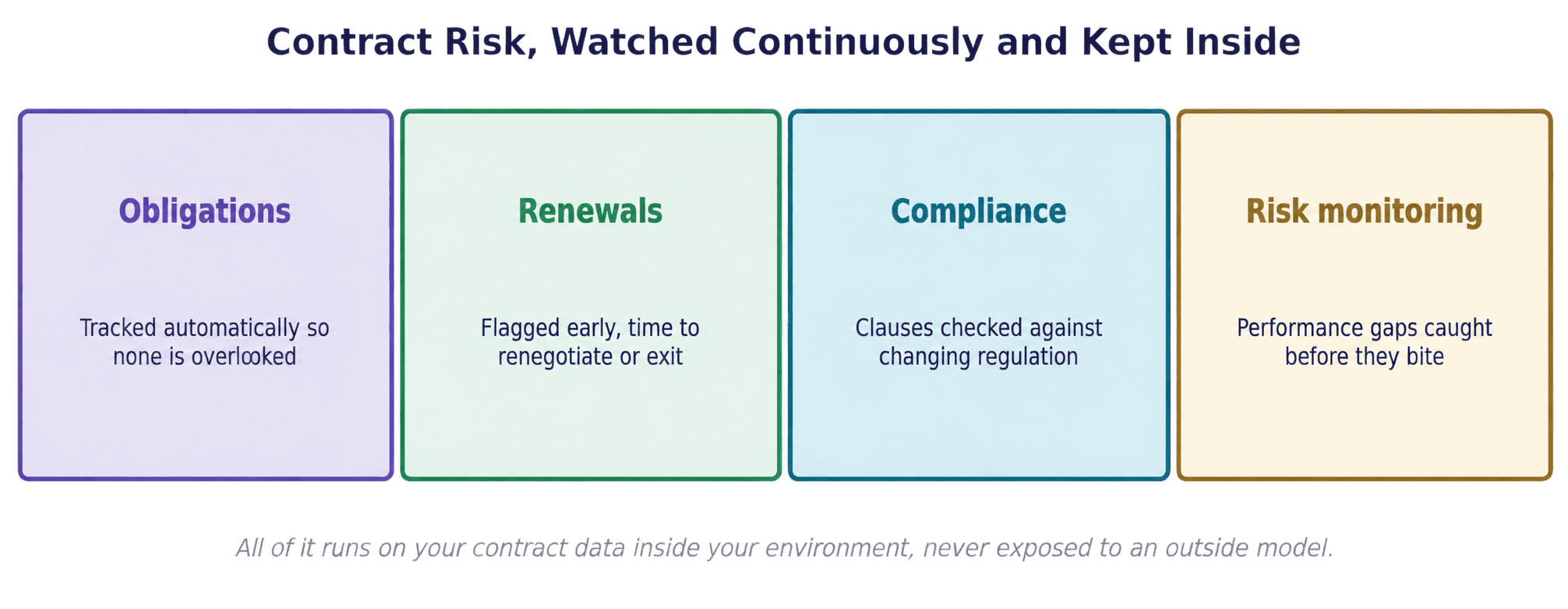
Governed AI closes that gap by watching the contract portfolio continuously. It tracks contractual obligations automatically so key commitments are never overlooked after execution, identifies upcoming renewals early enough to renegotiate or exit on your terms, reviews contract terms against changing regulations and flags clauses that need updating, and monitors supplier performance against commitments so a gap is caught before it becomes a breach. And because this is sovereign AI, all of it runs on your contract data inside your own environment, never exposed to an outside model. Contract intelligence and data protection are not in tension; the same architecture delivers both. For a procurement leader, this turns the contract portfolio from a source of latent, unseen liability into something continuously understood and controlled.
Why the three belong on one governed layer
Supplier data, award decisions, and contract risk are not three separate problems to solve with three separate tools. They are three faces of the same procurement operation, and they are strongest when they run on one governed, sovereign layer that spans all of them. The supplier data informs the award; the award becomes the contract; the contract obligations feed back into supplier performance and risk. Run on a single sovereign layer, that whole lifecycle stays inside your walls, every decision across it is explainable and audit-logged, and a human stays in control of the ones that carry weight. That is what makes it trustworthy enough to run in a defence, energy, or government environment, where governance and sovereignty are not features but preconditions.
Sovereignty is not a setting you switch on. It is the architecture the whole procurement lifecycle runs on.
Own your supply chain AI, end to end
For a regulated organization, the choice in supply chain AI has never really been about capability. The capable tools exist. The choice is about control: whether you can adopt AI without sending your supplier data outside your walls, without making award decisions you cannot defend, and without losing sight of the contract risk accumulating across your portfolio. Answer those three, and the sovereignty gate that stops most supply chain AI Agent initiatives becomes a gate you can walk straight through.
elsai runs as a sovereign AI platform inside your own infrastructure, on-premises, private cloud, or air-gapped, so your supplier data never leaves your environment. Its evaluation and award agents score bids on consistent criteria and recommend with clear reasoning, while high-impact decisions route to your authorized approvers and every step is traceable through ARMS, the AI observability layer.
Its contract agents track obligations, renewals, compliance, and risk continuously on your own data. It sits on top of the ERP, procurement, and contract systems you already run, from SAP to Oracle to Coupa, rather than replacing them, and it is proven where it matters: across defence prime and national oil company ecosystems that cannot put procurement in the cloud at all. If your procurement AI has to clear a sovereignty gate, this is the architecture designed to clear it. Explore the procurement platform request a demo.
FAQ
What is sovereign AI for procurement?
It is AI that runs entirely inside your own infrastructure, on-premises, in a private cloud within your tenant, or air-gapped, so the sensitive parts of procurement never leave your walls. The model comes to your data rather than your data going to an external model endpoint, which is what makes AI usable for defence, energy, government, and other regulated procurement where data cannot be exposed to a third party.
Why can't we just use a cloud procurement AI tool?
Because processing your data on a cloud tool means sending your supplier records, pricing, and contract terms to a third-party model endpoint outside your environment. For many regulated organizations that is legally unusable under data-residency, export-control, or national-security rules, and the EU AI Act adds penalties of up to 35 million euros or 7 percent of global turnover. Sovereign AI avoids the exposure by keeping the processing inside your infrastructure.
How does sovereign AI make an award decision defensible?
It evaluates every bid on consistent criteria and attaches the reasoning to its recommendation, but the award itself is approved by an authorized person, not the AI. The whole chain, evaluation, reasoning, and approval, is logged and traceable through ARMS, so if a losing bidder challenges the award or an auditor reviews it, the complete justification already exists and can be produced on demand.
How does it help with contract risk without exposing our contract data?
The AI watches your contract portfolio continuously, tracking obligations, flagging renewals early, checking clauses against changing regulations, and monitoring supplier performance, so risks surface as early warnings rather than as liabilities. Because it is sovereign, all of that runs on your contract data inside your own environment, so you gain continuous contract intelligence without ever sending the data to an outside model.
Do we have to replace our existing ERP and procurement systems?
No. The sovereign layer sits on top of the ERP, procurement, contract, and finance systems you already run, such as SAP, Oracle, and Coupa, and makes them act as one, without a rip-and-replace. You can start with one workflow, evaluation and award, or contract risk, prove it in your own environment, and expand across the lifecycle from there.


We’d love to chat with you about how your team can secure and govern Ai agents everywhere
Get a demo →