
When good agents go to war: why multi-agent systems need AI governance, not more agents

Every agent in your estate can be individually excellent. Left uncoordinated, they will still fail you.
The pattern
Building an individual AI agent has become genuinely easy. Any technical team with access to a capable model and a few days can stand one up. That ease is, on its own, a good thing. It is also, without a governance layer above it, the root of a failure mode I have now watched play out firsthand.
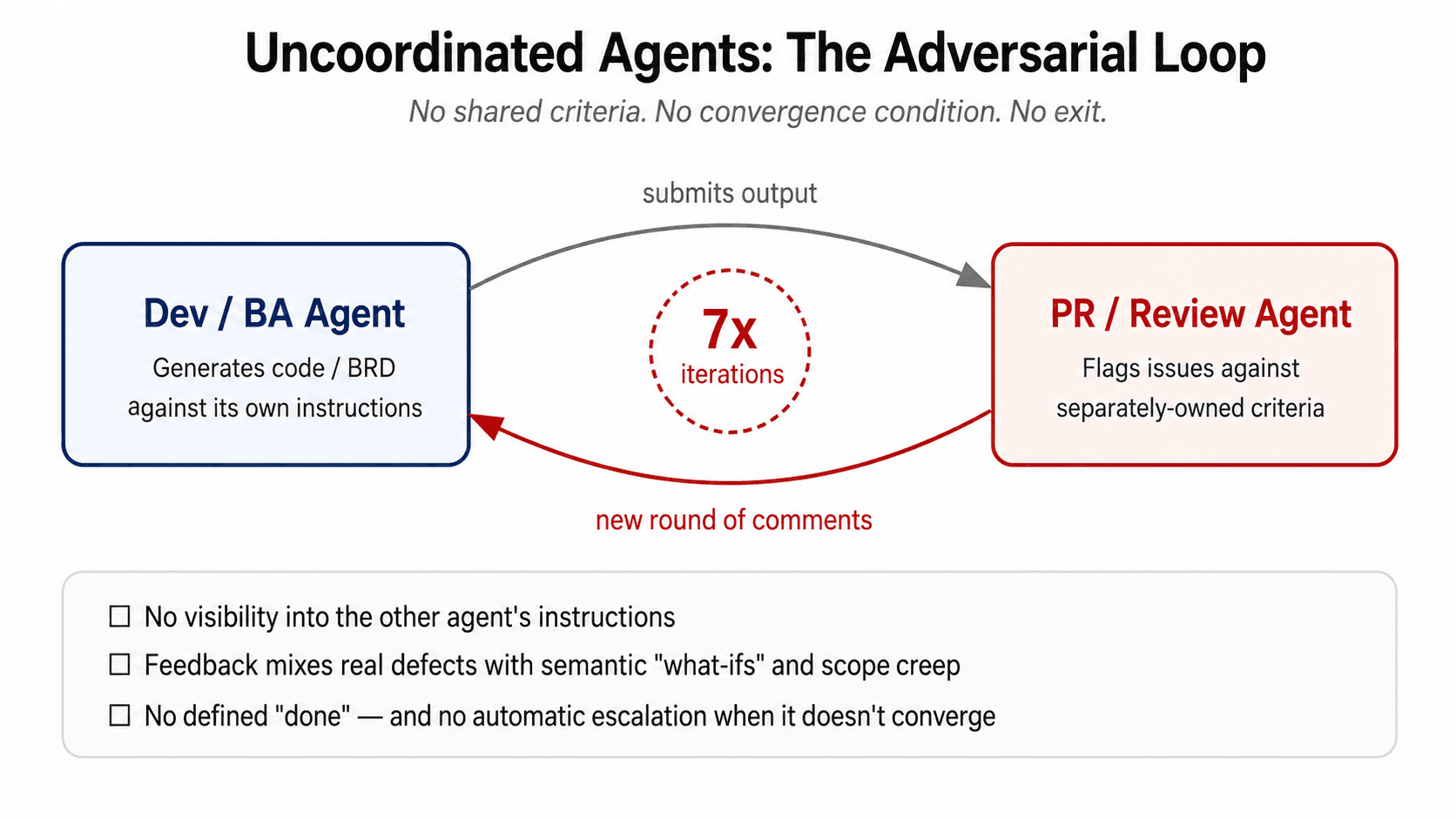
Here is what it looks like in practice, from a large-scale application modernisation engagement we ran on our iBeam platform, OptiSol’s agentic platform for the software development lifecycle, which builds specialised agents for legacy application modernisation and is part of the same family of platforms as elsai Platform. We built a Dev agent to convert legacy application code into a modern stack. The client’s own technical team, independently, built a Peer Review agent to assess code quality before anything reached a human reviewer. The instructions behind that PR agent were written by a different team, on a different timeline, without visibility into what our Dev agent had been instructed to produce.
The result was a review cycle that would not converge. Seven rounds of PR comments on the same piece of code, in one case, before it stopped. Many of the flagged items were not defects, they were stylistic preferences, hypothetical edge cases, and occasionally feature requests dressed up as code quality feedback, asking for functionality that was outside the agreed project scope entirely.
Two well-built agents. Two reasonable sets of instructions. Zero coordination between them. The outcome was not efficiency. It was a hamster wheel, developer hours and project time consumed by rework that produced no functional improvement, while nobody had defined what “done” actually meant.
“Two agents, each optimising for their own local instructions with no shared convergence criteria, do not settle into agreement. They oscillate — structurally similar to a generative adversarial network with no training objective, except nobody designed this pairing to converge, and nobody is watching the loss function.”
This is not an SDLC-specific problem

Or consider Procurement supply-chain. A sourcing agent identifies vendors and drafts purchase recommendations based on cost and delivery criteria. A compliance or policy agent reviews those recommendations against procurement policy, vendor risk criteria, and budget authority rules. Left uncoordinated, the same pattern can emerge: the sourcing agent optimises for cost and speed, the policy agent — with no visibility into the sourcing agent’s actual constraints — flags recommendations against a policy standard nobody surfaced upfront, and procurement cycles that should compress under automation instead stretch out under agent-to-agent friction.
In every one of these cases, the individual agents are not the problem. Each one, built and evaluated in isolation, might perform well. The failure lives in the space between them — a space that, in most organisations today, nobody explicitly owns.
What a governance layer actually needs to do
This is precisely the class of coordination problem that elsai Platform was designed to solve. As a Sovereign AI Platform, it gives enterprises a governance and orchestration layer they own and control, regardless of which models, agents, or cloud environments they choose.
Not by building better individual agents — organisations are already capable of doing that themselves, on Claude, on open-weight models, on whatever platform fits their use case. elsai Platform exists as the sovereign control plane that sits above those agents, regardless of who built them or what they run on, and makes coordination a designed property of the system rather than an accident of however each team happened to write their instructions.
Concretely, that means four things.
A shared, versioned instruction and acceptance-criteria layer.
Every agent contributing to a shared outcome — a converted codebase, a submitted claim, a purchase recommendation — needs to be operating against the same definition of “done,” visible and auditable, not discovered after the fact through a slow iterative review cycle. In elsai Platform, this lives as a managed prompt and policy layer, versioned and reviewed the same way any other operational asset would be.
Deliberately designed agent-to-agent workflows.
A pipeline of agents should be an intentional architecture, not an emergent side effect of multiple teams touching the same artefact. elsai Platform’s orchestration layer is built to define these handoffs explicitly — what each agent receives, what it is accountable for, and how its output is validated before the next agent acts on it.
A defined human-in-the-loop threshold.
When agents disagree, or fail to converge after a bounded number of retries, the process should escalate automatically to a named human reviewer — not continue iterating indefinitely while nobody notices the cost accumulating. This is a core guardrail in elsai Platform’s governance model: bounded retries, automatic escalation, and a clear audit trail of what was escalated and why.
Full observability over tool use, actions, and token spend.
An uncoordinated multi-agent loop is not only a time cost. It is a direct, measurable infrastructure cost, often invisible until a bill or a burn-rate review surfaces it. elsai Platform gives leadership visibility into what every agent in the estate actually did, and what it cost to do it — before that number becomes a surprise in a budget review.

The lesson that applies everywhere I look
The uncomfortable truth underneath all of this is that none of the teams in the examples I have described were doing anything unreasonable. Every agent involved had a legitimate purpose and a defensible set of instructions. Nobody set out to build friction. It emerged, every time, from the absence of a governance layer that made coordination somebody’s explicit job.
As agent-building continues to become commoditised — and it will, across every vertical, at increasing speed — the organisations that get real value out of this technology will not be the ones with the most agents. They will be the ones who treat the coordination layer between agents with the same rigour they apply to the agents themselves.
That is the coordination challenge elsai Platform is designed to solve, not simply as another orchestration framework, but as a governance layer that travels with an organisation across every process it chooses to put agents against, whether that is legacy application modernisation, healthcare claims, procurement, or whatever comes next.
“The agents were never the problem. The absence of a referee was.”
Recent blogs


Secure your agents
We’d love to chat with you about how your team can secure and govern Ai agents everywhere
Get a demo →