Document Drafting Agents: Turning an Approved Master Protocol Into ICF and Patient-Guide First Drafts

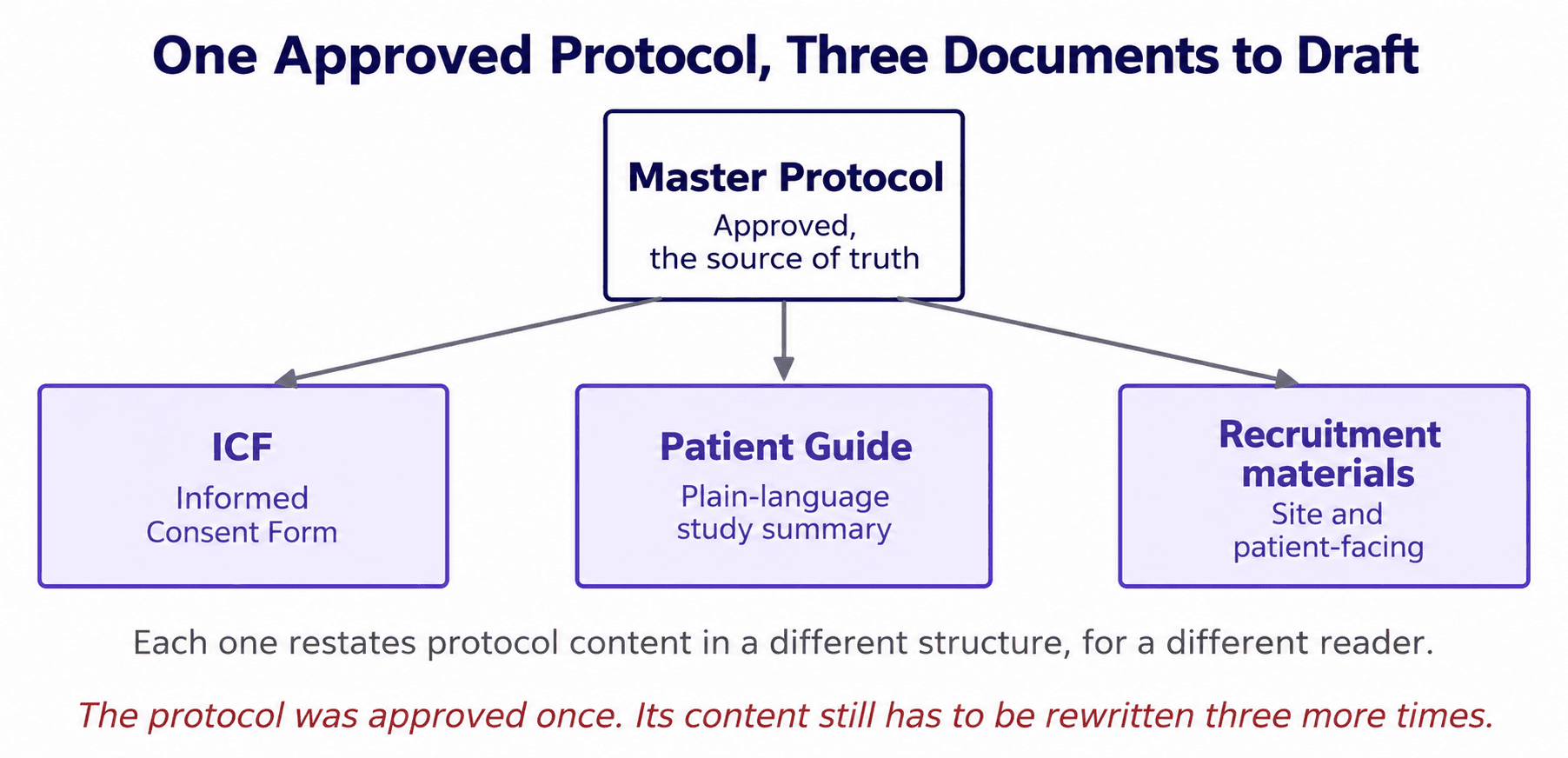
An approved Master Protocol gets written once, reviewed, and signed off. Its content then gets rewritten at least three more times: once as an Informed Consent Form, a patient can read, once as a Patient Guide in plain language, and once again as recruitment materials for sites and prospective participants. None of the content is new. All of it already exists in the protocol. It just has to be found, restructured, and rewritten for a different reader, by hand, for every study.
That gap, between an approved protocol and the documents that have to be derived from it, is what agentic AI for clinical trials applied to document drafting is actually built to close. It isn't about generating new clinical content. It's about taking content that's already been reviewed and approved once and turning it into a structured first draft for a downstream document, without asking a medical writer to start from a blank page or re-verify every fact against the source protocol by hand.
This piece looks at where a medical writer's time goes when drafting ICFs and Patient Guides manually, how a document drafting agent turns an approved protocol into a traceable first draft, and what stays firmly in human hands once that draft exists.
One Approved Document, Several More to Write
Creating downstream clinical study documents, Informed Consent Forms, Patient Guides, recruitment materials, is a repetitive and time-consuming process precisely because most of the content is already derived from the approved Master Protocol. The inclusion and exclusion criteria in the ICF are the same ones defined in the protocol. The study procedures described in a Patient Guide are the same procedures the protocol specifies. The risks disclosed to a participant are the same risks as the protocol's safety section already documents. Nothing here requires new clinical judgment. It requires accurate translation, consistently applied, across every document that draws from the same source.
AI agents in life sciences built for this specific gap don't replace the medical writer's judgment about tone, clarity, or what a patient needs to understand. They remove the part of the job that isn't really writing at all: locating the right protocol section, restating it accurately for a new audience, and checking that nothing drifted from the approved source in the process.
Where a Medical Writer's Time Actually Goes
Ask a medical writer where a typical ICF or Patient Guide draft takes the most time, and the honest answer is rarely the writing itself.

Locating the right protocol section for a given ICF clause or Patient Guide paragraph means cross-referencing a document that can run to hundreds of pages, by hand, every time. Rewriting that content for a new reader, plain language for a patient rather than clinical language for an investigator, is a genuine writing task, but one that starts from scratch for every document rather than building structured source material. Checking that the rewritten version still matches the approved protocol, that no detail was dropped, added, or subtly changed in translation, is verification work that has to happen manually because there's no built-in link between the draft and its source.
How the Draft Actually Gets Built
A document drafting agent starts from the same place a medical writer does: the approved Master Protocol, plus whatever additional context the study provides. What changes is how the first draft gets assembled, and the mechanism supports two different starting points depending on what already exists.

In template mode, a sponsor or CRO provides an existing .docx template, and the agent parses its structure and section headings first, then fills each section from the relevant protocol content in order, preserving the template's own format rather than replacing it. In free-form mode, when no template exists yet, the agent generates a complete draft in a single pass, drawing on the protocol and any additional supplied context. Both modes are governed by the same non-negotiable rule: only information present in the protocol or supplied source material can appear in the draft, and every generated statement carries an inline citation back to the specific text it came from. If the source material doesn't support a claim, the draft doesn't include it.
What Stays With the Person, Not the Agent
In agentic AI clinical trial data management, the output of a document drafting agent is a complete draft, not a finished document. It's routed into a review queue where a person, typically the medical writer who requested it, accepts, edits, or rejects the AI-generated content section by section before anything moves forward. Regulatory Affairs Specialists and CROs review and finalize the output beyond that point. No capability in this platform issues an automated regulatory approval independently; every draft, recommendation, or finding exists for human review, not as a substitute for it.
This division of labor is deliberate, not a limitation worked around. A medical writer's judgment about tone, patient comprehension, and cultural or regional appropriateness in an ICF is not something a first draft can replace, and it was never meant to. What changes is the starting point: instead of a blank page and an afternoon spent cross-referencing a 200-page protocol, the writer starts from a structured, cited first draft and spends their time on the parts of the job that actually require their judgment.

The First Draft Was Always in the Protocol
An ICF, a Patient Guide, and a set of recruitment materials are not new documents in any meaningful sense. They're the same approved protocol content, restructured for three different readers, and a medical writer currently must perform that restructuring by hand, from scratch, for every study. The content was already reviewed once. Deriving three more documents from it shouldn't require starting over three more times.
This is what elsai Document Drafting capability is built to give a medical writing or regulatory affairs team directly: a first draft of the ICF, Patient Guide, or recruitment material, generated from the approved Master Protocol in either template or free-form mode, with every sentence traceable back to the exact source text it came from, routed into a review queue where a person makes the final call before anything is finalized. Explore how elsai supports agentic ai in life sciences across the trial lifecycle, from hypothesis validation through document drafting, at elsai.ai/agents/life-sciences.
FAQ
Can a document drafting agent generate ICF content that isn't in the approved protocol?
No. The agent enforces a zero-hallucination rule: only information present in the Master Protocol or other supplied source material can appear in the draft, and every generated statement includes a citation back to the specific source text. If the protocol doesn't support a claim, the draft won't include it, which means a gap in the draft is a signal to check the protocol, not an agent inventing content to fill a blank.
What's the difference between template mode and free-form mode?
Template mode applies when a sponsor or CRO already has a .docx template for the document; the agent parses its structure and fills each section from the protocol in order, preserving the template's own format. Free-form mode applies when no template exists yet; the agent generates a complete draft in a single pass from the protocol and any additional context provided. Both modes produce a fully cited draft, they differ only in whether an existing document structure is being filled or a new one is being generated.
Does this replace the medical writer, or just the first draft?
Just the first draft. The output is routed into a review queue where a person accepts, edits, or rejects the AI-generated content before it's finalized, and Regulatory Affairs Specialists and CROs review the output beyond that. The agent removes the manual cross-referencing and rewriting-from-scratch burden; the medical writer's judgment on tone, clarity, and patient comprehension remains fully in human hands.
How is Document Drafting different from the protocol audit and compliance review capability?
They're separate capabilities serving different stages. A clinical trial protocol audit agent checks whether an already-written document satisfies validation rules or compliance requirements, finding gaps or non-compliant language in existing text. Document Drafting generates the document in the first place, producing a first draft of an ICF or Patient Guide from the approved protocol before that document exists to audit. A drafted document can still go through audit and compliance review afterward as a separate step.
What happens if the protocol is amended after a document has already been drafted?
Because every sentence in the draft is traceable back to specific protocol text, a protocol amendment gives the team a clear, precise way to identify exactly which downstream document sections were derived from the changed content, rather than having to manually re-check an entire ICF or Patient Guide against every protocol update.
See how elsai connects clinical trial workflows with AI agents for clinical trial data management.
Request free demo →


We’d love to chat with you about how your team can secure and govern Ai agents everywhere
Get a demo →