
EPC Procurement Automation: Connecting Project Planning, Inventory, Sourcing and Supplier Decisions

Mid-market EPC and capital-project firms lose an estimated $500,000 to $1.1 million a year in pure administrative overhead, document compilation, and coordination work spread across procurement, legal, and operations. A single compliance failure, an uninsured subcontractor, a missed obligation, an audit finding traced back to a gap nobody caught, carries an estimated $500,000 to $2 million in direct liability. Vendor onboarding alone runs 5 to 15 business days on average, and every one of those days is a mobilization risk on a schedule that doesn't have slack built in for it.
None of those figures are sourcing problems in the traditional sense. They're the compounding cost of running project planning, inventory, sourcing, and supplier decisions as four separate systems that happen to sit inside the same project. Each function has an accurate view of its own slice of work. None of them has a reliable view of the other three, and on a capital project, that gap is exactly where schedule risk and cost overrun actually originate.
Construction procurement software built for this reality must do more than digitize a single stage. It must connect the four functions that currently run in parallel without talking to each other, so a change in one becomes visible to the other three automatically, not three weeks later in a status meeting.
This piece looks at why these four functions stay disconnected even in procurement operations that are individually well run, the specific points where that disconnect turns into a missed install date or a wrong supplier decision, and what changes when a schedule update, an inventory count, a sourcing intelligence, and a supplier award all draw from the same live picture of the project.
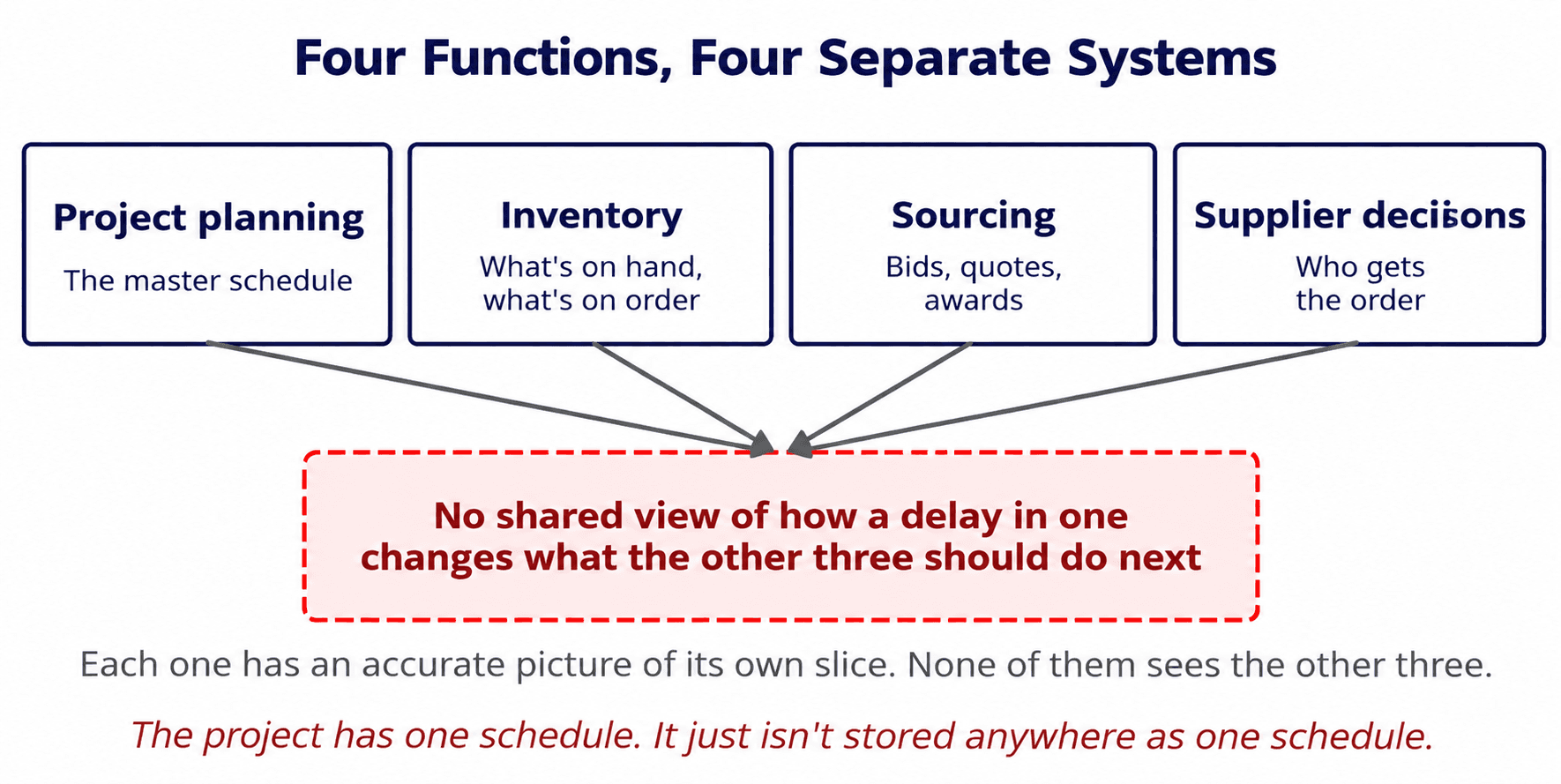
Four Functions, Built as Four Separate Systems
Project planning owns the master schedule and knows exactly when a given system, structure, or piece of equipment needs to be on site. Inventory knows what's physically on hand and what's already on order, but rarely knows why a particular delivery date matters beyond the purchase order it's tied to. Sourcing runs bids, evaluates quotes, and manages awards, usually against a procurement timeline that was set once, early, and rarely revisited against the live schedule. Supplier decisions, who actually gets the order, get made against sourcing's own criteria: price, quoted lead time, past performance, without a live read on which supplier's delivery promise actually protects the current schedule and which one quietly puts it at risk.
Each of these functions does its job competently in isolation. failure isn't a competence problem. It's that procurement automation applied to any single one of these four in isolation optimizes a piece of the process while leaving the connections between pieces exactly as manual, and exactly as fragile, as they were before.
Where a Schedule Slip Actually Originates
A missed install date rarely traces back to a single dramatic failure. It traces back to one of a small number of quiet, structural gaps that show consistently across capital projects to run on disconnected systems.

A schedule pulled forward doesn't automatically reach sourcing, so a long-lead item gets ordered against the original date rather than the revised one. Inventory and sourcing can each believe a shortfall is covered;, inventory assuming sourcing placed the order, sourcing assuming inventory has stock on hand, when neither is true. A supplier gets selected on quoted price and lead time alone, without visibility into which vendor's current backlog or delivery reliability actually threatens the specific milestone that award is meant to protect. None of these three is a sourcing team failing at its job. Each is a visibility gap between systems that were never designed to inform each other.
What Changes When the Four Functions Share One View
The fix isn't a faster version of any one function. It's making a change in one function immediately visible, and actionable, to the other three.

When the schedule moves, an install date pulled forward, a phase sequenced, that change should immediately check against inventory: is the required material already on hand or on order in time for the new date. If it isn't, the gap should route to sourcing automatically. Before the date is at risk, not after a site team discovers the shortfall during a weekly coordination call. And the supplier's decision itself should reflect the current picture: which vendor can meet the revised date, not just which vendor quoted the best price against a schedule that's already out of date.
This is the practical meaning of connecting AI agent in procurement work across a project rather than deploying it inside one function. elsai's Procurement Tracking workflow, already running on EPC and shipbuilding programmes, applies exactly this kind of connected visibility: email intelligence that captures supplier commitments as they're made, auto-generated file notes and comparison reports that keep the record current without manual compilation, and full programme-level tracking that gives procurement teams and programme directors the same live picture rather than four separate ones.
The Cost of Staying Disconnected
The numbers cited at the outset aren't abstract industry statistics floating separately from this problem; they're the direct, compounding cost of the four-system gap. The $500,000 to $1.1 million in annual administrative overhead is largely the labor of manually reconciling what planning, inventory, sourcing, and supplier records each show; work that exists specifically because those systems don't already agree. An AI agent for supply chain management can help connect these workflows, while a multi agent procurement AI platform can coordinate planning, sourcing, inventory, and supplier intelligence without requiring teams to replace the systems they already use. The 3 to 10 days it takes to reconstruct an audit trail after an inspection is a direct consequence of decisions, a supplier award, an inventory adjustment, a schedule change, being recorded in separate systems with no connected history. Where operations teams have moved to a connected model, the throughput gain has run as high as three times the work on the same headcount in comparably coordination-heavy settings, a directional pattern worth naming honestly rather than as an EPC-specific guarantee.

Built on the Systems Already Running the Project
A capital project's schedule, inventory position, sourcing pipeline, and supplier decisions describe one underlying reality, the actual state of the project on any given day. Running them as four disconnected systems doesn't just create administrative overhead. It creates the specific conditions where a schedule slip, a stock miscount, or a supplier chosen without full visibility becomes the version of the project a team discovers weeks after it happened, rather than the moment it started to happen.
This is what elsai Procurement Tracking and Supplier Intelligence agents are built to give an EPC or capital-projects procurement team directly: a schedule change that automatically checks against inventory, a shortfall that reaches sourcing before a date is missed, and a supplier decision informed by which vendor can actually meet the project's current reality, not the one it started with. See how the platform supports EPC and capital-project procurement at elsai.ai.
FAQ
Why does connecting planning and sourcing matter more on EPC projects than on simpler procurement categories?
Because EPC and capital projects carry long lead times, sequenced installation dates, and high-value equipment where a missed date has a direct, visible cost, a delayed milestone, idle site labor, a resequenced schedule. A shorter or lower-value procurement category can absorb a planning-sourcing disconnect with less consequence; a multi-year capital project generally cannot.
Does connecting these four functions require replacing our existing ERP or scheduling software?
No. The connection is designed to sit across the systems a project already runs, the scheduling tool, the ERP, inventory records, and the procurement platform, reading and reconciling what each already contains rather than requiring a migration to a single new system mid-programme.
What specifically counts as a supplier decision being informed by the current schedule?
It means the award reflects a vendor's ability to meet the project's current install date and current inventory position, not just the quoted price and lead time submitted against an earlier version of the schedule. If the schedule has moved since a bid was submitted, the decision should account for that, rather than proceeding on stale assumptions.
How does inventory visibility prevent a schedule slip before it happens?
By checking on-hand and on-order stock against the current schedule automatically, rather than periodically, a shortfall against a specific install date can be flagged and routed to sourcing while there's still time to act on it, instead of surfacing only when a site team discovers the material isn't there.
Is this the same as general procurement automation, or specific to EPC and construction?
The underlying mechanism, connecting planning, inventory, sourcing, and supplier decisions into one live view, applies to any project-based procurement environment. It matters most acutely in EPC, construction, and capital projects specifically because of the long lead times, sequenced milestones, and high cost of a missed date that define those programmes.


We’d love to chat with you about how your team can secure and govern Ai agents everywhere
Get a demo →