
A Lapsed Contract Is a Silent Breach: How a Renewal Intelligence Agent Tracks Notice Periods

Nothing happens when a notice window closes. No invoice runs late, no system throws an error, and no one is paged. A supplier contract with a 90-day notice period passes its deadline on an ordinary Tuesday, and the first sign is an invoice at next year's rate or a supplier that has stopped delivering.
That silence is why a lapsed or auto-renewed contract behaves like a breach. Strictly, whether a missed notice date is a breach depends on the contract and the jurisdiction, and often it is simply a right that went unused. The effect is the same either way: a commitment you did not choose, a gap you did not plan for, or leverage you no longer have, discovered after the fact.
The problem is documented, if unevenly. In a 2021 survey of 100 UK in-house lawyers and company secretaries, commissioned by a contract software vendor, almost half said their companies were missing automatic renewals, reporting an average of just under 2.5 missed renewals in the prior year on contracts worth about £29,800 each. More recently, Docusign research reports that 90% of procurement teams struggle to find and properly evaluate vendor agreements within 30 days of a renewal deadline. Notice periods commonly run 30, 60, or 90 days, so a team that starts looking a month out is often already late.
This piece explains why the date on the contract is the last of three dates that matter, how a Renewal Intelligence Agent built on contract intelligence tracks renewal and notice-period obligations and flags lapsed contracts, and which neighbouring agents supply the evidence for the decision. It also shows why reminders from contract renewal software leave the hard part undone.

A Renewal Date Is the Last of Three Dates
Most teams track one date: the renewal date written in the contract. Three dates actually govern the contract renewal process. The renewal date is when the new term begins. The notice deadline is the renewal date minus the notice period, and it is the last day anyone can act without the contract rolling over. The decision start is the notice deadline minus the time the team needs to review the supplier, align stakeholders, and take a position.
Take a contract that renews on 1 December with a 90-day notice period. The notice window closes on 2 September. If the team needs 45 days to review and align, which is an assumption for illustration, the work has to begin on 19 July, more than four months before the date on the contract. A reminder set for 1 December, or even 60 days before it, arrives after the window has closed.

Multiply that by hundreds of supplier contracts, each with its own term, renewal length, and notice wording, and the calendar stops being a list. It becomes a set of overlapping clocks that someone has to read out of the paperwork, one clause at a time. The first two dates come from the contract. The third depends on how much time your team needs, which is why early warning matters more than the date itself.
How the Renewal Intelligence Agent Tracks Notice Periods
The Renewal Intelligence Agent is built for the contract renewals manager, whose problem is the one this article opens with: notice periods get missed, and contracts roll into unfavourable auto-renewals. It sits in the Contract Intelligence family on the elsai platform and tracks renewal and notice-period obligations against the renewal calendar. It flags contracts that have lapsed, so the manager can renegotiate, renew, or exit on time.
Early warning is the point. The agent identifies upcoming renewals early, which gives a team time to renegotiate, renew, or terminate on purpose instead of by default. It works within the same contract lifecycle workflow as AI clause analysis and plain-language contract querying, so a manager can ask a question about a term instead of searching a forty-page document. It connects to the ERP, contract repository, and finance systems a team already runs rather than asking for a migration.
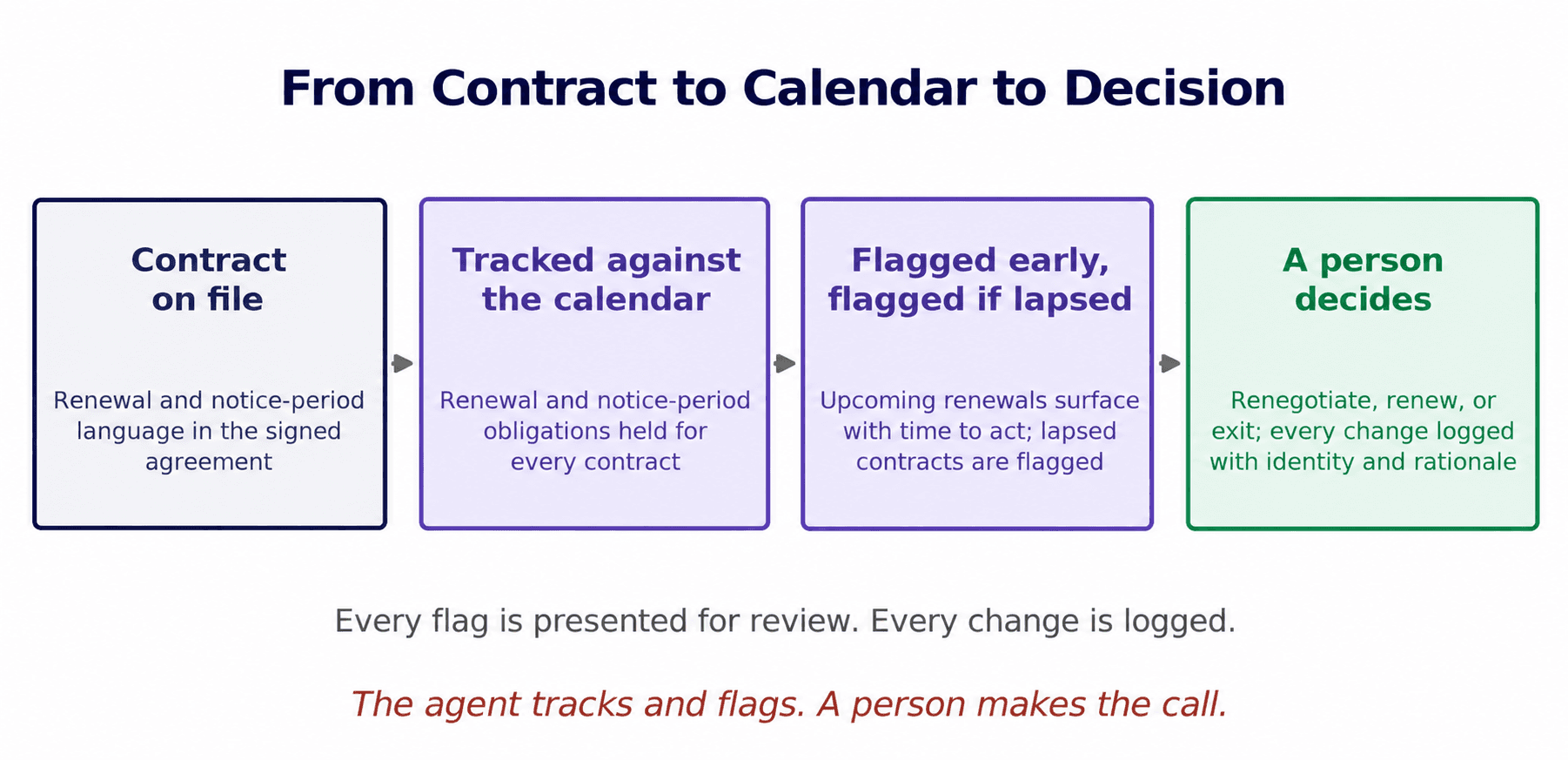
Nothing in this flow acts on its own. A manager reviews each flag, and every change is logged with identity and rationale, so the record shows who decided what, and why.
Two measures show whether the tracking is working: the share of contracts held against the renewal calendar, and the share of notice windows acted on before they close. The agent's stated aim is every contract tracked and no renewal missed by default. Those are targets, not published results.
Why a Reminder Is Not Renewal Tracking
In most supplier contract management setups, the renewal calendar is a spreadsheet or a shared mailbox. Contract renewal software that stores a date and sends a reminder solves a narrow problem. A supply chain AI agent can go further by helping track renewal dates, account for contract amendments, and ensure the right owner has the context to act. Relying on manual date entry, outdated information, and reminder follow-ups creates gaps that can go unnoticed.
Ownership is the weakest link. When the same survey asked who is responsible for renewals, 55% of in-house lawyers named the legal team, 37% procurement, 26% sales, 22% finance, and 21% business owners. The shares total 161%, so many respondents named more than one owner. One contract software executive described what follows as responsibility falling between the cracks once the deal is signed, and 15% of the lawyers surveyed said they relied on Post-it notes.

AI Agent contract management that only stores and searches agreements inherits the same weakness. It makes the paperwork findable, but a findable clause does not wake anyone up on 2 September. An agent that holds renewal and notice-period obligations against the calendar does not wait for a person to remember.
Three Ways the Silence Ends
A missed window does not stay silent forever. It ends in one of three ways, and each shows up in a different place.

An evergreen clause, which many contracts call an automatic renewal clause, renews the agreement for another term unless one party gives written notice inside a defined window. That is convenient for continuity and costly for anyone who stops watching the window. Treating renewal windows as part of contract risk management, not as calendar housekeeping, changes who cares about them.
Where the Demand Is: Software Renewals at Volume
The pull for this agent is clearest in software renewals. In elsai's own customer demos, a services firm managing a large portfolio of software renewals named renewal management as its strongest interest.
The reason is arithmetic. Software agreements often renew automatically on annual terms, owners are scattered across departments, and each renewal is small enough to slip past a manager yet large enough to matter in total. A calendar that depends on memory breaks first at volume. That is the case for starting small: one agent on the renewals that matter most, before widening to the rest of the contract estate.
The Evidence Behind the Decision
A renewal date tells a manager when to decide. It does not say what to decide. An AI agent in procurement is most useful when it does not work alone, because the renewal conversation needs evidence that sits with neighbouring agents on the same platform, sharing context rather than handing over files.

• Is the supplier still at risk? The Risk Scoring Agent holds one weighted risk score per supplier, and the Continuous Monitoring Agent tracks drift between reviews, so the renewal call starts from current risk instead of last year's review.
• Did the supplier meet its terms? The Obligation Extraction Agent builds a structured register of obligations from the contract text, and the Obligation & Deviation Monitoring Agent tracks obligations, milestones, SLAs, and pricing-escalation clauses and alerts on deviation. This is where breach belongs in elsai's vocabulary: it acts on deviation from committed terms during the term, before a breach becomes a dispute.
• What would a failure cost under this contract? The Contract Exposure Agent links supplier risk and disruption impact to contractual SLA, exclusivity, and penalty exposure.
• What else is about to expire? The Vendor Compliance Agent tracks certificate and licence expiry, and the Statutory & Regulatory Deadline Agent tracks statutory and notification deadlines and escalates inside the lead-time window.
The division of labour supports the title. The calendar is the Renewal Intelligence Agent's job, and a lapsed contract is a window that closed, not a supplier failure. Performance during the term is a neighbour's job. Keeping them separate stops a missed notice date from hiding behind a good scorecard.
Deciding on Purpose Instead of by Default
Every contract reaches a renewal date, and every renewal is a decision. The only choice is whether someone makes it on purpose, with time to review the supplier and room to negotiate, or whether the calendar makes it by default. A missed window is the second option, taken without anyone noticing.
Procurement automation that ends at the award, and contract tools that end at storage, leave that decision to memory. A Renewal Intelligence Agent moves it onto the calendar: it tracks the renewal and notice-period obligations, flags the window while there is still time to act, and flags the contracts that have already lapsed, with its neighbours supplying the evidence to decide with. To see how the elsai platform handles renewals and notice periods on a real contract case, request a demo at elsai.ai/agents/procurement.
FAQ
What is an evergreen clause, and how does the notice period work?
An evergreen clause renews a contract for another term unless one party gives written notice within a stated window before the term ends. The notice period is the length of that window, commonly 30, 60, or 90 days, though the contract sets the figure. The deadline to act is the renewal date minus the notice period, so a 90-day notice period on a 1 December renewal closes on 2 September.
Is letting a contract lapse or auto-renew a breach?
Usually not by itself. A missed notice date is often a right that went unused rather than a breach, and an expiry is not a breach either. What matters is what the contract says and which jurisdiction applies, so confirm specifics with counsel. The practical consequences are the same whatever the label: an unplanned renewal term, a service or cover gap, or lost leverage.
How does a Renewal Intelligence Agent track notice periods?
It tracks renewal and notice-period obligations against the renewal calendar, identifies upcoming renewals early so the team has time to act, and flags contracts that have lapsed. It works within the same contract lifecycle workflow as AI clause analysis and plain-language contract querying, connects to the ERP, contract repository, and finance systems already in use, and presents every flag for review, with each change logged with identity and rationale.
How is it different from calendar reminders or contract renewal software?
A reminder counts down to a date someone typed in, and it depends on that person staying the owner. The agent holds the renewal and notice-period obligations against the calendar as a tracked record, flags upcoming renewals early and lapsed contracts afterward, and sits beside neighbouring agents that supply the supplier risk, performance, and exposure evidence a manager needs to decide.
Does the agent send notices or decide whether to renew?
No. It tracks and flags, and a person decides whether to renegotiate, renew, or exit. At the platform level, supplier correspondence capabilities draft routine emails, renewal notices among them, for a person to send or approve. Every change is logged with identity and rationale.
See how elsai streamlines supplier contract renewals with governed supply chain AI agents.
Request free demo →


We’d love to chat with you about how your team can secure and govern Ai agents everywhere
Get a demo →