
Where does the AI run? Which model processes the data? And can the enterprise prove what the agent did after the workflow completes?
Those three questions determine whether an AI deployment is truly sovereign. For regulated enterprises, controlling data residency is only one part of the requirement. The enterprise also needs control over model execution, deployment infrastructure, policies, and the operational record generated by every agent action.
Sovereign AI architecture therefore goes beyond on-premises deployment. It defines where data is processed, where inference occurs, which models the enterprise can use, and how the organization monitors, governs, and audits agent activity.
Gartner expects more than 40% of agentic AI projects to be canceled by the end of 2027 because of escalating costs, unclear business value, or inadequate risk controls. That makes governance and operational control a production requirement, not simply a security preference.

The Trade-Off Nobody Should Have Had to Accept
For the last two years, enterprises evaluating AI have effectively been offered two options. Public AI and SaaS copilots are fast to pilot and genuinely capable, built on frontier models with real reasoning ability. In a conventional cloud AI architecture, prompts and enterprise data are processed by a provider-managed service outside the organization's own infrastructure boundary. The alternative, building everything in-house on fully on-premises infrastructure, gives real control, but it's slow, expensive, and most enterprises don't have the AI engineering bench to build and maintain a production-grade agent stack from scratch.
Neither option was ever really about AI capability. Both were about where the enterprise was willing to give something up, either data control or delivery speed. That's a false choice, and it's worth naming as false, because the vendors selling the first option have very little incentive to point out that a third one exists.
Where Control Actually Leaks
To see why the two-option framing is wrong, it helps to break "control" into the three places it can actually be lost, because most ai agent governance conversations collapse them into one and then solve for only one.

Data control leaks the moment a prompt, a document, or a record has to leave the enterprise's own environment to reach a hosted model. For a regulated healthcare group or a defence supplier, that single hop can be the entire problem, regardless of how good the model's answer is. Model control leaks when the reasoning engine itself is vendor-hosted: the enterprise doesn't choose which model version runs, can't audit how it was trained, and has no say when the vendor changes its behavior. Operational control leaks last, and it's the one enterprises notice latest and regret most: without a traceable record of what an agent did, on whose authority, and why, there's no way to answer a regulator, an auditor, or a customer who asks a specific question about a specific decision six months later.
Point fixes address one of these at a time; a VPN doesn't fix model opacity, and a private model endpoint doesn't create an audit trail. That's why sovereignty has to be architectural, not a setting a customer toggles on.
Five Layers, Not One Switch
A sovereign architecture closes all three gaps at once by design rather than by add-on. The elsai platform is built on five integrated layers, and the ordering matters: sovereign AI is the foundation everything else sits on, not a feature bolted on top of a SaaS product.
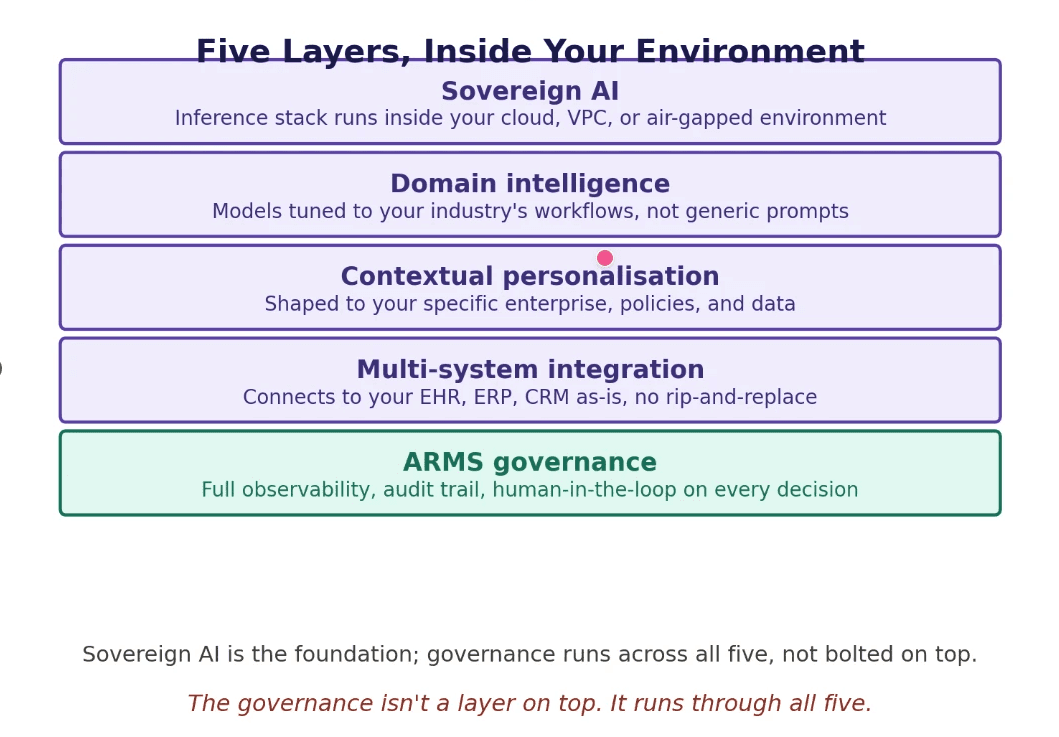
Sovereign AI means the inference stack itself, the actual model execution, runs inside the enterprise's own cloud, virtual private cloud, or a fully air-gapped environment, not a third-party tenant. The platform is model-agnostic, allowing enterprises to work with models available through services such as AWS Bedrock and Azure OpenAI, as well as supported self-hosted or open-weight models. The deployment model determines the level of sovereignty: cloud-hosted model services can operate within controlled cloud boundaries, while fully air-gapped deployments require models that the enterprise can host within that environment.
Domain intelligence and contextual personalisation are the two layers that make agents useful rather than generic: models tuned to the actual workflows of healthcare, life sciences, or supply chain operations, then shaped further to one enterprise's own policies, terminology, and data. Multi-system integration connects agents to the systems already in place, EHR, ERP, CRM, without a rip-and-replace migration, because a sovereign deployment that still forces a system overhaul isn't actually solving the adoption problem.
The fifth layer, elsai observe governance, is the one that turns the other four into something a CISO can actually sign off on. elsai observe gives full observability into what every agent did: token usage, cost, latency, and distributed traces across every agent action, captured as a traceable operational record rather than reconstructed after the fact from logs scattered across five tools. Alongside it, Guardrails runs the policy-enforcement layer itself, input and output checks for PII and PHI exposure, toxicity, tool authorization, and rate limits, before and after every model call, with a human-in-the-loop checkpoint on the decisions that need one.
The Part Most Vendors Skip: The Audit Trail, Not Just the Perimeter
It's worth being direct about a pattern in the current market: a growing number of AI orchestration vendors now use the language of governance, connecting fragmented systems and agents into one coordinated layer. That part of the pitch is legitimate and increasingly table stakes. What's usually missing is that the orchestration itself still runs in the vendor's own cloud, with no on-premises or air-gapped option, which quietly disqualifies it for exactly the regulated buyers who most need the governance story to be real. Orchestration without sovereignty solves the operations problem and leaves the data and model problems exactly where they were.
This is also where ai agent observability stops being a nice dashboard and starts being the actual trust mechanism. Every agent action, every policy check, every human approval or override needs to be inspectable after the fact, not just visible while it's happening, because the question that actually matters in a regulated review is rarely "is this working right now" and almost always "what did the agent do on this specific case three months ago, and who approved it."

Why This Doesn't Slow Delivery Down
The instinct is to assume sovereignty and speed pull in opposite directions, more control, slower delivery. In practice the opposite failure mode is more common: the pilots that stall are the ones built without governance from the start, because the moment they need to scale past a sandbox, security and compliance review catches up with them and the project stops cold. A sovereign ai deployment front-loads that review instead of deferring it. The infrastructure question, security posture, and audit requirements get resolved before the first workflow goes into production, not after a successful pilot triggers a review that kills it.
This is also why deployment fits the infrastructure an enterprise already runs, rather than requiring a new one. The elsai platform runs in the cloud, in a private cloud, or fully on-premises, and connects to existing enterprise applications rather than replacing them, so "sovereign" doesn't mean "start over." It means the same ai agent orchestration an enterprise would get from a cloud-only platform, minus the part where that orchestration's own record of what happened lives somewhere the enterprise can't reach.
Control You Can Prove, Not Just Claim
The organizations asking the sharpest questions about AI right now, healthcare systems, defence and aerospace suppliers, financial institutions, government agencies, aren't asking because they're behind on AI. They're asking because they're the ones who'll actually be held accountable for what an agent did, and "the vendor's dashboard says it's fine" isn't an answer that survives an audit.
This is what the elsai platform is built to give an enterprise ai platform buyer directly: an inference stack that runs inside the infrastructure you already control, models you choose rather than models a vendor assigns you, domain intelligence and personalisation layered on top of your own data and policies, integration with the systems you already run, and ARMS governance that makes every agent decision traceable, policy-checked, and reviewable, not just while it happens but months later when someone asks. The result is a governed AI architecture in which the enterprise controls the deployment environment, model selection, data boundaries, policies, and operational audit trail. See the full architecture at elsai.ai/enterprise-ai-platform, or explore how the platform is sovereign by design at elsai.ai.
Frequently Asked Questions
What does sovereign AI actually mean, beyond “runs on-premises”?
It means an enterprise keeps control of three separate things at once: the data an agent processes never has to leave the enterprise's own environment, the model doing the reasoning runs on infrastructure the enterprise chooses (cloud, private cloud, or air-gapped) rather than a vendor's shared tenant, and every action an agent takes is captured in a traceable, auditable record the enterprise owns. On-premises deployment is one way to satisfy the first two conditions, but sovereignty is the combination of all three, not any single deployment location on its own.
Does choosing a sovereign, governed AI platform mean slower deployment than a SaaS copilot?
Not in practice. SaaS copilots deploy fast but frequently stall later, when a pilot that worked in a sandbox meets a security or compliance review it wasn't built to pass. A sovereign architecture resolves the infrastructure, security, and audit questions up front, which avoids that stall later in the process. It also connects to the enterprise's existing EHR, ERP, or CRM systems rather than requiring a separate migration, which removes a second common source of delay.
Can a sovereign AI platform still use leading models like GPT, Claude, or Gemini?
Yes. Sovereignty is about where the inference stack runs and who controls it, not which model family sits inside it. A model-agnostic sovereign platform can integrate with leading model services such as AWS Bedrock and Azure OpenAI, while also supporting self-hosted or open-weight models where the deployment requires full infrastructure isolation. For an air-gapped environment, the selected model must support deployment within that environment.
What's the difference between AI agent orchestration and sovereign AI agent governance?
Orchestration connects fragmented agents and systems into one coordinated workflow; governance determines whether that coordination is provably safe, policy-compliant, and auditable. A platform can orchestrate agents without being sovereign, running the coordination layer in a vendor's own cloud with no on-premises or air-gapped option, which quietly rules it out for regulated buyers. Governed, sovereign orchestration does both: agents coordinate across systems and every action they take is policy-checked and logged inside an environment the enterprise controls.
Who actually needs sovereign AI, versus a standard SaaS AI tool?
Any enterprise operating under strict data-residency, regulatory, or audit requirements, healthcare systems bound by HIPAA, defence and aerospace suppliers under export-control and local-content rules, financial institutions, and government agencies, is in a position where a standard SaaS AI tool is often legally or contractually unusable for its most sensitive workflows, regardless of how capable the underlying model is. For less regulated use cases the trade-off is less severe, but the same three-part control question, data, model, operations, is worth asking before scaling any agent into production.
Recent blogs


Secure your agents
We’d love to chat with you about how your team can secure and govern Ai agents everywhere
Get a demo →