Procurement AI agents let defense organizations run and govern whole stretches of the source-to-contract cycle, qualifying suppliers, tracking negotiations, evaluating bids, and monitoring contract compliance, as autonomous workflows rather than manual tasks.
Procurement is one of the highest-stakes functions in defense. It runs on controlled and export-controlled data that cannot leave the organization's walls, and it produces award and compliance decisions that have to be defended, on the record, years after they are made. A platform that gets this wrong does not just slow a programme down; it can put an award, an audit, or a clearance at risk.
That is why procurement AI agents have become one of the fastest-moving categories of enterprise AI. Deloitte highlights that defence organisations face increasing pressure to modernise acquisition and procurement approaches as technology cycles accelerate and traditional processes struggle to keep pace with changing operational requirements.
The distinction that matters isare what "agent" actually meansmeans. If a procurement platform can only summaries a contract or answer a question about a supplier, but cannot extract a qualification field, generate a bid comparison, or flag an expiring certificate as a real action against live data, with a human approving the ones that carry weight, it is not an agent. It is a search tool with a chat box.
The market is now crowded with platforms claiming, "agentic AI." Very few offer the coverage, governance, and sovereign deployment a defence programme requires, and for a controlled programme two of those are pass-or-fail: where the audit trail is stored and controlled, and whether the platform can run on-premises or air-gapped.
In this guide, we review the seven procurement AI agents most relevant to defence in 2026, evaluating each on its ability to run and govern the full procurement cycle inside your own infrastructure.
Key takeaways
Defence procurement adds two non-negotiable criteria to any vendor comparison: where the audit trail is stored and controlled, and whether the platform can run on-premises or air-gapped.
Most procurement AI platforms are strong at one stage, negotiation, intake, sourcing, or a full suite, rather than the whole governed cycle.
Cloud-only SaaS platforms, however capable, are off the list for controlled and export-controlled programmes that cannot send supplier data outside their walls.
The right shortlist depends on your primary pain: match the function you most need owned to the platform built for it.
Defence Procurement Is Moving From Point Tools to Governed Agent Workflows
On a defence programme, a single compliance failure, an uninsured subcontractor, a lapsed clearance, a missed offset obligation, can cost an estimated 500,000 to 2 million dollars, and reconstructing the evidence of how a procurement decision was made can take 3 to 10 working days when it is scattered across email and spreadsheets. Those are the numbers that make procurement one of the highest-stakes functions in defence, and they are why defence teams are moving from single-function procurement tools toward AI agents that can run and govern whole stretches of the procurement cycle. The question for a defence procurement leader is no longer whether these agents can automate a task. It is whether the organisation can govern the decision and the action across its existing systems, and keep the data inside its own walls while doing it.
That is what makes defence a distinct buying context. In a commercial procurement team, an AI agent that lives in a vendor's cloud and speeds up sourcing is a straightforward win. In a defence programme handling controlled and export-controlled data, the same agent may be unusable no matter how capable, because the supplier information, the award reasoning, and the audit trail cannot leave the organisation's environment. This article sets out the five criteria a defence procurement team should evaluate against, then compares the seven platforms most relevant to this space against them, fairly and consistently, so the shortlist you finish with is the one that can actually clear your governance and sovereignty requirements.
Defence procurement also carries obligations no commercial category does, and any AI agent in procurement has to operate inside them. A defence programme is bound by an acquisition framework, such as India's Defence Acquisition Procedure, with its indigenous-content and Make-in-India thresholds, its offset obligations, and its export-control and security-classification rules on who may see supplier and design data. Programmes run for years across thousands of tiered suppliers, many carrying clearances, licences, and local-content commitments that must be evidenced on demand. An AI agent that cannot track those obligations, keep the evidence inside the security boundary, and show exactly how a qualification or award decision was reached is not merely less efficient in this context. It is inadmissible. That is the bar the platforms below are measured against.
Why Defence Procurement Teams Are Adopting AI Agents Now
The shift is not driven by novelty. It is driven by a widening gap between what defence procurement programmes have to deliver and the headcount available to deliver it, and by the specific, measurable drag that manual coordination puts on a programme. The figures below are drawn from elsai's own reported procurement deployments, so treat them as vendor-reported outcomes to validate rather than independent benchmarks; even read conservatively, four operational costs make the case.
Administrative overhead is a seven-figure line.
In reported elsai procurement deployments, the manual administrative overhead that agentic workflows remove runs to an estimated $500,000 to $1.1 million a year for a large programme, the cost of coordinating suppliers, chasing documents, and re-keying data by hand across disconnected systems.
Supplier onboarding collapses from weeks to hours.
Bringing a new supplier through qualification and onboarding by hand typically takes 5 to 15 business days. With agentic document extraction and qualification scoring, that compresses toward under 24 hours, which on a time-critical defence programme is the difference between a mobilised supplier and a slipped milestone.
Audit reconstruction stops being a multi-day scramble.
When an inspection or dispute requires evidence of how a procurement decision was made, reconstructing it from email and spreadsheets takes 3 to 10 working days. A governed agentic system holds that evidence continuously, taking audit readiness to a reported 95 percent or better and every decision to a fully traceable record.
A single compliance failure is expensive.
The compliance-failure exposure noted at the outset, an estimated $500,000 to $2 million per failure, is the sharpest example: continuous compliance and obligation monitoring is how agentic procurement turns that from a recurring exposure into a managed one, while reported document-preparation effort falls 80 to 90 percent and procurement cycle time 70 to 85 percent.
What Makes a True Procurement AI Agent, Not Just an ERP Feature
Before comparing platforms, it helps to be precise about what a procurement AI agent actually is, because the word agent is now attached to everything from a chatbot to a spend dashboard. A genuine procurement AI agent, the kind worth evaluating for a defence programme, has three capabilities that a bolt-on AI feature does not.
1. Reasoning across the workflow, not a fixed script.
An agent understands the objective, evaluate these bids, qualify this supplier, check this contract for risk, and works through the steps to reach it, handling the exceptions a rigid rules engine would break on. A rules engine checks whether a document is formatted correctly. An agent assesses whether the supplier behind it is qualified.
2. Action across your systems, not just answers.
A true agent is connected to the ERP, contract, and supplier systems it works on, so it can extract a qualification field, generate a comparison report, or flag an expiring certificate as real actions against live data, not describe them. If it can only answer questions about procurement, it is a search tool, not an agent.
3. Governed autonomy, with a human at the decision gate.
This is the capability defence procurement cares about most. A real agent operates within enforced policy limits, escalates the decisions that carry weight to a named human, and records every action it takes. Autonomy without governance is a liability on a controlled programme; autonomy with a governed audit trail is what makes it deployable. This is exactly why the evaluation criteria below weigh governance and sovereignty so heavily.
What to Evaluate Before You Shortlist a Procurement AI Agent
Vendor features are easy to compare and easy to be misled by. The more useful exercise, especially in defence, is to answer five questions about your own requirements first, then hold every platform to the same five. This is the framework the rest of the article applies.
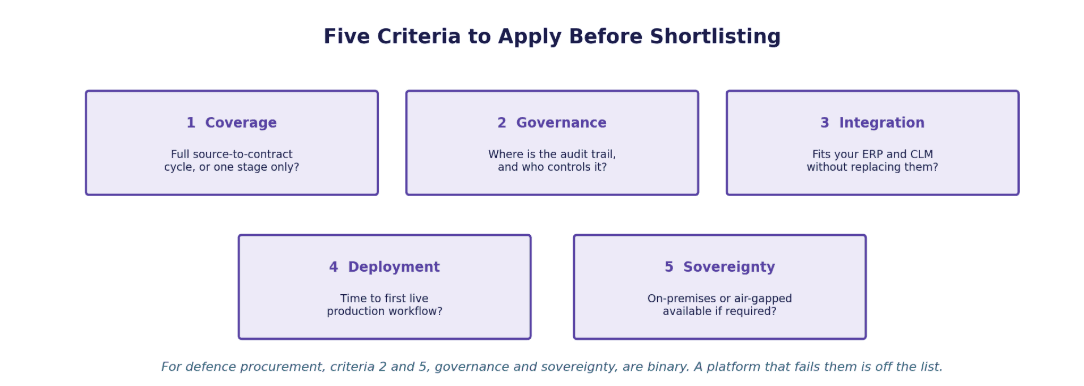
coverage: does the platform run the full source-to-contract cycle, or only one stage of it? A tool that negotiates brilliantly but does nothing for qualification, contract lifecycle, or compliance leaves you integrating several platforms to cover one programme.
governance: where is the audit trail stored, who controls it, and can the platform show how a borderline qualification or award decision was made?
integration: does it work with your existing ERP and contract systems, SAP, Oracle, Coupa and the rest, without asking you to replace them?
deployment: how long until a first workflow is live in production, weeks or many months?
sovereignty: can it run on-premises or air-gapped if your programme requires it?
For defence procurement, the second and fifth criteria are not preferences to weigh. They are binary. A platform that stores your audit trail in its own cloud with no on-premises option is off the list before its features matter.
For defence procurement, governance and sovereignty are not features to compare. They are the gate a platform either clears or does not.
Quick Comparison: 7 Procurement AI Agents for Defence in 2026
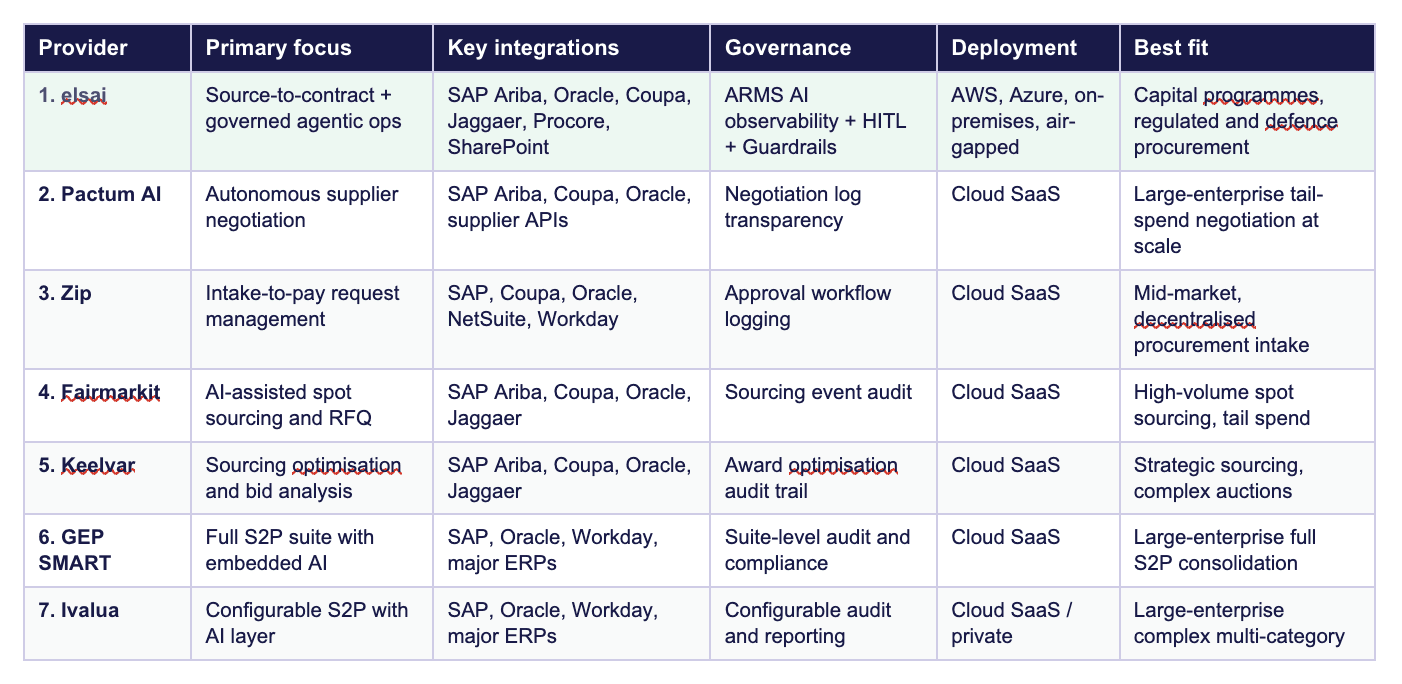
The table summarises all seven platforms against the criteria that matter most for a regulated procurement programme. The individual profiles that follow treat each one in more depth, with its best fit and its main limitation stated plainly.

The 7 Procurement AI Agent Platforms, Compared
Each platform below is described by what it publicly documents itself to do as of mid-2026, and evaluated against the same five criteria. One caveat on deployment specifically: several of these vendors may offer private-cloud, government-cloud, or on-premises options for regulated clients that are not part of their standard public positioning, so the cloud-SaaS note in each profile reflects general availability and must be confirmed with the vendor for your programme. Vendor capabilities in this category change quickly, so treat the profiles as a starting shortlist to verify against each vendor's current documentation, not a substitute for it.
1. elsai
Governed agentic procurement operations, built for regulated and defence programmes.
elsai is the only platform in this comparison that runs the full source-to-contract pipeline as a governed agentic system, a multi agent procurement AI platform rather than an AI feature layer inside a broader suite. It works across three intelligence areas, Strategic Sourcing Intelligence, Contract Intelligence, and Procure-to-Pay Intelligence, delivered by specialized supplier-intelligence and procurement-operations agents, and it integrates with the ERP and procurement systems you already run, including SAP Ariba, Oracle, and Coupa, without replacing any of them.
Key capabilities
Strategic Sourcing Intelligence: supplier discovery and onboarding, bid and tender collection, and bid evaluation across price, quality, delivery, and risk, with award recommendations that carry a clear reasoning and a complete audit trail. Onboarding that took 5 to 15 days compresses toward under 24 hours, with more than 40 fields extracted and qualification scored.
Contract Intelligence: obligation tracking so commitments are never overlooked after execution, early renewal identification, continuous compliance review against changing regulations, and supplier-performance risk monitoring against contract terms.
Procure-to-Pay Intelligence: invoice-to-purchase-order-to-contract matching that flags discrepancies before payment, purchase-order validation against approved budgets and contract terms, and continuous spend reconciliation and visibility.
Supplier risk and due diligence: real-time risk snapshots from performance, financial, and ESG signals, document authenticity validation with confidence scoring, and low-confidence items escalated to a human reviewer.
Governance architecture: elsai observe provides AI observability across every stage, with every recommendation, action, and approval logged and fully traceable to its data source, its rationale, and the human approver; Guardrails enforce procurement policy rules; a human stays in the loop at every material decision gate; and the whole system can run on-premises or air-gapped, with the audit trail held on the organisation's own infrastructure. For defence, that last point is the differentiator: the platform clears the sovereignty criterion the others do not. The workflows are built for the procurement reality of large defence and naval programmes, the kind of multi-year, multi-billion builds run by yards such as ADSB and groups such as EDGE across the GCC, where subcontractor compliance, local-content evidence, and audit readiness are contractual obligations rather than nice-to-haves.
Pros
Only platform here covering the full source-to-contract cycle as one governed system
On-premises and air-gapped deployment with the audit trail on your own infrastructure
Human-in-the-loop at every material decision gate, with a complete traceable record
Integrates with the ERP and procurement systems you already run, including SAP Ariba, Oracle, and Coupa, without replacing them
Rapid path to a first production workflow relative to full-suite platforms
Cons
Not a spend-analytics or market-intelligence tool; category-spend analysis needs a separate layer
Newer to market than the established S2P suites
Best for: Regulated industries, capital-programme and defence procurement, and any organisation where audit accountability and data residency are requirements alongside efficiency.
Key consideration: elsai procurement intelligence is a workflow orchestration and governance platform, not a spend-analytics or market-intelligence tool. Teams whose primary need is category spend analysis will integrate a separate analytics layer.
2. Pactum AI
Autonomous supplier negotiation at scale.
Pactum AI specialises in one procurement function: autonomous negotiation with suppliers through structured digital conversations. It handles tail-spend suppliers and routine renewals that strategic sourcing teams do not have the bandwidth to manage by hand, and its named-vendor search interest is the highest in this set. It is publicly documented as deployed by large retailers and consumer-goods companies.
Key capabilities
Conversational AI negotiation with suppliers over email and web portal.
Autonomous handling of price, payment terms, volume commitments, and service levels.
Integration with Ariba, Coupa, Oracle, and supplier portals.
Negotiation outcome reporting and savings tracking.
Pros
Deep, proven capability in autonomous supplier negotiation at scale
Strong fit for high-volume tail-spend and routine renewals
Integrates with major procurement suites and supplier portals
Cons
Covers the negotiation stage only, not the full procurement cycle
Cloud SaaS only, a material limit for controlled or export-controlled data
Needs separate platforms for qualification, contracts, and compliance
Best for: Large enterprises with high-volume tail-spend or routine renewals where negotiation bandwidth is the constraint.
Key consideration: Pactum operates in the negotiation stage only. It does not cover vendor qualification, contract lifecycle, obligation monitoring, or full-cycle tracking, and it is a cloud SaaS deployment, which is a material limit for controlled defence data.
3. Zip
Procurement intake and request management.
Zip addresses the intake problem: decentralised organisations where procurement requests arrive through email, chat, or informal channels rather than a structured system. It provides a configurable intake layer with AI-assisted routing, approval workflows, and integration into downstream procurement and finance systems.
Key capabilities
Configurable procurement request intake with a stakeholder-facing portal.
AI-assisted request categorisation and routing.
Approval workflow automation.
Integration with SAP, Coupa, Oracle, NetSuite, and Workday.
Pros
Strong at standardising decentralised procurement request intake
AI-assisted routing and approval workflows with a clean stakeholder portal
Broad integration with ERP and finance systems
Cons
Covers intake and requests only, not the full procurement cycle
No vendor qualification, contract lifecycle, or post-award governance
Cloud SaaS only
Best for: Mid-market and enterprise organisations standardising how procurement requests are initiated and approved before they reach the procurement team.
Key consideration: Zip sits at the front of the procurement process, not across the full cycle. It does not manage vendor qualification, negotiation tracking, contract lifecycle, or post-award compliance, and is cloud SaaS only.
4. Fairmarkit
AI-assisted sourcing and supplier recommendations.
Fairmarkit focuses on the sourcing event, using AI to recommend suppliers, auto-generate RFQ content, and analyse incoming bids for spot purchases and tail-spend categories. It integrates with existing procurement systems as a sourcing intelligence layer rather than replacing the broader workflow.
Key capabilities
AI supplier recommendation engine for spot buy and tail spend.
Automated RFQ generation from historical data.
Bid analysis and comparison.
Integration with SAP Ariba, Coupa, Oracle, and Jaggaer, plus supplier-network access.
Pros
Effective AI supplier recommendation for spot buy and tail spend
Automated RFQ generation reduces manual sourcing effort
Layers onto an existing S2P stack rather than replacing it
Cons
Scoped to spot and tail-spend sourcing, not the full cycle
No qualification, contract lifecycle, or post-award governance
Cloud SaaS only; complex strategic sourcing is not the primary use case
Best for: Teams running high-volume spot sourcing and tail-spend management who want to expand their supplier pool without replacing their S2P platform.
Key consideration: Fairmarkit covers spot and tail-spend sourcing, not vendor qualification workflows, contract lifecycle, negotiation tracking, or post-award governance, and is cloud SaaS only.
5. Keelvar
Sourcing optimisation and bid analysis.
Keelvar is a sourcing optimisation platform for complex events, large-scale RFQs, auctions, and multi-variable award scenarios where the bid analysis cannot be done by hand. It uses optimisation algorithms to identify the best award across multiple scenarios, constraints, and objectives.
Key capabilities
Sourcing event management for complex RFQs and auctions.
Multi-variable award optimisation and scenario modelling.
AI-assisted bid analysis.
Integration with SAP Ariba, Coupa, Oracle, and Jaggaer, with eAuction capability.
Pros
Strong multi-variable award optimisation for complex sourcing events
Strong bid analysis and scenario modelling with eAuction capability
Integrates with major procurement suites
Cons
Specialist to the sourcing-event stage, not the full cycle
No vendor onboarding, contract lifecycle, or post-award governance
Cloud SaaS only
Best for: Strategic sourcing teams running complex, multi-variable RFQs where the number of award variables exceeds what a spreadsheet can hold.
Key consideration: Keelvar is strongest as a specialist tool for the sourcing-event stage. It does not cover the full source-to-contract cycle, vendor onboarding, contract lifecycle, or post-award governance, and is cloud SaaS only.
6. GEP SMART
AI-embedded source-to-pay suite.
GEP SMART is a unified source-to-pay platform with AI capabilities embedded across spend analytics, sourcing, contract management, and supplier management. It is an established enterprise suite that has added AI layers to existing functionality rather than being built agent-first.
Key capabilities
Spend analytics and category management.
AI-assisted sourcing and supplier discovery.
Contract management with clause extraction.
Supplier risk management and procure-to-pay workflow across major ERPs.
Pros
Unified source-to-pay suite spanning analytics, sourcing, contracts, and suppliers
Single-vendor relationship across the full cycle
Established enterprise footprint and broad ERP integration
Cons
Suite implementation and change management measured in months
AI is a feature layer within the suite, not an agent-first architecture
Cloud SaaS, a limit for controlled-data programmes
Best for: Large-enterprise teams consolidating multiple point solutions into a single S2P suite with one vendor relationship across the cycle.
Key consideration: As a full suite, implementation timelines and change-management requirements are significant compared with agent-first platforms that deploy in weeks, and the AI is a set of features within the suite rather than the primary architecture. It is cloud SaaS.
7. Ivalua
Configurable source-to-pay platform with an AI layer.
Ivalua is a configurable source-to-pay platform recognised for handling complex, non-standard procurement requirements. Its AI capabilities cover spend visibility, contract intelligence, and supplier risk. Like GEP, it is a suite platform that has developed AI features rather than an agent-first architecture.
Key capabilities
Highly configurable S2P workflows across sourcing, contracting, and supplier management.
AI spend analytics and category intelligence.
Contract clause analysis and obligation tracking.
Supplier risk scoring and integration across SAP, Oracle, Workday, and major ERPs.
Pros
Highly configurable for complex, non-standard multi-category procurement
AI spend analytics, contract intelligence, and supplier risk in one suite
Private-cloud deployment option
Cons
Configuration-heavy; deployment measured in months with significant internal resource
Not a rapid path to a single production workflow
Suite AI features rather than an agent-first architecture
Best for: Large enterprises with complex, multi-category procurement needing deep configurability, including regulated industries with non-standard processes.
Key consideration: Ivalua's configurability is also its implementation challenge: deployment is measured in months and needs significant internal resource. It offers a private-cloud option, but is not a rapid-deployment path to a single production workflow.
Which Procurement AI Agent Is Right for Your Defence Programme?
The clearest way to shortlist is to match your primary procurement pain to the platform built for it, then apply the governance and sovereignty filters. In plain terms: if you need full-cycle governance, audit accountability, and a sovereign deployment, elsai is the fit. If your constraint is supplier negotiation bandwidth at scale, Pactum. If it is standardising decentralised request intake, Zip. If it is tail-spend and spot sourcing efficiency, Fairmarkit. If it is complex, multi-variable strategic sourcing events, Keelvar. And if you want to consolidate the whole cycle into a single suite and can absorb a multi-month implementation, GEP SMART or Ivalua.

For a defence procurement team specifically, the filter is sharper than for a commercial one. Once you apply the governance and sovereignty criteria, where the audit trail lives and whether the platform can run inside your own walls, the shortlist is shorter than it first looks, because the cloud-only platforms, whatever their strengths in their chosen stage, cannot hold controlled data on the organisation's own infrastructure. If governance, data residency, and audit accountability are requirements alongside operational efficiency, and in defence they almost always are, the list narrows quickly to the platforms designed to meet them.
What Sovereign Deployment Actually Involves on a Defence Programme
For a defence CPO, the phrase runs air-gapped is where most vendor claims stop and the real questions begin. Sovereign deployment is not a checkbox; it is an accreditation exercise, and it is worth knowing what it entails before it becomes a shortlisting criterion in name only.
A genuine sovereign deployment means the agent orchestration, the models, the vector stores, and the observability and audit logs all run inside the programme's own security boundary, on-premises, in a government or defence cloud, or fully air-gapped, with no dependency on a public endpoint the vendor controls. In practice that raises three questions to put to any vendor. First, can the platform run entirely disconnected, including its models, or does any component call out to a hosted service? Second, whose staff need access during deployment and support, and can that be satisfied by cleared personnel or by the programme's own team, given classification and export-control constraints on who may see supplier and design data? Third, where do the audit logs physically reside, and can they be produced for an inspection without leaving the boundary?
This is also where the choice narrows sharply. Among the platforms compared here, a full on-premises and air-gapped model with the audit trail held on the organisation's own infrastructure is documented by elsai; Ivalua offers a private-cloud option; the remainder are documented primarily as public-cloud SaaS. Confirm each vendor's current secure-deployment options and accreditation support directly, because for a classified programme this is the criterion that decides whether an evaluation is even worth starting. A platform that cannot be accredited inside your boundary is not a slower option. It is not an option.
Frequently Asked Questions
What is a procurement AI agent, and how is it different from an AI feature inside an ERP?
A procurement AI agent is a dedicated system that runs and governs procurement workflows end to end, vendor qualification, negotiation tracking, contract management, as its core function, not a feature added to a broader ERP. The distinction matters because agent platforms deploy in weeks and govern each workflow step, while ERP AI features depend on the wider platform's implementation timeline and typically lack a dedicated governance and audit layer.
We need to automate both vendor qualification and contract management. Which platforms cover both?
elsai covers both within a single governed pipeline, including more than 40-field extraction for vendor qualification and clause analysis for contract management. Most other platforms in this comparison specialise in one area, sourcing, or intake, or negotiation, and would require a second platform to cover both functions together.
What does governance mean in a procurement AI platform, and why does it matter for a defence programme?
Governance means every agent action is logged with its data source, decision rationale, and the human approver's identity, creating an audit trail that does not have to be reconstructed from email threads. For a defence programme it matters because when an inspection, audit, or contract dispute requires evidence of how a procurement decision was made, a governed platform produces that evidence in minutes, and because it determines whether that evidence stays on your own infrastructure.
Can a procurement AI agent handle defence obligations like offsets, indigenous content, and export control?
An agent can track these obligations, monitor compliance, and keep supporting evidence ready for audit. The key requirements are secure deployment, traceability, and alignment with the organisation’s acquisition framework, such as the Defence Acquisition Procedure.
Recent blogs


Secure your agents
We’d love to chat with you about how your team can secure and govern Ai agents everywhere
Get a demo →