
Turning RCM Analytics Into Action: From What Happened to What Should We Do Next

US healthcare loses an estimated 450 billion dollars a year to prevent administrative cost, leaked revenue, and uncollected balances, and the revenue cycle is where much of it drains away. Denials run at an average rate near 11.8 percent, roughly 86 percent of them preventable, and a large share of that revenue is never recovered. The business problem is not that revenue cycle teams cannot see this. They can: most have dashboards for the denial rate, days in accounts receivable, clean-claim rate, and cost to collect, refreshed daily and reviewed in every operating meeting. The money leaks anyway, because seeing the problem and acting on it are two different things, and analytics has been built to do the first, not the second.
Key takeaways
• Reporting tells you what happened. It does not, on its own, tell your team what to do next, which is where most RCM value is lost.
• A single headline KPI like the denial rate hides the real leak; the action lives in the breakdown by payer, procedure, root cause, and dollars at risk.
• The gap between a dashboard and a decision is an operational-intelligence gap, not a reporting gap, and adding another dashboard does not close it.
• Governed RCM agents move from insight to prepared action: root-cause the denial, prioritise by dollars, draft the appeal or fix, and route it to a person to approve.
• The result is measured in recovered revenue and less rework, not in more charts.
What Does Turning RCM Analytics Into Action Actually Mean?
Turning revenue cycle analytics into action means closing the gap between knowing what happened and doing something about it. Traditional RCM analytics is descriptive: it reports the denial rate, the A/R days, the trend line. Turning it into action means the system does not stop at the chart. It identifies the root cause of each denial, prioritises the work by where the recoverable dollars actually are, prepares the next step, an appeal, a corrected claim, a process fix, and routes it to the right person to approve. Reporting shows the score. Actionable analytics changes it.

Why the Denial Rate Alone Hides the Real Leak
The problem with running a revenue cycle on headline KPIs is that a single number tells you there is a problem without telling you which one to fix first. A denial rate of 11.8 percent is a real signal, but it is an average across every payer, every procedure, and every root cause in the operation. It does not tell a VP of Revenue Cycle whether the leak is concentrated in one payer's authorization rules, one service line's coding, or a documentation gap at intake, and it certainly does not say where the recoverable dollars are largest. The action lives in the breakdown, not the headline.

The denial rate is one number. The action lives in the breakdown by payer, procedure, root cause, and dollars at risk.
This is the difference between healthcare analytics that describes and analytics that directs. Describing the denial rate is useful for the board slide. Directing the team requires classifying each denial to a root cause, mapping it back to the workflow step that produced it, and ranking the resulting work by dollars at risk, so the team spends Monday morning on the denials most likely to be overturned for the most money, not on whatever is at the top of the queue. That prioritisation, by payer, procedure, root cause, and dollars, is the first move from reporting to action, and it is exactly what a flat KPI cannot give you.
Reporting Versus Operational Intelligence
Reporting and business intelligence tools answer what happened: they aggregate data and present it, and the interpretation and the action are left entirely to the team. That is valuable, but it is also where the work stalls, because a stretched revenue cycle team cannot manually turn a hundred dashboards into a hundred prioritised, prepared actions every day.
Operational intelligence does not just show the denial trend; it identifies which denials to work, why they happened, and what to do about each one, and it prepares that work for a person to approve. A rules engine checks whether a claim is formatted correctly. An operational-intelligence layer identifies whether it is likely to be paid, and if not, what to change. The distinction matters because most RCM teams have plenty of the first and almost none of the second, and the gap between them is precisely the gap between a report and a recovered dollar. Prescriptive analytics in healthcare, analytics that recommends the next action rather than only describing the past, is the label for closing it.
How Governed RCM Agents Turn Insight Into Prepared Action
Closing the gap does not require replacing the analytics a team already has; it requires adding the layer that turns those insights into prepared, routed work. A governed agentic layer does this by running a continuous loop across the revenue cycle rather than producing a periodic report. An AI agent for revenue cycle management detects the issue, root-causes it, prioritises it, prepares the response, and routes it to a person, with the analytics feeding the action rather than sitting beside it.

The insight becomes a prepared action: detect and root-cause, prioritise by dollars, prepare the response, route to a person.
In practice, the loop works like this. The system detects a denial and classifies it to a standardized root cause, capturing the payer reason code, the assigned category, and the specific workflow step that produced it. For instance, a documentation gap at intake that led to a medical-necessity denial. It prioritises the resulting work by payer, procedure, and dollars at risk, so the highest-value recoverable denials rise to the top.
It prepares the next action, drafting the appeal with the supporting evidence assembled or flagging the process fix that prevents the denial recurring. And it routes that prepared work to the right person, because clinical and denial-risk decisions stay with the revenue cycle team, not the algorithm.
Every step is logged and traceable through elsai observe, the AI observability layer, and the root-cause classifications feed back continuously, so the same denial is less likely to happen again. This is what AI agents for healthcare revenue cycle management do that a dashboard cannot: they carry the insight all the way to a decision. It is also why ai agents healthcare revenue cycle management teams adopt are judged on resolved claims, not chart accuracy.
An agentic AI platform for revenue cycle management, a RCM analytics AI agent working inside your existing systems, is the mechanism, and it runs on top of the EHR and RCM tools you already use rather than replacing them.
The insight should not stop at a chart. It should arrive as a prepared action on the right person's desk.
What Changes, and How You Measure It
The reason this shift is worth making is that it changes the numbers a revenue cycle leader is accountable for, not just the number of reports. When analytics drive prepared action, the denials that were preventable get prevented, the ones worth appealing get appealed first, and the process gaps that generate them get closed. Reported outcomes when elsai RCM analytics drives action include 15 to 25 percent fewer preventable denials, 20 to 30 percent more claims resolved without adding headcount, 10 to 20 percent faster reimbursement, 90 percent or more of documentation complete on time, and 15 to 25 percent lower denial-related rework cost.
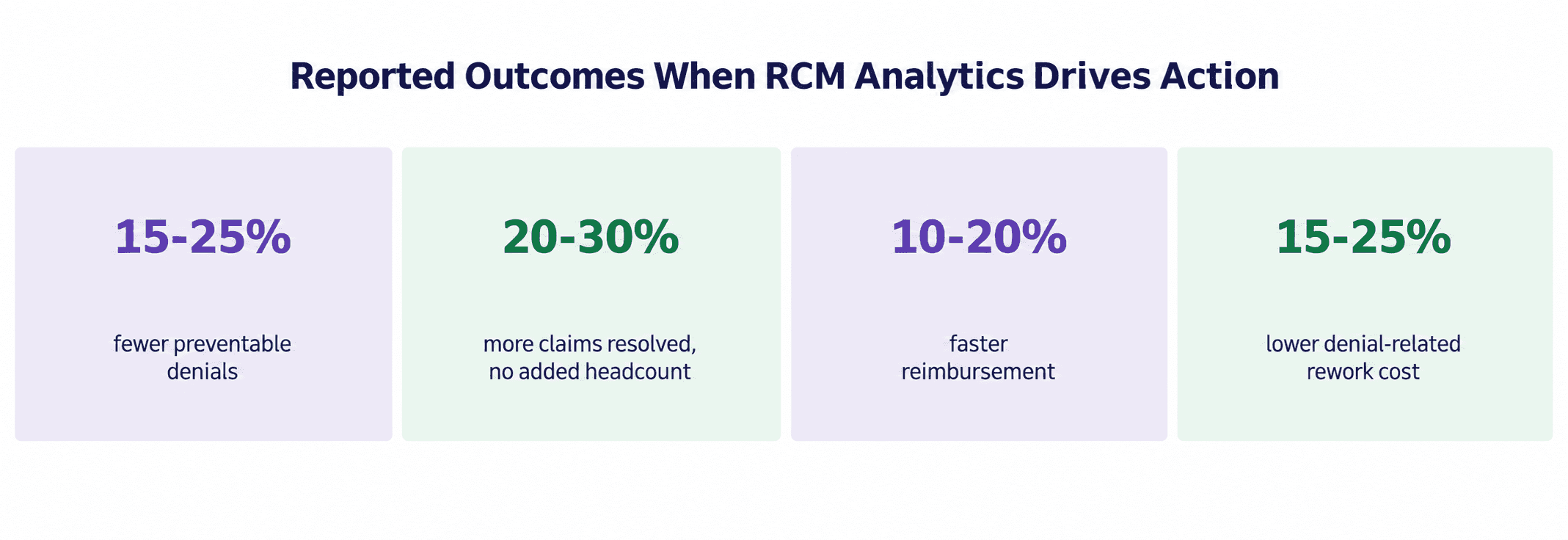
Reported outcomes when RCM analytics drives action rather than stopping at the dashboard. Source: elsai RCM materials.
The measurement test is simple: a reporting tool is judged by whether the dashboard is accurate, an operational-intelligence layer by whether the metrics moved. For a revenue integrity or revenue cycle leader, that means asking not just whether you can see the denial rate, but whether it is falling, whether more claims are being resolved on the same staff, and whether the rework cost is coming down. Those are the outcomes that distinguish analytics that inform from analytics that act, and they are the ones AI agents in healthcare are increasingly expected to move, not just display. This is the direction agentic AI in healthcare is heading: from describing the past to preparing the next action.
From RCM Visibility to RCM Action
Revenue cycle teams do not need more dashboards. They need a clearer path from signal to action.
Knowing that denial rates increased, A/R days are rising, or clean-claim rates declined is only the starting point. The real operational value comes from understanding why the change occurred, where the financial impact is concentrated, which issues require immediate attention, and what action should happen next.
An action-oriented RCM intelligence layer closes that gap. It brings together data from billing systems, EHRs, payer interactions, and analytics platforms to identify patterns, trace root causes, prioritize issues by financial impact, and prepare the next best action for the teams responsible for resolving them.
That changes the role of analytics in the revenue cycle. Instead of asking teams to interpret another report and decide where to begin, intelligence can direct attention to the issues that matter most and provide the context needed to act.
The goal is not another view of the revenue cycle. It is a revenue cycle that can detect problems earlier, understand their causes, prioritize the right interventions, and continuously improve the path from care to cash.
FAQ
What is the difference between RCM reporting and actionable RCM analytics?
Reporting describes what happened, the denial rate, A/R days, clean-claim rate, and leaves the interpretation and the action to the team. Actionable analytics goes further: it identifies the root cause of each denial, prioritises the work by dollars at risk, prepares the next step, and routes it to a person to approve. Reporting shows the score; actionable analytics helps change it.
Why isn't the denial rate enough to manage the revenue cycle?
Because it is a single average across every payer, procedure, and root cause, so it flags that there is a problem without saying which one to fix first or where the recoverable dollars are. The action lives in the breakdown, by payer, by procedure, by root cause, and by dollars at risk, not in the headline number. Managing to the KPI alone means managing the symptom.
Does an rcm analytics ai agent replace our existing dashboards and EHR?
No. It runs as a governed layer on top of the EHR, RCM, and reporting systems you already use, including the data in tools like Power BI, and turns their output into prepared, prioritised action. The systems of record and your existing analytics stay in place; the agent adds the root-causing, prioritisation, and preparation that a dashboard was never designed to do.
Does the AI make the appeal or write-off decisions on its own?
No. It root-causes the denial, prioritises it, and prepares the appeal or fix with the evidence assembled, but clinical and denial-risk decisions route to your revenue cycle team, who approve or override. Every action and override is logged and traceable, so the team keeps the judgment and the accountability while the repetitive analysis and preparation are handled for them.
How do we measure whether actionable analytics is working?
By whether the metrics moved, not whether the dashboard looks good. The outcomes to track are fewer preventable denials, more claims resolved on the same headcount, faster reimbursement, documentation completed on time, and lower denial-related rework cost. Reported ranges for these when analytics drives action are 15 to 25 percent fewer preventable denials and 15 to 25 percent lower rework cost, among others; the test is whether your own numbers improve.


We’d love to chat with you about how your team can secure and govern Ai agents everywhere
Get a demo →