
How AI Agents Are Redefining Healthcare BPO and RCM, and Where Epic and athenahealth Fall Short

Healthcare revenue cycle management has an execution problem. Prior authorizations, coding corrections, claim follow-ups, and appeals still move between EHR work queues, payer portals, clearinghouses, documents, and outsourced teams. Each handoff adds manual work, delays reimbursement, and creates another opportunity for errors.
The financial impact is growing. The Guidehouse 2026 Revenue Cycle Management Report found that the share of providers reporting final denial rates above 5% increased from 12% to 20%. McKinsey reports that providers write off an average of 2.63% of net patient service revenue because of clinical denials, while 64% lack the infrastructure required to prevent them. In a January 2026 poll, MGMA found that 48% of medical groups considered denials and appeals their largest revenue-cycle leak.
For healthcare providers and healthcare BPO organizations, adding staff to every growing queue is not sustainable. AI agents create a different operating model. They can monitor queues, collect clinical documentation, validate information, interact with payer systems, track responses, and route exceptions to the right person. Human teams retain authority over clinical, financial, and high-consequence decisions, while agents execute the repetitive work surrounding them.
Key takeaways
• AI agents are redefining healthcare BPO and RCM from a headcount business into an outcomes business: more work handled on flat staff, with people keeping the decisions.
• Epic and athenahealth are systems of record. They store the data and run the screens, which they do well; they are not built to be agentic execution layers.
• The gap is structural, not a product flaw: a system of record stores and displays the work, an execution layer reasons across it and does the work.
• The right architecture is an agentic layer that runs on top of the EHR and payer systems and makes them act, without replacing them.
• Governance is the condition of entry in healthcare: clinical and denial decisions stay with people, and every action is auditable.
This article examines how AI agents are changing healthcare BPO and RCM, where Epic and athenahealth provide strong native capabilities, and where an independent execution layer becomes necessary. It also explains how a governed platform such as elsai can coordinate workflows across EHRs, payer portals, and operational systems while preserving human oversight, policy enforcement, observability, and auditability.
How AI Agents Are Redefining Healthcare BPO and RCM
For two decades, healthcare BPO and revenue cycle management scaled the same way: to handle more prior authorizations, more coding, more claims, and more denials, you added more people, often in lower-cost delivery centres. That model built the industry, and it is now running into a wall, because the administrative burden is rising faster than anyone can hire against it safely. Prior authorization alone consumes around 13 hours a week per physician, and denials and rework drain the revenue cycle while skilled staff burn out on repetitive tasks.
AI agents change the unit of work. Instead of a person executing each task, healthcare AI agents handle the repetitive execution, verifying eligibility, checking prior-auth requirements, drafting and validating claims, root-causing denials, and preparing appeals, while the people who used to do that work move up to supervising it and making the decisions that need judgment. This is what agentic AI healthcare actually means for an operator: RCM automation is not a faster script but a system that reasons across the case and acts on it. The economics change with it;, output stops being tied one-to-one to headcount, which is the shift from a labour business to an outcomes business.
Where Epic and athenahealth Fit, and Where They Stop
Here is the part that must be said carefully, because it is easy to get wrong. Epic and athenahealth are not the problems in this picture; they are the foundation. They are the systems of record that hold the patient data, the coverage information, and the clinical documentation, and they run the workflow screens the staff live in. A US provider or RCM outsourcing operation cannot function without them, and nothing about agentic RCM changes that. The question is not whether they are good systems of record. They are. The question is what a system of record is designed to do, and what it is not.

A system of record stores data, enforces the structure of a workflow, and holds the record of truth. That is a different job from reasoning across that data and taking the next action. When a denial posts in epic RCM or in athenahealth, the system records it accurately and shows it on a worklist. It does not, on its own, root-cause the denial, prioritise it by dollars at risk, draft the appeal with the evidence assembled, and route it to the right person;, that is execution, not record-keeping.
The same is true across the revenue cycle: the EHR reads and stores the clinical note, but it does not work the prior authorization; it reports the denial rate, but it does not resolve the denial; it holds the contract or the payer rule, but it does not check each claim against it. These are not defects. They are the edge of what a system of record is built to do.

This is the honest meaning of “falling short.” It is not that Epic or athenahealth are deficient at their job. It is that agentic BPO and RCM need a capability that sits beyond the job a system of record was ever meant to do, and expecting an EHR or a practice-management platform to be the agentic execution engine is asking it to be something it was not designed to be. The gap is real, but it is a gap between two categories, not a hole in a product.
What an Agentic Execution Layer Adds, On Top of the EHR
Closing that gap does not mean replacing Epic or athenahealth. It means adding an agentic execution layer that runs on top of them, reads from and writes back to them, and does the work they were never meant to do. An AI agent for revenue cycle management working this way connects to the EHR and payer systems through their own APIs and interoperability standards, acts on the data in place, and returns the result to the system of record, so the EHR stays the single source of truth and the agents supply the execution.
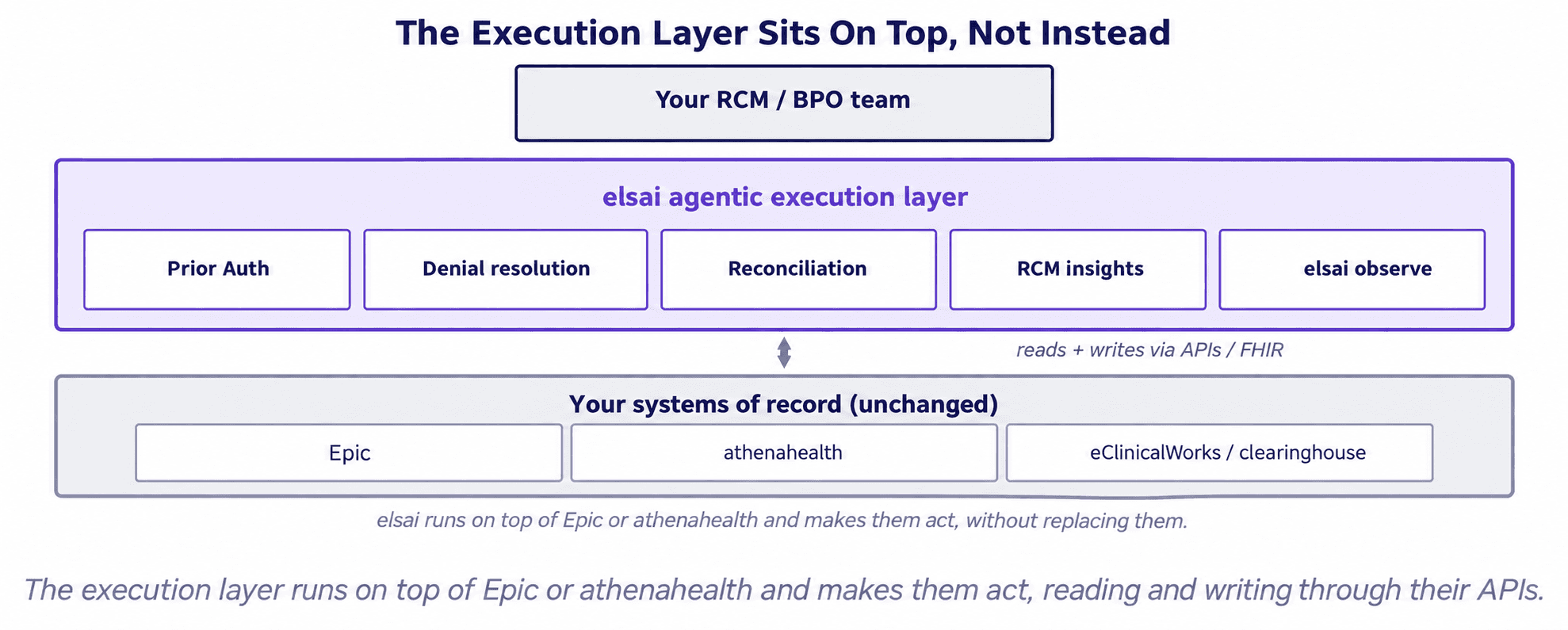
In a healthcare BPO or provider revenue cycle, that layer runs the workflows an EHR reports but does not execute end to end prior authorization , medical billing automation and claims preparation, denial root-causing and appeal drafting, reconciliation, and a RCM analytics AI agent that turns the denial and A/R data the EHR stores into prioritised, prepared action.
The people on the operation supervise and decide; the agents do the repetitive execution. Crucially for healthcare, AI agents for healthcare revenue cycle management only belong on top of a system of record if they are governed: clinical and denial-risk decisions route to people, PHI stays in the provider's environment, and every action is observable and auditable through elsai observe, the AI observability layer. That governance is not an add-on; in a regulated revenue cycle it is the condition of being allowed to run at all.
The EHR stays as the system of record. The agentic layer becomes the system of action on top of it.
What This Means for a Healthcare BPO or Revenue Cycle Operation
For an operator, the strategic implication is direct. The competitive moat is no longer how many trained people you can put on a client's Epic or athenahealth queues; it is how much governed execution you can run on top of those systems while keeping your people on the decisions.
An operation that adds an agentic execution layer handles more volume on flatter headcount, resolves more denials, and closes the process gaps that generate them, and it does so without asking the client to touch the EHR they depend on. That last point is what makes it sellable to a cautious provider CIO: the agentic layer is additive, not a rip-and-replace.
Reported outcomes when a governed execution layer runs on top of the EHR include 15 to 25 percent fewer preventable denials, 20 to 30 percent more claims resolved without adding headcount, 10 to 20 percent faster reimbursement, and 15 to 25 percent lower denial-related rework cost. Those are the numbers that separate healthcare revenue cycle operations that adopted agentic AI in healthcare as an execution layer from those still scaling by headcount on top of a system of record alone.

The System of Action on Top of Your System of Record
AI agents are redefining healthcare BPO and RCM by changing what the work is: from a headcount business measured in people to an outcomes business measured in resolved denials, faster reimbursement, and recovered revenue. Epic and athenahealth remain essential to that future, as the systems of record, they are built to be. Where they fall short is only in the sense that no system of record was ever meant to be the engine of execution, and expecting one to be is the mistake that keeps operations by scaling headcount.
This is the role the elsai platform is built to play. It is the governed agentic execution layer that runs on top of your existing EHR and payer systems, Epic, athenahealth, eClinicalWorks, and the clearinghouses, reading from and writing back to them through their own APIs, and running the prior-authorization, claims, denial-resolution, and revenue-cycle-analytics work the system of record reports but does not do.
Clinical and denial-risk decisions stay with your people at defined human-in-the-loop points, PHI stays in your environment, and every action is traceable through elsai ARMS for audits. It does not replace the systems your clients depend on; it makes them act.
For a healthcare BPO or revenue cycle operation deciding how to compete when headcount is no longer the answer, that execution layer on top of the system of record is the move. See how the healthcare workflows run at elsai.ai/agents/healthcare, and how the platform fits your existing stack at elsai.ai/platform.
FAQ
What is the difference between a system of record and an agentic execution layer?
A system of record, such as an EHR or practice-management platform, stores data, enforces workflow structure, and is the authoritative source of truth. An agentic execution layer reasons across that data and takes the next action, root-causing a denial, drafting an appeal, checking a claim against a contract, and routes decisions to people. One holds the record; the other does the work, and in a governed setup the two operate together, with the EHR staying the source of truth.
Does adopting an agentic layer mean replacing our EHR or our clients' EHR?
No, and that is the point. The agentic execution layer runs on top of the EHR and payer systems and connects through their own APIs and interoperability standards, reading data and writing results back. The EHR stays the single source of truth and is unchanged. For a BPO, this is what makes it sellable to a provider client: it is additive, not a rip-and-replace of the system they depend on.
How is this governed for a regulated US healthcare operation?
Clinical and denial-risk decisions route to your people at defined human-in-the-loop points, PHI stays in the provider's environment, and every agent action is observable, policy-checked, and auditable. In a regulated revenue cycle this governance is the condition of being allowed to operate, not an optional feature, which is why an ungoverned automation layer is not a viable substitute however capable it looks.


We’d love to chat with you about how your team can secure and govern Ai agents everywhere
Get a demo →