

A tier-two supplier misses a delivery. A certification expires without being flagged. A critical vendor stops responding across three open orders. By the time the issue reaches the CPO’s inbox, it is no longer an emerging risk. It has become an operational problem, often with a programme milestone already under pressure. Procurement leaders recognise this pattern because the warning signs are usually present well before the disruption, scattered across supplier records, email threads, compliance documents, and systems that are not being monitored as one continuous risk picture.
That blind spot has never been more expensive. Supply chains are being localized and re-shored at a scale the sector has not seen before, and the programmes riding on them are enormous. Saudi Aramco's iktva localization programme reached 70 percent local content in early 2026 and identified more than 200 localization opportunities representing roughly 28 billion dollars in annual market value, and in February 2026 Saudi Arabia announced military-supply-chain agreements exceeding SAR 4.26 billion to localize more than half its military spending by 2030. Programmes of that scale live or die on supplier reliability, and for a CPO overseeing defence, naval, pharma, or energy procurement across India, the Gulf, and beyond, supplier risk is no longer a quarterly review item. It is a continuous exposure across hundreds or thousands of vendors, each carrying qualification, compliance, performance, and concentration risk that can surface at the worst possible moment.
The organizations that manage this well are not the ones with the thickest audit binders. They are the ones that see the risk coming, while there is still time to act.
The real problem is not risk. it is learning about it too late.
Every supply chain carries risk; that is not the CPO's problem. The problem is timing. In most procurement operations, supplier monitoring, compliance validation, and reconciliation are done manually and periodically, which means risk is discovered on a review cycle rather than as it emerges. A certificate expires in March and is noticed at the September audit. A supplier's delivery performance slips for a quarter before anyone connects the dots. A financial warning sign appears in public filings that no one was watching. By the time the risk surfaces, it is already a disruption.

This is the gap between reactive and anticipatory supplier risk management. Reactive management is structurally always a step behind, because the information arrives after the event. Anticipatory management flips the timing: the drifting supplier is flagged while there is still room to qualify an alternate, renegotiate, or intervene. For a CPO, that shift from lagging to leading is the whole game, because a risk seen early is a decision, while a risk seen late is a crisis.
A risk seen early is a decision. A risk seen late is a crisis.
Where supplier risk hides from a cpo today
The reason risk surfaces late is that it hides in places a periodic manual review cannot reach. A CPO managing a large supplier base is effectively blind to several categories of exposure at once, not through any failure of the team, but because the volume and pace of change outrun manual oversight.

Qualification gaps hide in suppliers onboarded quickly under deadline pressure and validated incompletely. Expiring credentials, certificates, licences, and insurance, lapse quietly between reviews. Performance drift, a slow decline in delivery reliability or quality, is invisible until it causes a miss. Risk in the second tier and beyond, the suppliers of your suppliers, is almost never visible at all. Compliance changes leave a once-qualified supplier suddenly non-compliant against a new rule. And concentration risk, an over-dependence on a single source, only becomes obvious when that source fails. None of these announces itself. Each is a disruption waiting to happen, and for the CPO in a regulated sector such as defence or pharma, any one of them can halt a programme or trigger a finding.
What anticipatory supplier risk intelligence looks like
Seeing risk early is not about hiring more analysts to review suppliers more often. It is about putting continuous intelligence across the entire supplier base, so every supplier is watched all the time rather than sampled on a cycle. An agentic procurement layer does this by running specialized risk agents that monitor, assess, and score supplier risk continuously, and surface the ones that need attention before the exposure becomes a disruption.
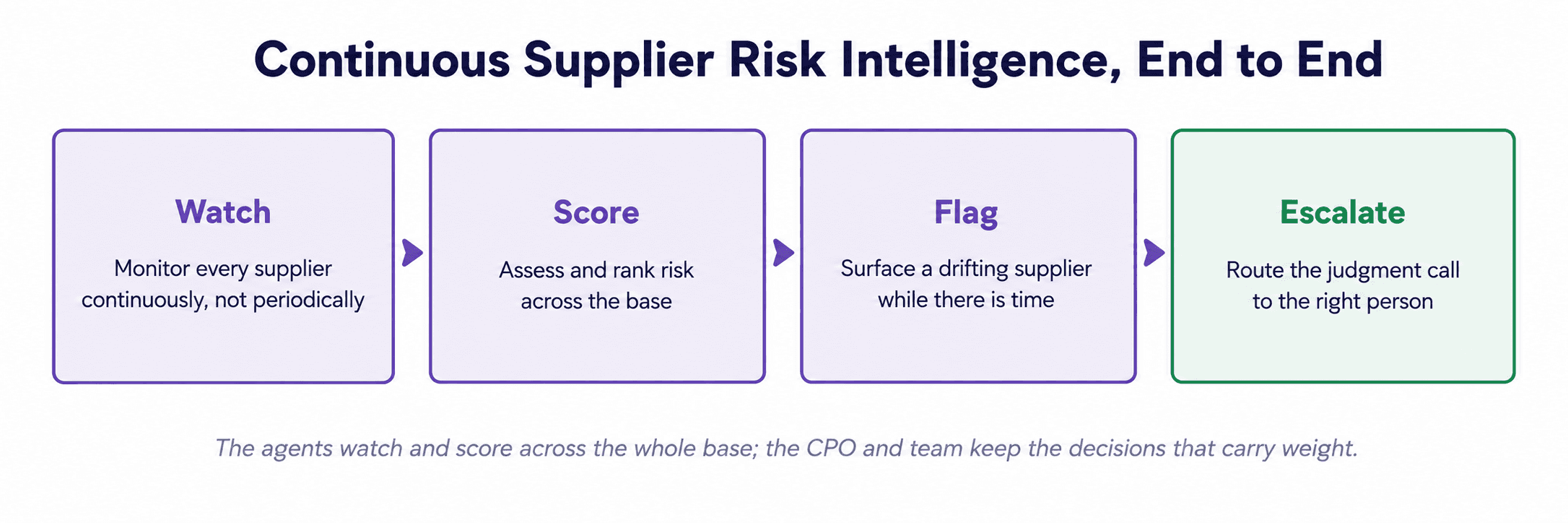
The loop is straightforward and it changes what the CPO can see. The agents watch every supplier continuously, drawing on the qualification records, compliance status, performance data, and external signals already flowing through the procurement and ERP systems. They score and rank risk across the base, so the CPO sees not a flat list of vendors but a prioritized view of where the exposure actually sits. They flag a supplier the moment it drifts out of a compliance standard, lets a credential lapse, or shows a performance decline, while there is still time to act. And critically, they escalate the judgment call to the right person: the agents surface and quantify the risk, but the decision to requalify, dual-source, or intervene stays with the CPO and the procurement team. This is what turns supplier risk management from a backward-looking audit into a forward-looking capability, and it is the foundation of genuine supply chain resilience.
Why this matters more in regulated, high-stakes procurement
For a CPO in a commercial, low-regulation category, late risk visibility is costly. For a CPO in defence, naval shipbuilding, pharma, or energy, it is existential. A defence prime managing supplier qualification, security clearance, export controls, and local-content verification cannot afford to discover a compliance gap at audit. A naval shipbuilding programme with thousands of parts and long-lead items cannot absorb a supplier failure that surfaces only when a milestone slips. A pharma manufacturer under FDA and GMP oversight faces recalls and shortages when supplier quality drifts unseen. In each of these, the supplier base is both larger and less forgiving, and the cost of seeing risk late is measured in programme delays, failed audits, and lost contracts.
This is also where the requirement for traceability and control becomes non-negotiable. In these sectors, it is not enough to flag a risk; the CPO has to be able to show how it was identified, assessed, and handled, with a full record. Anticipatory risk intelligence in a regulated environment therefore has to be both continuous and fully auditable, and it has to run where the organization's sensitive supplier data is allowed to live, which for many defence and government-linked programmes means inside their own environment.
From watching the rear-view to seeing the road ahead
This is exactly the shift elsai was built to deliver for procurement. Its supplier risk agents monitor, assess, and mitigate risk continuously across the entire supplier base, scoring exposure and surfacing the suppliers that need attention while there is still time to act, with the judgment calls always escalated to the CPO and the team. Every assessment is observable and fully traceable through ARMS, and because the platform can run inside the organization's own environment, on-premises or in a controlled deployment, it fits the sovereign and regulated procurement that defence, naval, and energy programmes demand. It works across the ERP and procurement systems a CPO already runs, from SAP to Oracle to Coupa, rather than replacing them. For a CPO who would rather see supplier risk as a decision than meet it as a crisis, that is the difference worth having. See how the procurement intelligence works by request a demo.
FAQ
What is the difference between reactive and anticipatory supplier risk management?
Reactive management discovers risk on a review cycle, after a certificate has lapsed, a delivery has slipped, or an audit has flagged it, by which point it is often already a disruption. Anticipatory management monitors every supplier continuously and flags a drifting supplier while there is still time to requalify, dual-source, or intervene. The difference is timing, and timing is what determines whether a risk becomes a decision or a crisis.
How can a CPO get visibility into second-tier and concentration risk?
Continuous risk intelligence draws on the data already flowing through procurement and ERP systems to map dependencies and score exposure across the base, including over-reliance on a single source and risk carried by the suppliers of your suppliers. Because the monitoring is continuous rather than periodic, these exposures surface as they develop rather than when they fail.
Does anticipatory risk intelligence replace the procurement team's judgment?
No. The agents watch, score, and flag across the whole supplier base, but the decisions that carry weight, requalifying a supplier, changing sourcing, escalating an intervention, stay with the CPO and the procurement team. The intelligence removes the blind spots; the people keep the judgment, with each flagged risk fully documented.
Can this run inside a sovereign or on-premises environment for defence procurement?
Yes, and for defence, naval, and government-linked programmes that is often essential. The platform can run inside the organization's own environment, on-premises or in a controlled deployment, so sensitive supplier and programme data stays within its walls, and every risk assessment is fully auditable, which regulated procurement requires.
Will it work with our existing ERP and procurement systems?
Yes. The risk intelligence connects to the ERP and procurement systems already in place, such as SAP, Oracle, and Coupa, and runs across them rather than replacing them. A CPO can start by putting continuous risk monitoring over the existing supplier base and expand from there.


We’d love to chat with you about how your team can secure and govern Ai agents everywhere
Get a demo →