
Procurement Agents for National Oil Companies: Local-Content Scoring Without Slowing the Tender

In a national oil company tender, local content is rarely the criterion that decides the contract and often the one that decides the calendar. The technical team finishes its evaluation; the commercial team finishes its comparison, and then a third workstream begins: reading bidder declarations, chasing certificates, and scoring local content by hand. The tender waits for the slowest spreadsheet in the building.
Local-content scoring does not have to be a third lap. Scored in the same pass as the technical and commercial reads, with the evidence attached, it adds a criterion without adding a stage.
The stakes are structural. State-owned companies account for more than half of global oil production and close to 60% of the world's oil and gas reserves, according to the IEA, so their procurement rules shape the market. Those rules often write local content requirements into the tender. Nigeria's 2010 content act, as enacted, requires operators to submit a content plan and to consider local content when evaluating bids. In Indonesia's upstream sector, the energy ministry recorded about $1.5 billion of domestic component commitments as of April 2026, equal to 62.95% of a $2.38 billion procurement cost base. Behind each figure sits a bidder's declared commitment that a buyer has to evaluate and verify.
This blog shows why local-content scoring slows tenders, how to move it into the same evaluation pass, which agents in elsai tender evaluation chain carry each step, and where people must stay in charge. It is written for heads of procurement and local content at national oil companies and their major operators.

Why Local-Content Scoring Slows the Tender
Oil and gas procurement at a national oil company runs on long, high-value tenders, and the evaluation is where time is won or lost. Local content slows it for five reasons that have little to do with the scoring formula itself:
• It starts late. Technical and commercial evaluation finish first, then local content begins as a third stage.
• It starts as a declaration. A bidder states a commitment, and the buyer still must find the evidence.
• The evidence is scattered. Plans, certificates, and registration status live in email, spreadsheets, and supplier portals.
• Silence and deviation look alike. A bidder who did not answer and a bidder who stated a shortfall need different next steps, but both show up as a gap.
• Eligibility surprises arrive late. An expired certificate or a lapsed registration is found at award, not at shortlisting.
Buyers describe the cost in their own terms. In elsai demo conversations, management could not tell whether the vendor or the internal team had caused a delay and wanted the reason. A third stage makes that question harder to answer, because nobody owns the whole timeline.
Hand work has a price too. Comparison reports and file notes alone take 5 to 10 days to compile by hand, before any local-content review is added.
Score It in the Same Pass
The fix is to treat local content as one more requirement in the same read, not as a separate stage. elsai's tender evaluation family starts with the Technical Compliance Matrix. It reads every bid against every tender requirement at the same time, pre-populates the evaluation matrix, and marks each requirement Met, Deviation, or Not Addressed with the evidence attached. A local-content commitment written into the tender is a requirement like any other, so technical bid evaluation and local-content review stop being two sequential jobs.
That is where a procurement AI agent earns its place: it does the reading that builds the matrix, and a person decides. The formula that turns evidence into points is the national oil company's own policy, and it stays that way. The agents gather and structure the evidence the formula needs and flag where it is missing. elsai's positioning describes agents that encode sourcing rules, approval thresholds, and local-content frameworks per category and region, so the criteria can follow the owner's rules instead of a generic template.
The committee then starts with a finished first read. An AI agent for procurement automation has already compared every bid with every requirement, so the committee spends its time on the judgments that need people.
Silence Is Not Deviation
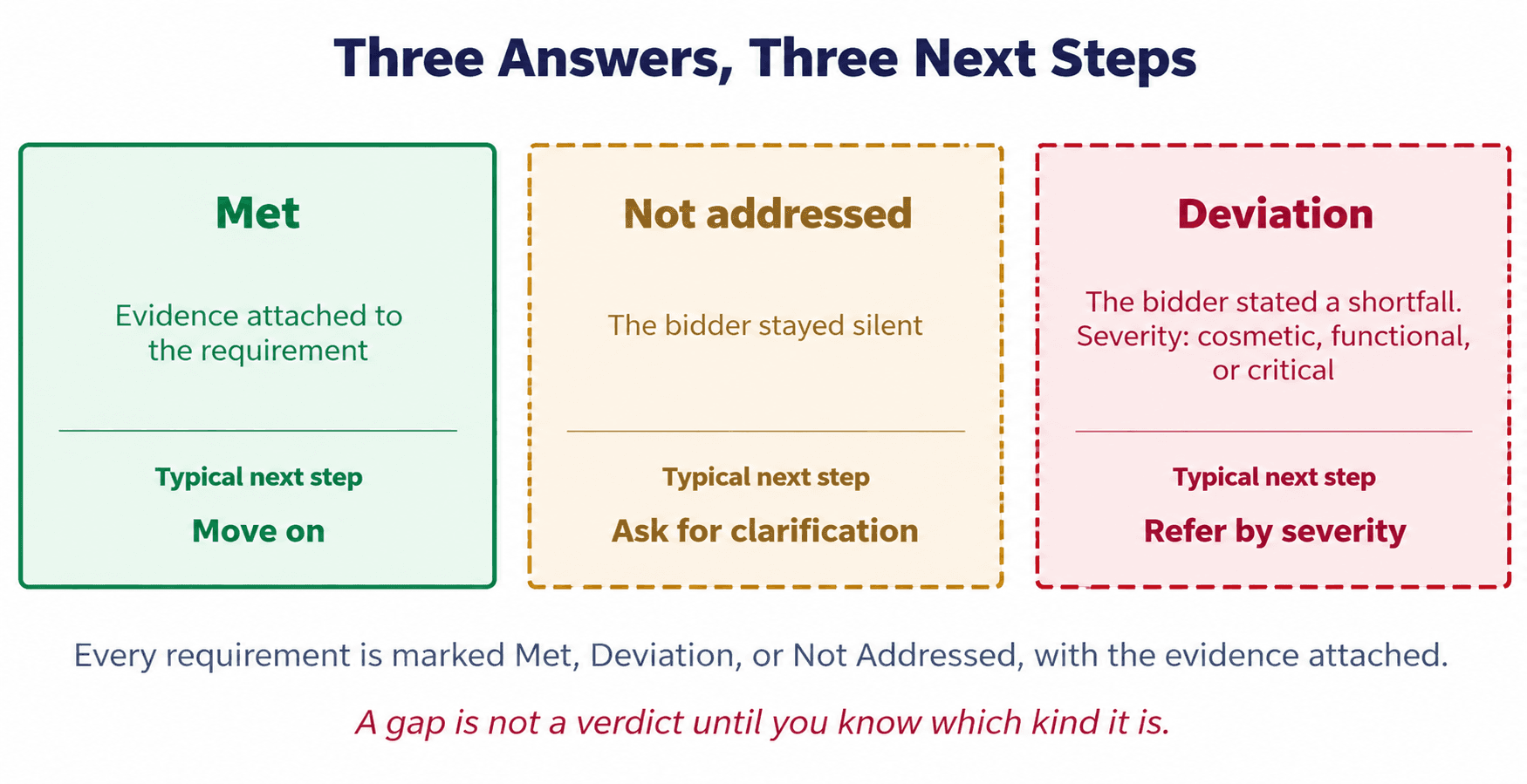
A local-content declaration can be met, missing, or contradicted, and each call for a different next step. The Silence and Deviation Classification separates a bidder that did not respond from one that stated a deviation, and scores the severity of a deviation as cosmetic, functional, or critical according to how critical the requirement is. Technical leads can then focus on the deviations that matter instead of reading every gap in the same way. In any RFP evaluation, silence and deviation are different facts, and treating them alike is one-way tenders fall into extra rounds of clarification.
Evaluation also has to survive change. One buyer asked what happens when a specified rating changes during technical evaluation, and whether the whole process restarts. In another demo, a mid-cycle change in specification was answered through configuration instead of a restart. Minimum content levels can differ by category of good or service in some regimes, so an evaluation template must bend without breaking.
Eligibility Before the Bids Land
A bid is only worth scoring if the bidder is eligible. The Vendor Compliance Agent verifies vendor registration daily against the national supplier registry, tracks certificate and licence expiry, and alerts on compliance risks, so a lapsed registration surfaces long before the shortlist. That makes vendor qualification a running state instead of a gate at the end, and it is why supplier qualification stops being a late surprise.

Timing matters as much as eligibility. The Procurement Intake Agent starts every tender on a structured, timed record, so the contracting clock runs from the first day, and the Statutory and Regulatory Deadline Agent tracks procurement-cycle directives, such as a mandated contracting deadline, and escalates inside the lead-time window.
Rank on Total Risk, Not Just Price and Points
Taken together, the chain looks like this:

Once the evidence is in, the Commercial Normalization and Comparison Report Agent normalizes the lowest, second-lowest, and third-lowest prices on effective cost, including payment terms, discounts, and advances, runs best-and-final-offer analysis, and generates the technical, commercial, and cost-benefit comparison reports for review. Risk-Weighted Ranking then combines compliance, normalized cost, and live supplier risk into one ranking, shown beside the naive price-and-compliance rank, so a committee can see when the cheapest compliant bid is not the safest award.
A multi agent procurement AI platform is what runs this chain, because each step hands the next one structured evidence. Agentic AI sourcing of this kind is built on that handoff. elsai positions its tender evaluation agents to deliver up to 90% faster bid evaluation. That is a platform-level figure, not a promise for any single tender, and the idea behind it is the one in this piece: do the reading once, in one pass.
Where People Stay in Charge
Agents prepare and people decide. The Technical Compliance Matrix is validated by the engineering or technical lead at the first checkpoint; procurement leads review the comparison reports instead of compiling them, and the contracting authority makes the award. Every ranking is traceable, with supplier-risk reasoning and a full audit trail, so a decision can be explained and defended.

The policy stays with the owner's: the local-content formula, the weights, and the thresholds. Where the platform runs matters to state-owned buyers too. The elsai platform can deploy on public cloud, private cloud, or air-gapped on-premises servers, so evaluation data does not have to leave the organization's own environment.
Add the Criterion, Not the Stage
Local content will stay a criterion in national oil company tenders, and the figures behind it, whether a share of procurement cost or a content plan, will keep being watched closely. The question is whether each new criterion adds a stage. It should not.
Procurement automation that adds a stage for every criterion slows the tender it was meant to speed. An AI agent in procurement earns trust the other way: one read, evidence attached, silence separated from deviation, eligibility checked before the bids land, and people deciding. To see how elsai tender evaluation agents work on a real tender, book a demo at elsai.ai/request-a-demo, or read about sourcing intelligence at elsai.ai/supplychain-procurement/sourcing-intelligence.
FAQ
What is local-content scoring in a tender?
It is the evaluation of a bidder's commitments to local goods, services, and capability as one criterion in a tender. The formula and weights are the owner's policy. Regimes differ: Nigeria's 2010 content act requires a content plan and consideration of local content in bid evaluation, and Indonesia treats its domestic component level as a preferential criterion in upstream procurement.
Why does local-content score slow national oil company tenders?
Usually because it runs as a third stage after technical and commercial evaluation, begins as a declaration that still needs evidence, relies on scattered documents, treats silence and deviation alike, and finds eligibility problems late. None of those are about the formula, which is why moving the work into the same pass helps.
How can a procurement AI agent help without taking over the decision?
It does the reading and structuring: it compares every bid with every requirement, marks each as met, deviating, or not addressed with evidence, classifies silence and deviation, normalizes cost, and ranks beside supplier risk. People validate the matrix at the first checkpoint, review the comparison reports, and award. The scoring formula and weights stay with the buyer.
How do you tell a bidder that stayed silent from one that deviated?
Silence is a requirement left unaddressed, and the usual next step is to ask the bidder for clarification. A deviation is an explicit shortfall, and its severity (cosmetic, functional, or critical) decides how it is handled. The classification separates the two before commercial review, so each gets the right response.
Can this run inside a national oil company's own environment?
The elsai platform can deploy on public cloud, private cloud, or air-gapped on-premises servers, and it works with the ERP and procurement systems a team already runs. Evaluation data does not have to leave the organization's own environment, and the specifics for each component should be confirmed in a security review.
See how elsai streamlines tender evaluation with governed procurement AI agents.
Request free demo →


We’d love to chat with you about how your team can secure and govern Ai agents everywhere
Get a demo →